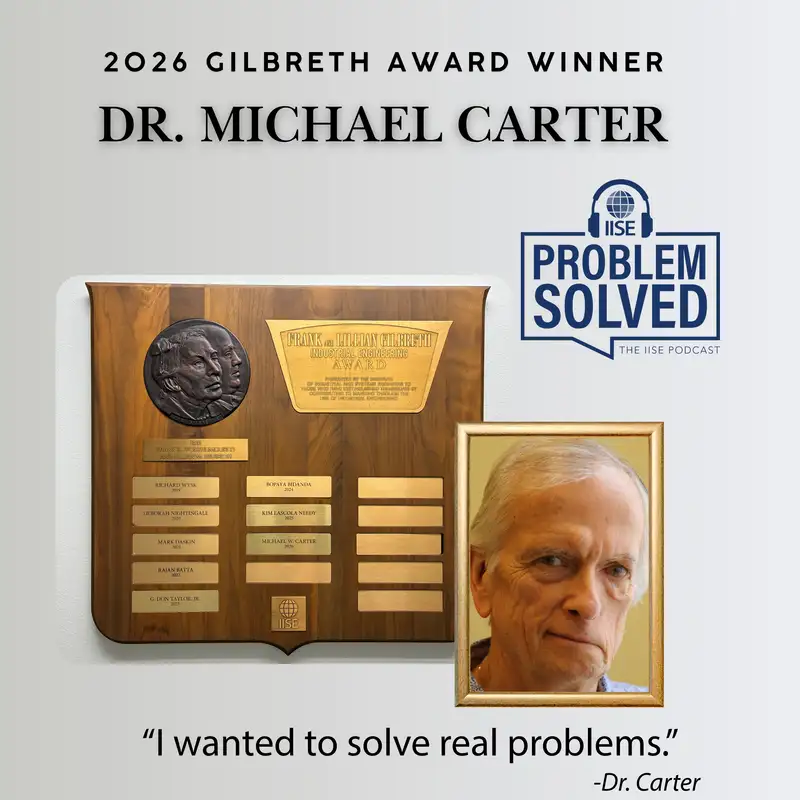
2026 Gilbreth Award Winner Dr. Michael Carter: "I wanted to solve real problems"
Download MP3Today on Problem Solved, we're
speaking with the recipient of
IISE's highest honor, the Frank
and Lillian Gilbreth Award.
Over the course of his career, Dr. Carter
has helped pioneer healthcare systems
engineering in Canada and mentored
hundreds of students along the way.
In this conversation, we talk about
how he found his way into industrial
engineering, why healthcare became
his life's work, the future of AI in
healthcare systems, and what receiving the
Gilbreth Award means to him personally.
Here's our conversation
with Dr. Michael Carter.
Today we are joined by Dr. Michael
Carter, a professor in mechanical and
industrial engineering at the University
of Toronto, where he has been since 1981.
Over the course of his career, he has
become a leading voice in healthcare
systems engineering, with decades of work
focused on healthcare resource modeling
and improving how care is delivered.
He is the founding director of the
Center for Healthcare Engineering and
has mentored hundreds of students,
many of whom are now working
directly in healthcare systems today.
His impact spans research, education, and
real-world implementation, contributing
to healthcare in Canada and beyond.
Dr. Carter is a fellow of the Canadian
Academy of Engineering, the Canadian
Academy of Health Sciences, INFORMS, and
IISE, and most recently, he has been named
the recipient of the Frank and Lillian
Gilbreth Award, IISE's highest honor.
So Dr. Carter, thank you so
much for joining us today.
Well, thank you for having me.
Well, let's start at the beginning
of your journey, if you don't
mind taking us back a little bit.
can you tell us a little bit about
how did you first find your way into
industrial engineering and ultimately
into a career as a professor?
That's right.
Though it's, it's interesting that, when
I started out, now in 1960s, I decided
I wanted to be a computer programmer.
I wanted to learn about programming,
and so I enrolled in computer science
at the University of Waterloo.
Waterloo at that time was the only
university in Canada where undergraduates
were allowed access to computers.
And, so I went there, and, around
in my third year, I took a course
in operations research, and it sort
of changed the direction of my life.
I really enjoyed it.
I really liked it, and I wound
up, I decided I wanted to
specialize in operations research.
I switched, specialties from
computer science to combinatorics
and optimization, sort of very
theoretical operations research.
And, I wound up, when I graduated, I
actually got a job at the University
of Waterloo as a systems analyst.
I worked there for seven years,
and I decided I wanted to do
graduate work to, just to find out
more about operations research.
So I did a master's and part-time,
and then I started a PhD
just to pick up more courses.
I really had no idea about,
being a professor or going on.
And, my joke was, during my PhD,
they wanted me to do theory.
They wanted me to solve
theoretical, theoretical problems.
I wanted to solve real problems.
And I should've been in industrial
engineering all the time, but, frankly,
because of the name, I didn't know
this, that they were really the
application of operations research.
In 1981, I got hired as assistant
professor in industrial engineering
at the University of Toronto, and I
ended up where I should have been.
So it kinda took you a while
to, to find your way there, huh?
Exactly.
Yeah.
You know, I, I know.
I meet, undergraduate students today
who have decided, you know, "I'm
gonna do a PhD and be a professor."
That was not me.
Hmm.
Yeah.
So at some point along the
way, though, your work began
to kind of focus on healthcare.
Yeah.
So when... Can you kinda tell us
when that transition happened?
Was there something, like, in particular
that made you realize it could re- you
could really make an impact in that field?
Exactly.
Like it's-- And, and, I spent, well,
sort of the first ten years of my, of
my, academic career working on scheduling
problems with, with companies, you
know, looking at, process optimization,
operations research applications.
And then, in around nineteen
eighty-five, I, I got, hired to
do a small consulting project with
one of the hospitals in Toronto.
And the problem they had was that nurses
in Ontario at that time, the standard
workday was eight and a half hours.
And the reason it was eight and a
half hours is there was a half an
hour for, for turnover, for handoff.
You know, the, the nurse from the
previous shift could talk to the
nurse coming on, and they spent a
half an hour talking about patients.
And in nineteen eighty-five, the
nursing union in Ontario, they
changed the-- they, they, got an
agreement to do eight-hour work.
And now it's-- it has created
handoff problems that continue
today, but that's another story.
Anyway, one of the hospitals came to
me, and they had, they had, operating
room nurses, fifty-three operating room
nurses, and, they said, "Well, we're going
from eight and a half to eight hours."
The nurses were basically working
from Monday to Friday from,
seven thirty to four o'clock.
And, they're going eight-- they're
losing a half an hour per nurse.
So they figured they probably need to hire
three more nurses to fill the gap So they
asked me to look at the problem, and, they
gave me two months' worth of schedules.
And what I quickly realized was
that the nurses were showing up at
seven thirty in the morning, spend
a half an hour prepping the room.
The room was ready to go at eight o'clock.
The doctors were showing up at
nine and ten, and then the doctors
were sometimes working overtime and
going till six or seven at night.
The nurses were working overtime.
And not only that, but on Friday
afternoon, nothing was happening.
They had virtually, virtually no
operations on Friday afternoons.
So the nurses were sitting
around with nothing to do.
So I looked at it and I said, "Well,
you know, really what you need
to do is you really need to do...
You know, this, this
doesn't make any sense.
So what we should have is we should
have staggered start times for the
nurses and probably longer days Monday
to Thursday, shorter days on Friday."
And, and so I made this report and
I said, "You don't need new nurses.
You can just redistribute
the work you've got.
Makes perfect sense." And, and I gave it
to them, and they were furious because
what they wanted was they wanted Professor
Carter to write a report to say they
needed to hire three nurses to go to
the board, and that's not what I said.
Mm. And I, and I realized,
like, the inefficiency of it
all, it was, it was crazy.
Now, the doctors in Ontario typically
do not work for the hospital.
The doctors are private.
The doctors are-- work on their own,
and they are paid fee for service,
so they get paid for what they do.
So they really didn't care.
anyway, so... And then, then four
years later, I got involved in a
large project, major project, looking
at operating room scheduling- Mm-hmm
and, a simulation project with
five large hospitals in Toronto.
And I realized that the hospitals were
incredibly inefficient, not just with the
doctors' time, but all over the place.
There were no standards.
There was no data collection.
There were no performance
metrics nor error tracking.
Each physician was running their
own show at their convenience.
No one was allowed to question the doctor.
Mm.
There,
there were no appointments
on Friday afternoon.
Surgery started late,
finished early, finished late.
They didn't care.
Mm-hmm.
There was no concept of, of
patient flow or process flow.
Every part of healthcare
was working in silos.
I mean, if, if you ran a company like
this, it would fold in, in weeks.
And I just-- And I looked at
it and I just... You know,
from an industrial engineering
perspective, it was a disaster.
I mean, things are quite a bit better now.
There-- We've still got a lot of
issues, but, things have changed.
And nobody was doing anything, and in,
in Canada, very little in the US, and,
and I felt something had to be done
And
I decided the only way that, Mike
Carter, I could influence, assistant
professor, that I could influence
the industry, I had to create a small
army of IEs working in healthcare.
And so I've spent the past 38 years
trying to convince engineers to work in
healthcare, and I also had to convince
healthcare they needed engineers.
So this became my passion.
This is-- I wanted to make a difference.
And th-this isn't a, a research project.
This has been a, a full-time passion.
I'm, I'm, I'm, I'm pushing 80 years of
age, and I'm still working full time.
It's, it still needs me.
You know, but-- And one of the things
that I realized was that there were
many people within the industry who
knew that things were bad . And they
knew that change was necessary, and
but they didn't know how to do it.
So my approach was to sort of dig
out these individuals and then match
them up with student projects to
demonstrate the, you know, the obvious,
advantages of an engineering approach
to a wider audience and demonstrate the
value in process improvement methods.
And so over the years, my net- my
network, I just been networking.
networking, that's been my, basic
method, has been trying to network
with people within healthcare.
Well, when you look back over the,
the past of your career and the way
that the field has evolved, and then
when you look at the future, like, we
can't talk about the future without
at least talking about AI a little bit
and things like advanced technology.
Yeah.
So how do you see the way-- how do
you see AI and advanced technology?
How do you see that changing the way
that healthcare modeling is going to
be taught and practiced in the future?
Well, it's, it's, it's funny, you
know, that, I-I'm a dinosaur . My--
All of my students all wanna do AI.
Mm-hmm.
and, and I actually took a two-week
boot camp intro to AI a couple
of years ago, so at least I would
know what they were talking about.
Yeah, that's
pretty
good.
You know?
It's not bad, right?
And, everybody in healthcare,
they all wanna do AI applications.
And one of the, one of the major problems
with that is that, you know, AI typically
requires large, comprehensive data sets.
You know, like, it-- I wanna, I
wanna be able to predict what's gonna
happen to these patients, and so I
need a data set with a few million
patients and all their information.
Mm-hmm.
And, and typically in
healthcare, we don't do it.
The-- People don't share data.
So, you know, primary care docs
have electronic data, but they
don't share with the hospitals.
The hospitals don't share long-term
care, rehab, walk-in clinics.
I think we're moving to a point
where, you know, researchers are,
are beginning to get access to large
Comprehensive, de-identified dataset.
It's a, it's a work in progress.
And, I think it's a huge,
you know, huge opportunity.
I have students doing work on natural
language processing to extract
labeled data from doctors' notes.
You know, doctors are recording their
notes now in machine-readable form,
so we pull information out of it.
I have students developing models to
predict adverse events before they happen.
For, for example, for patients who are
on chemotherapy, they often wind up in
the emergency department, and if we could
predict who might be doing that, we could
maybe change their protocol a little bit.
I tell, high school students about
industrial engineering and, in
particular, information systems.
And, I tell them that, you know,
like, computer science develops tools
and computer engineers develop the
machines, and, industrial engineers help
users apply these tools to make their
work easier, faster, more effective.
You'd never send a computer
scientist to help a user.
They would come up with
something inappropriate.
And I think the same is true for AI,
that Indies really need to know about the
tools and how to design systems to make
it easier for users to do their jobs.
And I, and I think that's our, that's our
role, and, it's that, interface with the
user.
What's your big hope for the
field of industrial systems
engineering in the future?
Well, I th-- yeah, I think it's, it's--
In, in a sense, it hasn't changed, right?
So you know- Yeah.
-back to, back to, you know, the
Gilbreths, what they were trying to do
was, you know, make it easier for people,
to do things and make it, you know, make
people more efficient, more effective.
industrial engineering, you know, in,
in my own area, in healthcare, we really
didn't have industrial engineers, you
know, thirty-five years ago looking
at, processes within healthcare.
And, today they really are.
You know, today we now have, in
every hospital that I know about,
has, performance measurement and
pro-- improvement teams, reporting.
they are tracking and, and,
measuring safety and quality metrics,
optimization of, operational processes.
So at this stage in your career,
what does receiving this award,
the Frank and Lillian Gilbreth
Award, what does it mean to you?
Oh, it's, it's huge.
It's, like it, it, it is truly special.
It was unexpected.
Mm-hmm.
You know, I think the, you know, the
Gilbreths were pioneers in the application
of industrial engineering concepts,
and it's, it's a privilege and an honor
to be counted among people like them.
You know, I, I, I don't think of
myself as a pioneer like them, but it
was sure up the old battle for years.
I, I've had several awards from Canadian
engineering, and, and healthcare
organizations, but, the- getting this
from, IISE, the, it- it's international.
And, I, you know, I, I look around
at, colleagues in other areas and
going like, "Why me?" And, like I say,
I was really surprised and honored.
Well, you've, you've influenced
many people throughout your career,
many students, and so your impact,
it's directly on your students,
but then it's also through what
your students have gone on to do.
So w- if you s- take a moment to stop
and reflect on that kind of ripple
effect that you've had, I mean, how
does that make you feel when you stop
to think about that for a minute?
I mean, that, that's... You know, you
know, a lot of the th- the things that
I have accomplished, I didn't really do.
I mean, what I did was I, I, I encouraged
students to get out into healthcare.
and you know, I've been doing this
for so long now, many of them have
worked their way up the food chain,
and they are making a difference.
And they are, they are changing things.
And so I sort of... I've, I've
created a path for them to go
out and do wonderful things.
So I, to me, this is, this is
just, th- this is, this is amazing.
I just sit back and watch them
and go, and go, "Wow," you know.
Dr. Carter, congratulations on your very
well-deserved honor receiving the Frank
and Lillian Gilbreth Award, and thank you
very, very much for talking with us today.
I appreciate it.
Thank you very much, Elizabeth.
It's a pleasure.
Dr. Michael Carter, recipient of the
2026 Frank and Lillian Gilbreth Award.
And hearing Dr. Carter reflect
on the Gilbreths themselves
raised another question for us.
Who exactly were Frank and Lillian
Gilbreth beyond the names attached
to the awards, scholarships,
and engineering history?
Next time on Problem Solved, we take
a deeper look at the real people
behind the legacy with Mike Farrelly
of the Montclair History Center.
He gave Frank a job as a helper,
and he started paying attention to
how each individual bricklayer did
their job and noticed that they
didn't all do it the same way.
And he began to start
thinking about the best way.
Nothing deterred Lillian.
She was interested in the
psychology of how things worked.
That, by the way, is one of the
biggest differences between them
and Frederick Taylor, is they
were most, Frank and Lillian were
very interested in the individual.
And in many ways, even though she was
the quiet partner, she was the dynamo
behind Frank and Lillian's collaboration.
People would see this enormous family
coming at them and ask Frank, well,
what's it like to have all these kids?
And, oh, they're cheaper by the dozen.
So
We hope you'll join us next time for a
historic deep dive on Problem Solved.