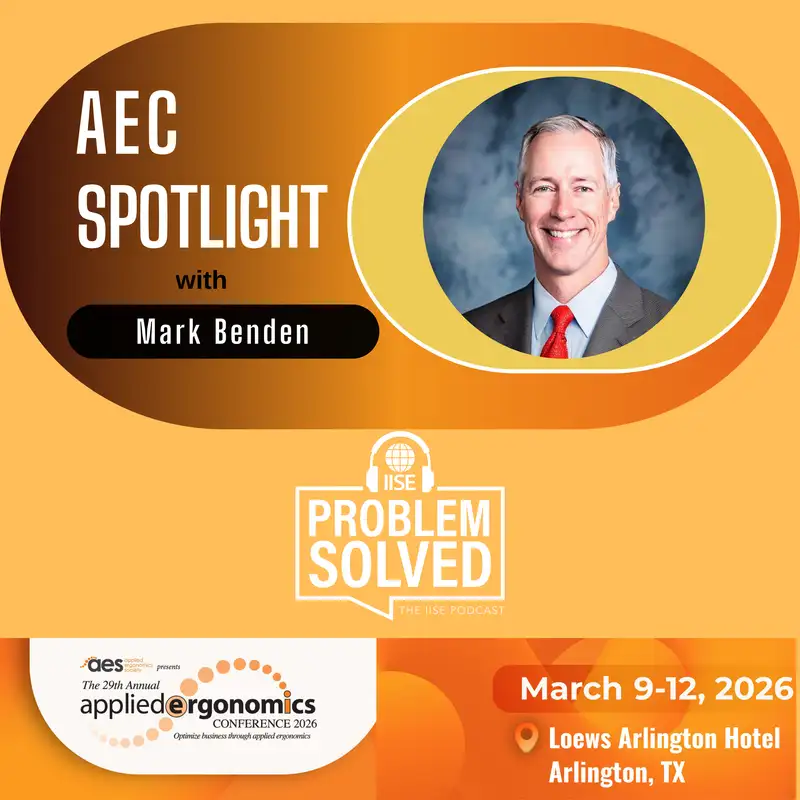
AEC Keynote Spotlight: From Idea to Impact with Dr. Mark Benden
Download MP3Here's the problem.
Every workplace has them.
The nuance tasks the fatigue
at the end of the shift, the injury.
That almost didn't happen.
What if you could build a solution
that could change an entire industry?
At the Applied Ergonomics Conference,
leaders are exploring how AI, wearable
technology, and human centered design
are transforming worker health and safety.
Welcome to a special episode of Problem
Solved.
Highlighting one of this year's
AEC keynote speakers, IISE’s
Frank Reddy
sits down with Dr. Mark Benden,
researcher, inventor of nearly 30 patents
and leader who has helped generate
more than $2.5 billion in economic impact
through ergonomic innovation.
In this conversation,
he walks us through the journey from idea
to commercialization, and why the next
big breakthrough might be sitting
inside your organization right now.
Join us.
I'm doctor Mark Benden.
I work here at the Texas
A&M University School of Public Health,
and I'm also the director
for the center for Worker Health.
And I am a certified professional ergonomist
and someone who's
been involved with the Applied
Ergonomics Conference since the beginning.
Perfect.
What do you look to highlight
in your keynote address
and what would you hope
for attendees to gain from that?
Probably the first thing would be
to have a little bit of fun.
So I have a few funny kind of anecdotal
stories planned from design requests
that people have given me over the years
that I think the audience will enjoy
and probably get a chuckle out of,
usually at my expense, of course.
There's,
you know, plenty of, flops and foolish
things that have happened over the years.
And it's always good to kind of share
some of those moments with people.
Another piece that I really hope
that they get, and one of the angles
that is kind of centerpiece of the talk
is around commercialization.
And so how do you take these ergonomic
improvements?
Sometimes their tools,
sometimes their processes.
How do you kind of take them to the world,
you know, how do you get them out there?
And a lot of people that do this type of
work are pretty good at solving problems.
Maybe,
for instance, at their current employer,
but they may not realize that that thing
could be used by lots of other employers.
And so how do you, get it out there?
How do you take it to the world?
So I'll spend quite a bit of time on that.
And then, of course,
a little bit of just encouragement
for everyone there, some fun
and some encouragement.
So you get some experience in the military
and business, in an education,
if you want to talk a little bit
about how your experience
and all those areas led to your role
at the center for worker Health.
Yeah, it's
a long and storied process over 40
plus years, obviously.
But, I think probably the easiest thing
to relate the audience to would just be
that I spent quite a bit of my career
in my early formative years,
getting dirty, getting sweaty,
getting tired.
You know, working in the heat,
working in the cold, getting injured,
you know, cut, scraped, bruised, burned,
you name it.
And I think that probably
as much as my formal education has kind of
informed the way that I approach trying
to figure out solutions for workers.
And, that was true in the military.
It was true.
You know, when I was a machinist
working in a machine shop.
Absolutely, necessary
to have the types of controls
and interventions that we work on
so often in ergonomics to try to improve
the quality of the outcomes
for the worker, not just the
the parts and pieces that they make.
We, of course, have to focus on
that as well.
It's a business.
But we sure love to take care of people
and make sure that they're able to go home
with their families safely and whole.
How would you say that advanced technology
is affecting efforts to improve worker
safety and health?
This is a really big topic right now
that comes up quite often.
You know, we're seeing some pretty big
advancements, for instance, in monitoring,
workers.
One of the things that used to happen was
they would send someone like me out
with a clipboard, a stopwatch, and,
you know, we would go stand
next to one worker for 4 to 6 hours,
take a sample of what they did,
and we would come back
and make claims about that whole area
or that whole workforce.
And as you know, the
the science of sampling is is very robust,
but it's also fraught with problems
and bad assumptions.
And the advantage today
is that we no longer have to really settle
for sampling 1 or 2 workers
or a small group of workers.
We can sample all the workers
all the time.
We can sample them through things like,
video systems
and smart intelligent systems.
We can do motion capture with cameras.
We can analyze that data using AI.
We could also have
wearables on the person.
So not only do I have a chance to capture
what is happening to the worker,
I can also capture how the worker's body
is responding in real time
and that is a that is a huge game changer
for technology in this field today.
One of the big places
that we're really heading next,
I think, is that we will begin to apply
that type of data collection
to real time corrections,
real time fixes, real time adjustments.
Those could be behavioral.
Right.
So Frank, I would say, hey,
Frank, you know, and your, hard hat,
helmet, earpiece I might say, listen,
this is happening and this is going on.
You know,
maybe you need to try it this way
or use this tool or do that,
you know, or stop.
Hey, don't do that.
You're going to get hurt.
Whatever happens to be.
It could be, real time
technological interventions
instead of
just what we've done in the past.
Typically, we've collected data and
we said, wow, Frank got hurt out there.
That's bad.
How do we keep Frank from getting hurt
again?
As opposed to, wow, look at Frank.
He's about to get hurt.
Let's stop that right now and fix that.
You know, in the moment and prevent
an injury.
Those are those are big changes
that are really just happening
daily because of technology.
And, you know, like I said, being able
to analyze massive amounts of data
in real time
without AI, without the algorithms
that are being written now, we wouldn't
have been able to do that before.
So very exciting times for the field.
Yeah, it sounds like it.
Can you share a
few of your patent inventions with us
and tell us why you're proud of them?
Sure.
Of course.
You know, I'm getting close
to 30 in a bunch more pending, but,
one of the earliest patents that I did
back in the 90s was an ergonomic armrest
that was four way adjustable for chairs,
and it's hard to imagine today,
sitting in an office chair
and not having adjustable arms
because we're all conditioned to that now.
But there was a time,
and this was one of the first,
to really be able to provide the,
the height, the width, the depth,
the rotation of the armrest.
So that was that was exciting.
It was a definitely a game changer
for the industry.
Standing desks has been another one
that I'm very proud of
and literally have gone around the world
with that for both adults and children
in schools, K through 12,
millions of children now are using those
standing desks from the original design.
And another thing for the office,
footrests for standing desks,
because I really believe strongly
that if you have a standing desk
and you don't have a foot rest,
you're you're only about halfway there.
You really need that foot rest
to make that comfortable.
And then, of course,
the most recent one, that is having
some nice breakthroughs for health care
is the use of digital humans
as agentic agents.
And so what I mean by
that is instead of doing,
a chat bot or something like that
where you're just typing,
this is actually having a conversation
with a human like avatar and, you know,
she's able to walk you through whatever
your health care problem or challenges
or help you pay a bill or schedule
an appointment, that type of thing.
So, very excited to see that
newer technology getting out there
and helping people, in ergonomics,
we've applied that to training.
So using these a agents to do ergonomic
training for remote workers.
And that has been met with,
a lot of great success.
I'm always I'm intrigued
because I'm not in ergonomics,
but I wonder, you know, I'm
I'm kind of like a
I have a lot of creative endeavors
in my life and
but I wonder, do a lot of your ideas
come from, you know, some deficient thing
you see in everyday life
that kind of lights the fire for you?
Yes, absolutely.
Supposedly
necessity is the mother of invention.
I would also add that probably,
new nuisance is the father of invention,
because a lot of times
it's just something super annoying
that you're having to do
and you're frustrated with your fighting.
And, you know, for me, or again,
early in my career, that meant,
you know, busted knuckles and scrapes
and scratches
and bruises and fatigue, you know,
and sometimes even injury.
And that idea, that concept of,
man, there's just got to be a better way.
And really, until someone stops
and kind of ask that question
and, you know, brainstorms problem solves
works their way through a few solutions
that might actually lead to that.
You know,
we're all bumbling through doing that
silly thing, that silly way.
And a lot of times we look back on it,
you know, years later, like, wow,
that was so obvious.
Why didn't I think of that?
Well, yeah, I mean, that is a question
I think, for all of us.
And, the person who did, they
not only thought of it,
but they,
they did something with it. Right?
They took it to those next few steps.
And so I think for my talk, that's
one of the things I want to help people
to understand a little more knowledge
about how to go from
I think there's a better way.
I might even have a better way.
What do I do with that?
How do I get that out to the world?
How do I protect it so that I might be
able to gain financially from it?
And then how do I take that
and get it commercialized?
And so I'll walk them through
some different scenarios
of of how they might accomplish that.
Gotcha.
So from the idea
to the full process of implementing.
Exactly. Gotcha.
Well,
jumping into the the AEC the conference,
what do you feel that
you gain each year by attending AEC
and being there with fellow ergonomics?
Yeah. Great question.
You know, it's for me
a way to, kind of reset.
So I go and I get the motivation,
of course, I pick up knowledge,
but I get to also, dial
into some of those friendships
and relationships in the field
that I've had for over 30 years.
Many of those people that I see
every year are folks
that I worked with
in my first job out of college.
And so it's exciting to,
just catch up and see what they're doing
and see what kind of breakthroughs
they're making.
And, you know,
what's happening with their companies.
We love to go as a school
because we take students.
The students get to interact
with the workers on the line
who are coming to the Eurocup.
But our students also get to interact
with the professionals in the field,
and they get to meet professionals
who are at different levels,
throughout their career.
And that's really helpful
because one of the things that students
struggle with is seeing themselves
in other professionals.
They don't
they don't meet enough of them and
come across enough of them, in my opinion,
to be able to picture themselves
doing that work
and being at that same place
in 5 or 10 years.
And so it's a really great conference
to be able to do those things.
Very few conferences out there
combine the levels and variety
of people, professionals, live workers
that this conference does.
So it's fantastic for all of the.
Well, I appreciate
you taking a few minutes for me today.
Absolutely free.
Thanks to our guest, doctor Mark Benden.
We hope you'll join us in person at AEC
for cutting edge
sessions, hands on workshops,
and the Ergo Cup competition.
I don't miss the Problem Solved LIVE
booth, where we'll be capturing insights
from leaders
shaping the future of ergonomics.
Every great solution
is a story worth telling.