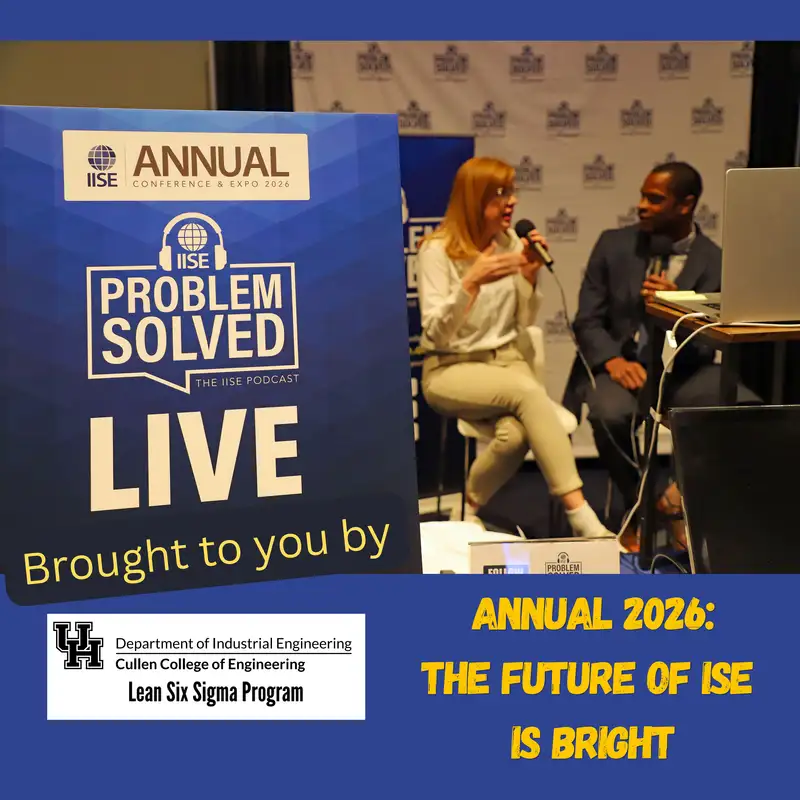
Annual 2026: The Future of ISE is Bright
Download MP3Annual 2026: The Future of ISE is Bright
Ad: [00:00:00] This episode of Problem Solved is sponsored by the University
of Houston's Cullen College of Engineering. At the University of Houston's
Cullen College of Engineering, the Industrial and Systems Engineering
Department prepares students not just to be team players, but to become
dynamic leaders. Ranked among the top 50 public universities by US News and
World Report, both the college and department are recognized for academic
excellence and innovation.
With flexible programs like professional project management and industry-
relevant certifications such as their Lean Six Sigma program at lss.uh.edu, the
University of Houston equips learners at every level to break through outdated
systems and lead meaningful transformation. Discover more at
ie.uh.edu.[00:01:00]
Elizabeth: At this year's 2026 IISE Annual Conference, one thing became very
clear. The future of industrial and systems engineering is evolving rapidly, and
the next generation is already helping shape it. Throughout the conference,
students, researchers, industry professionals, and longtime leaders gathered to
share ideas, tackle emerging challenges, and explore how industrial and systems
engineering continues to expand into nearly every industry imaginable.
From AI and healthcare systems to sustainability, automation, and human-
centered problem-solving, the conversations happening at Annual weren't just
about where engineering is today. They were about where it's headed next.
From students, academic leaders, and every level of industry professionals
helping define that future.
Ashish Goud Balagula: Thank you. My name is Ashish. I'm from Arizona
State University. I'm a graduate student in industrial engineering.
Elizabeth: [00:02:00] Okay. And is this your first conference?
Ashish: Yeah, this is my first conference, and I feel so good to be here.
Elizabeth: You're a graduate student. what is your, like, area of focus?
Ashish: So my area of focus is in supply chain.
I'm currently working on a thesis that is, structured segmentation based model
selection policy.
Elizabeth: Did you have a goal coming to the conference?
Ashish: Yes, definitely. I have an objective of meeting people, making some
valuable connections, and definitely I would like to know more about, the
univer- universities that are here because I'd like to pursue a PhD in one of
those.
Elizabeth: Okay.
Ashish: Uh-huh.
Elizabeth: And so what do you think about the field of industrial and systems
engineering? Where do you think it's going in the future?
Ashish: Def- honestly, it's g- it's gonna be the booming ... one of the booming
sectors compared to the other jobs, because we are everywhere.
Elizabeth: Right. And so, if you could, like, describe your experience so far in
one word, what would the one word be?
Ashish: My experience overall here?
Elizabeth: Yeah.
Ashish: Yeah. I would say extraordinary, 'cause this is my first time I'm being
to a [00:03:00] conference, and this was a really good kickstart for me. And I
feel like I would like to attend the next event as soon as possible. I mean, again,
I'm so interested to be ... amazed to be here, actually.
Geshna Raghvan: Hi, I'm Geshna. I'm from Arizona State University, and I've
just graduated with a master's in industrial engineering.
Fatima Godino: Hello, I'm Fatima. I'm also for Arizona State University. I just
graduated from my bachelor's in industrial engineering and data science.
Elizabeth: And you were also student volunteers for IISE, so we love our
student volunteers.
Geshna: I had volunteered for yesterday, and it was something that I did not
like ... You know, usually when you say volunteering, it's something serious,
but I really felt so, It was very happening. It was very nice, and people like,
they're ... It was so joyful. And it was nice interaction, and I did not expect I
would make a lot of, friends, [00:04:00] I would say.
I, I honestly met a lot of professionals, but I felt more close, more warm. And it
didn't feel like a volunteering job, honestly. It felt like, oh, my God, I'm, I'm
meeting this person, like, just like that. He's, like, such a huge position. So it
was really fun and really nice. So beyond just seeing it as a professional thing, I
really enjoyed the place.
Fatima: It was my first time going to a conference and seeing the behind the
scenes, how everything works. Getting to see how many people comes in one
day, it's just insane to see everything working together, and all the pieces
working together. So it's just amazing coming here and seeing different
perspectives that everyone can have about the same topic.
I'm just grateful that I got the opportunity to come. Thank you.
Elizabeth: Thank you, guys, so much.
Omar Faruq: Thank you. My name is Omar Fargis Sameh. I'm, from
Binghamton University. I'm a third-year PhD student.
Elizabeth: Okay. Great. Have you already done your presentation?
Omar: Yes, I have done it, my presentation. How did it go? [00:05:00] they,
they went well.
Great. But in one of them, there was, there was less people to c- ... just, just to
see the presentation. So it was kind of awkward. Even there was no chair.
Elizabeth: Oh, no. All right. Well, you got through it. Good job.
Omar: So, my paper was on- Its name was CoRis, so it's mainly the risk
prediction, ordinal risk prediction for the pregnant womens.
The reason for it was so we can predict any of their difficulties very early- Okay
... based on the focusing data. And also it's ordinal, so low, mid, and high. So
sometimes, we see that, the, well, patients, they are diagnosed with the higher
disease, but they are, the doctors say they are in the lower category of those
disease or, or those problems.
So, to find out those, solutions, so we, introduced this framework with, with the
real data, clinical, real clinical data sets.
Elizabeth: [00:06:00] So diag- the doctors are misdiagnosing them?
Omar: Sometimes, yeah. Okay. We are using some physiological measures, so
that gives us good opportunity to find out whether their decision is wrong or
right.
So we are saying that, and we think that though our dataset is not so large, so
but still we believe that if w- if we can, add more data, it will work very well
Prakash Patil: for welcoming. My name is Prakash Patil. I am from University
of Michigan-Dearborn. I'm a first year PhD student, and I work in automotive
industry.
Oh, my major is industrial engineering, and I, I have worked in the automotive
industry for a few years.
Elizabeth: What has stood out to you so far at the conference?
Prakash: definitely, definitely the people that I've met. brilliant people with a
lot of good insights into, how I can direct my research during my PhD.
Elizabeth: So what particularly, like, kind of research are you looking into?
Prakash: To give you more details, human and AI interaction [00:07:00] to
keep drivers awake while they're driving, especially on highways when it
becomes very boring and sleepy.
Elizabeth: Okay.
Prakash: We try to use LLMs, to, keep an, have an engaging conversation,
investigate what makes a conversation engaging that keeps the drivers awake.
Elizabeth: Oh, that is fascinating.
Prakash: It is. Wow. I'm excited. In the conference everybody's focused on
elements of AI and future of this- Yeah ... a lot. And then I am very excited to
explore how this is going to change industrial engineering specifically. this is
just the beginning is what I feel. We are talking about AI a lot, but there's robots
and, automation in industrial engineering that's gonna be, that's gonna change
the face of the industry.
It is. And then to explore this in the future is going to be very fascinating,
because we think about robots now and how they will interact with humans
now, but it may become a very different situation. For good. For good. Yeah.
As well. [00:08:00] Something that I have, we are probably not thinking so
much about, some kind of technology that disrupts the way we think about
robots today.
Elizabeth: Uh-huh. But you're optimistic.
Prakash: Absolutely. Cool. Absolutely.
Elizabeth: Welcome back to Problem Solved, and can you introduce yourself?
Faruk Muritala thank you. I'm, Faruk Muritala I'm a student at Kennesaw
State University. I'm in the program of, PhD data science, and I'm in sixth year.
I got invited for innovative design competition.
Elizabeth: Uh-huh. And what was your presentation? What was that about?
Faruk: So we designed a data centric where we can effectively, propose a
solution for cooling effect.
Elizabeth: For what?
Faruk: Cooling.
Elizabeth: Oh,
Faruk: cool. Cooling effect. Yeah, so that's what we're working on. Yeah.
Elizabeth: Cool. All right.
Faruk: So I think I felt much in- integrated with the company people.
Okay. And they were able to, like, give me some feedback when I was doing
my initial presentation. So- Yeah ... as a good thing, I was able to see today
Elizabeth: For many students at Annual, [00:09:00] the conference represented
something bigger than presentations and research papers. It was an opportunity
to connect with professionals, explore new ideas, and begin imagining where
the field might take them next. But while students are stepping into a rapidly
changing profession, industry leaders and experienced engineers are already
navigating the realities of that transformation, especially as artificial
intelligence, automation, and new technologies continue reshaping the way
organizations operate and solve problems.
Ricardo Valerdi: I'm Ricardo Valerdi. I'm a professor at the University of
Arizona.
Elizabeth: Okay, great. And what brings you to annual conference this year?
Ricardo: One of the attractions to come to the IISE conference is to attend the
CIEADH meeting, which is one of the many times that we get together
throughout the year and talk about all sorts of issues going on, not just in the
profession, but at our own universities, and how we can exchange ideas, learn
from each other, and help move industrial engineering and systems engineering
forward.[00:10:00]
Elizabeth: And for those listening who don't know what CIEADH is, can you
explain what that is real quick?
Ricardo: It's the Council of Industrial Engineering Academic Department
Heads.
Elizabeth: Nice. Okay. What's some of the things that y'all discussed during
your time at, the conference this year?
Ricardo: In addition to recognizing outstanding PhD students, outstanding
papers, and outstanding young faculty, we also talk about really interesting
things like artificial intelligence and how it's impacting the students that are at
our universities, how we can prepare them for the workforce, but how we can
get ahead of this because it's moving so quickly that, it's kind of head-spinning,
and- Yeah
just ideas on how we wrap our arms around it and, and really leverage it to
move the profession forward.
Elizabeth: Can you share any of those ideas with us?
Ricardo: Certainly. What's interesting about Artificial intelligence is usually in
academia, if you use AI, you're considered to be cheating.
Elizabeth: Mm.
Ricardo: But if you use AI in [00:11:00] industry, you're a hero.
Elizabeth: Oh, interesting
Ricardo: point. It's an interesting paradox, right? So we're trying to get away
from the cheating mentality, but instead, how does AI become your assistant?
How do you control AI to be more efficient, but also to do more things than you
could do before? So analyzing large amounts of data, for instance, you could
outsource that to AI.
But the thinking of, well, how do you present the results, and how do you
influence somebody to make a decision that has to be done by the human? So
that line is very blurry right now. We wanna make it more clear.
Elizabeth: Okay. anything else?
Ricardo: Well, I think the, connection to ethical decision-making is important
because if you let AI do the whole thing and make the decision for you, then
you can be in a lot of trouble.
So the other task is to figure out where the line is, where AI can give you ideas,
but ultimately, you, the, the [00:12:00] human, has to decide whether something
is ethically correct or not. You don't wanna ever outsource that to AI.
Elizabeth: Yeah. What do you think all this is gonna do for students in the next
couple years?
Ricardo: Well, I think it's gonna change the types of jobs that they go into. in
fact, I was just talking to another department head today that our students are
going to be entering jobs that don't exist
Elizabeth: yet.
Ricardo: Mm. That's scary, right? So the job, the responsibility that we have is
to teach them the fundamentals that will apply to anything that they do.
Elizabeth: Oh, wow. That's interesting.
Elizabeth: Yeah. and then just a- a little bit about yourself, I know that, you
have a particular area of focus, and you also have a book coming out. Would
you mind just talking about that for a minute?
Ricardo: Sure. My research area is cost analysis, which is all numbers. Like a
lot of industrial and systems engineers, we deal a lot with numbers.
The context happens to be sports analytics as well, and my book that's coming
out, in a [00:13:00] few months is about decision-making and sports, and it's
called The Five-Tool Team.
Elizabeth: Very interesting. Okay, and we're hopefully gonna talk about that
more later on on an episode of Problem Solved, so everyone, be looking out for
that episode.
But, thank you for talking with us. Was there anything else that you wanted to
say that we didn't touch on yet?
Ricardo: No, I think it's great to see all the young attendees at the conference
because that's the future of the profession. you know, there's a lot of gray hair in
the, department head meeting, including my own, but it's great to see all the
energy, all the papers that are being presented.
that to me is extremely motivating, refreshing, and this is... that's why we do
this, is to help those people make an impact on society in the next few decades.
Elizabeth: Yeah. Any, For students who are listening, I mean, can you leave
them with something either really motivating or a great piece of advice?
If they're listening and they're moving forward, what can you tell them? What
can you leave them with?
Ricardo: I think being able to sell yourself as an industrial and systems
engineer is [00:14:00] important, and so having like that one tagline or that one
soundbite that allows you to communicate to others what you bring to the team.
And one of the really effective ones is the science of better. We keep repeating
that over and over in a lot of different contexts, so just for students to remember
that this is what they bring to the table, is making things better.
Elizabeth: Great. Thank you so much. Appreciate it.
Ricardo: Thank you.
Amy Sartain: Hello, my name is Amy Sartain, and I'm the co-founder of
Industrial Engineer AI. We focus on the best of industrial engineering best
practices, along with new and innovative AI tools, and we bring those together
to help solve problems, reduce waste and defects within companies and within
their workflows and their, within their pro- their business processes.
Elizabeth: Fascinating.
Amy: We are doing a hands-on interactive session where, students and faculty
and all those that join will have eighty minutes to build their own AI agent, and
we've got some [00:15:00] tools and platforms that help make that easier. And
so looking forward to seeing what people create. We're gonna share out at the
end of the session the things that people build and how they automate their
processes.
Elizabeth: So people listening who are interested in this kind of thing, what,
what can you tell them about AI if they're interested in learning more about this,
how to do it themselves, how to automate themselves?
Amy: Absolutely. We think that it's really important for industrial engineers to
lead the change in organizations with AI, and you have to start with yourself.
You need to be a daily user, teaching yourself new things and work your way
up. Challenge yourself. this is a great time to upskill. whether you're a student in
school or whether you're a professional in industry, you should be learning
something new about AI every single day, and you should be the one bringing
that out within your organization so you can help others with the transition.
Elizabeth: What do you see the future looking like?
Amy: I think that cameras and sensors are going to be much more prevalent in
operations. I think that, data will be more connected across organizations so that
people [00:16:00] don't have to manually run reports and fish for things. I think
we'll be able to see status at a glance, and that will help industrial engineers with
problem-solving.
and we also talk about outer space a lot. it's- Yeah ... it's fun and interesting. We
think that the students today that are in school are gonna have s- part of their
career involved with space in the future. And, so that's just kind of something
exciting out there that, we w- we're following, and that we can't wait to hear
from students and, and those that are working on projects with that.
Elizabeth: Cool. we have a contest going right now that, we've got a astronaut
coming up on an episode of Problems Solve, Colonel Shane Kimbrough. So if
you could ask an astronaut a question, what do you think you would ask?
Amy: Absolutely. That's a, that's an exciting episode. I can't wait to listen to
that. I would probably ask, what do we think, industrial engineers should be
doing to be helpful in getting involved in space exploration?
Elizabeth: Awesome. Thank you so much.
Amy: Yeah.
Kyle Collins: How everybody doing? My name is, is Kyle Collins. I'm a
industrial engineer, for UC Southwestern Medical Center. Been [00:17:00] there
for about six years now, so in the healthcare industry. Love making the
processes flow better and using all the tools that we learn here at this
conference.
Elizabeth: The, Gilbreth... Were you here this morning for the keynote speech?
Kyle: I, I was not, no.
Elizabeth: Okay. Mm-hmm. So one of the award winners, the Gilbreth, winner,
he is in healthcare. Mm-hmm. So like, like that's like our biggest award.
Kyle: Mm-hmm.
Elizabeth: And he's a healthcare systems engineer. Okay. So that's kinda neat.
Cool. So how did you get into that field?
Like what drew you to that?
Kyle: I didn't even know industrial engineers could be in healthcare initially.
But, at, I w- went to Texas Tech U- U- University, and then for my senior
design project, we had a, a hospital that we partnered with, and I did the project
with that. So ended up doing that, loved it, and I applied to UT Southwestern
Medical Center, ended up getting it, and then that's how I kinda got, got there.
I, I like it. Yeah. I, I think everybody could relate to it. Yeah. You, you've been
to the doctor or somebody else you know have been to the doctor, and you
always go in there like, "Oh, it could be a little faster"- Yeah ... "or a little better
or [00:18:00] a little more efficient in some type of way." Right, right, right.
Yeah.
So you can relate to it.
Kyle: Yeah,
Kyle: totally. So, I th- I think that helps, and then if you do make change, then
you're changing it for somebody else or somebody else you may know that can,
you know, that'll get a turnaround time faster. You might get a results faster
than eight months or something like that, or you might can get it in, in 10
minutes, you know?
Right. So that's kinda our goal to make things better-
Elizabeth: Yeah ...
Kyle: overall. I'm looking forward to some AI stuff that we can make 'cause, of
course, that, that spits out information so quickly, and we just wanna make sure
we can, get information to patients faster, so. Yeah. that's, that, those are the
main things.
Looking forward to that. But I think the, the change management piece of trying
to implement all of these things, I did go to some, change management, classes,
and it's nice to hear that everybody's in the same- Yeah ... space.
Yousef Abushaaban: I used to go to Shaban. I've graduated at University of
Texas at Arlington in 2017 as an industrial engineer.
and now I'm working in the industry, as, at, [00:19:00] a natural gas company,
here in Dallas. so I work as a, as a system planner. One thing I'm really
passionate about is, modeling and simulation.
Elizabeth: Uh-huh.
Yousef: I, I got to see, like, how other industries, take on those challenges and,
lesson learned, and I can take it away and, recapture that into my, day-to-day
Elizabeth: Is there a certain way that you would use that in, in what you do?
Yousef: Yeah, I can adapt really quick to, the change management side, just
understanding like how change management is a, is quite a process in different
industries. and I, I've learned that it- it's helped so many industries understand
like how the resistors of change, what's coming, kinda like show that, personal
relationship is what really, really is, built to build upon is change management.
So I really like it. Yeah.
Elizabeth: Why is that so important?
Yousef: I believe it's really important, because, as industrial [00:20:00]
engineers, it's driven as a people process and technology, and the value of us
being, of me being an industrial engineer is what got me into the industrial
engineer world. I'm more of a people person and I like to network.
building that trust and, on a personal level and then professional level, I mean, it
builds confidence.
Elizabeth: Kind of the core-
Yousef: Yeah, the core aspect- Yeah ... of industrial engineering. Yes.
Elizabeth: Yeah.
David: My name is David Burford. this is my first time at an IISE conference.
Elizabeth: Oh, cool.
David: I've been a part of IISE since about 2017.
There's a lot of, sessions to see and there's a lot of rooms to go to, so I feel like I
am, I'm seeing a lot, but there's a lot of stuff I'm missing too. I think the best,
one of the best sessions I went to, was the Operational Excellence Town Hall. it
was good to see a lot of the IISE operational excellence team and just,
practitioners throughout the industry.[00:21:00]
My avenue of interest is Lean Six Sigma. so I'm a Six Sigma Master Black Belt,
and I've been doing projects for about 13 years.
Elizabeth: Okay. So what do you hope to gain out of this conference?
David: networking and some great, great knowledge.
Elizabeth: The Innovation Cup competition offers a glimpse into what the
future looks like in practice.
It's one of the highlights of Annual each year. Teams from across industries
showcase innovative solutions using industrial and systems engineering
principles to solve real-world
problems and create measurable impact.
These are the third-place winners of the Innovation Cup. Congratulations, and
go ahead and introduce yourselves.
Brenden Mosier: Thank you. I'm Brendan Moser, and this is Tom Boose next
to me. I am a performance consulting analyst with the Mayo Clinic in
Rochester, Minnesota, and Tom is an environmental services manager in the
same, enterprise group. And we're here from the Mayo Clinic, in Rochester
[00:22:00] presenting about using automation and robotics to help solve some
problems in our support services work groups.
Elizabeth: What was the main problem that your team solved?
Tom: Our team did a gap analysis using the demand framework to determine
several issues within our support services departments of, staffing challenges, as
well as a heavy manual burden on our staff.
Brenden: By leveraging robotics to take care of that manual work stream and
take, you know, near the 20% of the staff's walking distance, off their hands into
the hands of robotics, we're able to drop that exertion days lost, to a total of 55
days combined between 2025 and 2026.
It originally started as implementing robotics back in 2024, but since then, and
in 2025 and 2026, it's been an upscaling of robotics, not only in, in new physical
locations, but increasing the [00:23:00] usage of robotics in existing locations as
well.
Elizabeth: Fascinating. And the second place Innovation Cup winner.
Naveen Chandra Kukkala: Hi, my name is Naveen.
I'm from EssilorLuxottica. I work as a director of distribution, mostly work on
warehouse optimization.
Elizabeth: And can you talk a little bit about your organization and the problem
that you solved, and just tell us about it.
Naveen: Yeah. a lot of people doesn't know that EssilorLuxottica is behind a lot
of brands.
The, the Ray-Ban Meta that I'm wearing right now, we own this brand.
Elizabeth: Okay.
Naveen: And, we own a lot of brands like Oakley, Costa, Sunglass Hut,
LensCrafters, and there are so many others, I don't have time for that . but, yeah,
my- myself, my team, we work with warehouse optimization. We work with our
other business partners in delivering products to our customers quicker and
cheaper.
So the problem that we tried to solve is within the warehouse. we [00:24:00]
wanted to help our operations pick more and get the products to customers
much faster. So i- previously, we used to measure, the forecast, but we started
measuring our hope to measuring what we actually did. You know, hope is not
the best plans, and right now we're measuring what we are doing, and
previously we used to measure what we hope we're doing.
So that's what, shifted, the previous results from... We used to get, like, 80%
accurate on slotting. Now we're getting 99, 98 consistently. So- All right ...
yeah.
Elizabeth: That's great. Congratulations.
Naveen: Thank you so much. All
Elizabeth: right. I am here with the Gold Cup winners of the Innovation Cup.
Congratulations, all from Smurfit Westrock.
And could you all please introduce yourselves?
Devin Corbett: Hi, I'm Devin Corbett. I'm a process engineer at the Covington,
Virginia mill.
Rishabh Bhandawat: Hello, I'm Rishabh, and I'm a data [00:25:00] scientist at
Smurfit Westrock, and I work out of Atlanta, Georgia.
Andre Perez : And I'm Andre Perez, an IT and process controls engineer.
Devin: I work at a paperboard facility, that has an integrated power plant
cogeneration, and it's, it has a lot of different boilers and turbine generators,
separate electrical grids.
Very complex and we needed to be... We needed to have a tool, where we
could, real time compute what the most efficient and optimal, strategy to
produce power was, with ever-changing electrical prices and gas prices.
Rishabh: And part of the solution that we came up with was creating a, model
with our data scientists where we took all the constraints, all the upper and
lower constraints that we had for each, power boiler, all of our physical
limitations, and we calculated including our dynamic economic factors,
[00:26:00] what the best lowest cost scenario would be That would utilize the
most, renewable energy sources that we had available, and to generate the most,
you know, most profit and most renewable energy credits, which is something
that we have.
One of the beautiful things about the model that we created was it, it's a mixed
integer linear programming model. And to be, to see something that I've learned
in, during grad school being implemented at, at an industry level is good to see.
And also, it solves really quickly, so we, like, brainstormed ideas where we can,
we made sure that, this model works very fast and is adaptable to the changing,
demand of the electricity and the steam that the mill requires, but also changing,
electricity prices, and make sure it's, adaptable.
Yeah.
Elizabeth: And so, how's your experience been with the Innovation Cup? I
know that you've had experience before, [00:27:00] so, what's your experience
been this time, and, what's your advice to other people who are thinking about
entering the Innovation Cup?
Rishabh: So this year, definitely a better experience because we got gold.
but yeah, it, it, people like Sagar, Bhanu, and other committee members of the
Innovation Cup, they've been very helpful with, guiding us through the process.
but it was also great to see what other companies are doing within their own
organization and how, they're trying to be innovative and standing out.
So, was great to hear other, other people's innovations as well. So if you think
you have, you're doing some great work, definitely, definitely, submit for next
year. This is a project that the three of us worked on. We're really proud about
this project, so it felt great to have an audience, to be able to present our, you
know, our results.
We ... Th- this project led to about $6 million worth of savings per year at this
[00:28:00] one facility, and we're looking to expand on that. And it was exciting
because we had many different disciplines here. So we had, you know, process
engineering, data science, IT, so all these different, you know, realms having to
come together, collaborate to make a really working solution for operations
was, was awesome.
So yeah, just like Rishabh said, if you have a project that you want to, present
and put in, in front of others and compete on, this is a great, this is a great
avenue for that. Would highly recommend it.
Amy: Well, thank you, guys, and congratulations again.
Rishabh: Thank you. Thank you.
Elizabeth: From first-time conference attendees to experienced professionals
leading change across their industries, this year's IISE Annual Conference and
Expo highlighted a profession that continues to evolve alongside the world's
biggest challenges.
Thanks for joining us on this special episode of Problem Solved. Every great
solution is a story worth [00:29:00] telling