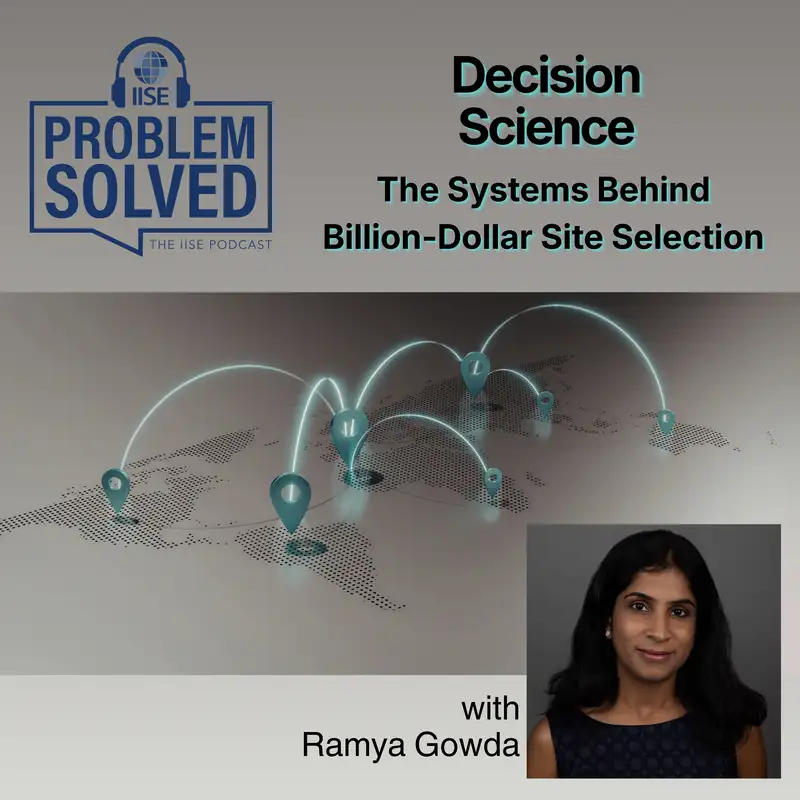
Decision Science: The Systems Behind Billion-Dollar Site Selection with Ramya Gowda
Download MP3Are you looking to sharpen your skills,
boost productivity,
or take your career to the next level?
The IISE Training Center offers
world class professional development
built for busy engineers, managers,
and problem solvers.
Whether you're diving into analytics,
earning a Lean Six
Sigma certification,
or exploring supply chain logistics,
our expert led courses
deliver practical tools with real results.
Learn online or in person, with options
tailored to every career stage.
Plus, our Training Works Pass
participants have applied their knowledge
to save their companies
over $250 million in real world projects,
and 90% of Lean Six Sigma candidates
pass their exam on the first try.
Visit iise.
Org slash training
to explore the full course catalog
and start transforming your career today.
Here's the problem.
When companies decide
where to build, expand, or relocate.
That one decision shapes
everything that comes next.
Hiring, productivity, supply
chains, cost, and long term risk.
And yet, too often
those decisions are driven
by gut instinct, outdated assumptions,
or short term incentives.
But before the buildings, jobs and supply
chains, there's complex systems thinking
today on problem solved.
We're talking to someone who applies
industrial and systems engineering
at a scale.
Most people don't even realize exists.
Ramya Gowda is a managing director
at Newmark,
a leading commercial real estate advisor
to global corporations, where she leads
strategic consulting and site selection,
location strategy and labor analytics.
She helps organizations make some of
the biggest decisions of their careers.
Ramya, welcome to Problem Solved.
We are so glad to have you here.
Thanks, Elizabeth. I'm excited to be here.
And you've had a really interesting career
and it's been kind of international now.
You've earned
several of your degrees in India
and then in Illinois, Illinois
State University.
So I'm just curious when you started out
in industrial engineering,
did you think that it would lead you here?
No, no. Yeah.
When I started out of industrial
engineering, it's a very common thinking
that you always think industrial engineer
is mostly related to manufacturing.
That's where you want to be.
And, this all happened so organically,
you know,
I was looking at Bosch
as an industrial engineer.
I came across this opportunity at Newmark.
It was, for the site selection team.
So the role was actually looking
for someone
with a supply chain background
and someone with the financial building,
financial models, working with industrial,
in the industrial setup.
You know, a lot of that was very similar
to what I did at Bosch, though.
It was not
I was not on the consulting side.
I was more on the corporate side.
That's something that the company
was looking for.
And, I joined Newmark.
So let's just maybe help
some of our other listeners understand,
starting very simply.
If you're like,
say you're at a dinner party or something
and you're just explaining to somebody
who may not be an industrial systems
engineer, if you're explaining to somebody
what you do, how do you explain it?
Yeah.
So, you know, when a company wants
to build a manufacturing plant
or an office or a data center,
often they
have multiple, locations to pick from.
And, so what we do
is we help these companies
compare those locations
using data, real world
constraints and strategy,
helping them make that decision.
We help them.
We can location that actually works
for them, not just looks good on paper.
A very good example is,
when we are buying a home,
we are not just looking at the price,
right?
We are looking at the, proximity
to good schools,
our commute, and the quality of living.
And, how are the amenities.
So we are looking at so many things.
It's a very similar thinking,
but we do for corporations
and communities, often
for these kind of projects,
there are millions
and billions of dollars, at stake.
So it becomes, as, location
strategy consultants,
we help the clients make those decisions.
So, like buying a home.
But times a thousand,
right. So
so it's a location decision.
So if one of these location decisions say
it goes badly or they choose wrong,
what are the consequences
for these corporations.
Yeah.
So if they choose the wrong location
there's never a wrong location.
It's just that it's not, that wasn't
the location that was fit for them. So.
And so what happens
if they end up being in a location
that was not a good fit for them?
They may face labor workforce challenges,
and they may face limitations
for infrastructure.
And there will be regulatory delays,
and they may experience
higher operating costs.
So that it's kind of like
they will not experiencing these problems
if they don't choose the location.
Right.
And if you you've seen
have already built the manufacturing plant
in that location,
it can be really expensive
to undo that decision.
It's not very practical to like,
let's not do it now.
Once you are like down
the line of manufacturing plant,
it can be really expensive
to undo the decision.
Yeah,
it could kind of ultimately make or break.
Yeah.
Right.
So I mean it could be catastrophic
eventually.
Yeah. Yeah.
I mean location is always a strategy first
and then the real estate,
we don't want to think about buildings
or land on day one.
We want to think about it as a strategy
and then think about,
you know, what kind of building
you want to get into.
So if it's a bad project,
you can always fix it.
But if you end up in a location
that's not a good fit for you, eventually.
It's it's
hard to get out of that situation.
It will take some time.
It's going to follow you for decades.
Yeah. Okay.
So you've already kind of shown
how it's it's a lot more complicated
than just choosing like,
a geographic location.
So let's kind of zoom out and, you know,
talk about the systems behind it.
What are the other decisions that fall
underneath that location decision?
Yeah.
So, think of this location decision
more like a upstream,
system.
So if this system is not working fine,
your internal performance is struggle.
So what's happening in this upstream
system of deciding about a location?
So we got the infrastructure.
We got tools.
And then we have, cost conditions
be the taxes or labor cost or power cost.
And also some of the regulatory delays.
Think about the permitting
and how do we go through
all the permitting process.
So if all the factors that are involved
in this system
don't work
well for internal processes in stone and,
and there will be unnecessary
and additional costs and delays,
that will eventually
the company has to deal with.
Yeah, that's quite a lot to think through.
So is there something that you see
companies or corporations
consistently maybe overlook
or underestimate
when they're choosing this huge,
you know, this huge decision of location?
Yeah.
So most of the time, you know,
what happens is companies,
they underestimate the timelines
and relationships.
You know, they tend to underestimate
those two important things.
Well, you know, most of the time
these projects take more time than planned
because there might be some delays
with permitting or,
the infrastructure was not ready yet.
So what becomes
very important for projects
is the relationship
with economic development organizations.
They are highly supportive,
for all our clients,
they help make those right
connections, be it the workforce agencies
or utility companies
or permitting agencies.
They make those right connections
so we can explain some of those process.
And, there are not unnecessary delays.
And, working with the right partners,
really,
will help the company transition into the
not just become part of the community.
And so that that will reduce the risk
and also avoid some of the delays.
Yeah.
Yeah.
I can easily see how the timeline
would be underestimated because.
Yeah.
Just so complicated so quickly. Yeah.
A couple more things for companies, right.
They what they really need to do on their
and even before they start a project,
like that, when they want to be like,
oh, where should we expand?
They should think about
why they want to do that.
Is that, shifting their customer base?
Are they having talent challenges
in their existing location?
Or some logistics challenges, or
they want to grow in a different region
or they want to.
This is a cost reduction operation.
They need to be clear
about why they are doing this exercise.
Even before they start,
there should be some alignment.
And very important is that they need
to align their internal stakeholders.
We as location strategy
consultant, require
a lot of input data from different teams
like HR, the supply chain team.
And we also ask questions
to the operations team and legal.
So there are different teams involved.
So it's very important
for the organization to get that.
Make sure
that internal stakeholders are aligned.
So they know what's the risk involved.
What's the timeline.
And what are the important criteria
they need to sign off on when they need
to sign off on those criteria?
So if they set up all these things
right in the beginning.
So it's it just helps overall,
to avoid some unnecessary delays
and some misalignments down the line.
Yeah.
You sent
you sent me some articles which I read.
And what you just said kind of reminded me
you ended one of your articles, and
I'll link your articles in our show notes
because they're really interesting.
But you ended one with,
the leadership should ask,
not necessarily.
Where should we go,
but they should be asking,
are we ready to decide where to go?
Yeah. Yeah, yeah.
Which I thought was really interesting.
And then you talk about the term,
decision science.
Can you kind of talk is that it's
a, I think you were going through
some of that just now,
but can you unpack that a little bit more?
Maybe a little bit more step by step for,
for the industrial engineers
listening that term decision science
is really, really interesting.
Yeah, sure. Yeah.
So decision science, in our project,
we build a lot of decision, models.
What is this?
Which decision models are
the analytical foundation of our project?
The models really, looking to hundreds
of criteria around utilities, around
talent availability, cost of living,
quality of living infrastructure.
So it looks into different criteria
and we choose the criteria,
along with the client,
what really matters to their business.
And we also allocate weights
to these criteria.
So we want to see the locations
we have shortlisted.
So when we start a project
think of it as a funnel.
And the beginning, we have like
so many locations to choose from.
Say for example,
we have 25, 30 locations to choose from,
but we want to use our decision
making model to come down or rank
those locations to see how they rank
across this entire system.
That works well for our client.
So we are slowly getting down
the funnel of 20 locations to
we are down to see like 5 or 6 locations.
So this model helps us to,
look at different aspects.
That's important.
Every project is different.
That criteria keeps varying for
these projects the weights, the vetting.
So it's that something very important,
a central part of the analysis we do
and we also do like the simulation
sensitivity analysis.
We see what happens if we change some
weights, if we see, the past is important.
What happens to the other variables
in a week.
We do a sensitivity analysis around that.
So it visually
it really helps our clients to see it
and look at different scenarios
and make those defensible decisions.
So really
these models are central for our analysis
to give some examples of what we call
a critical location factors.
So we have like the what's the labor force
available within the 30 minutes
drive time from the site identified,
or that how many vendors are there
within 30 minutes?
How many machines are there?
How many software engineers are there?
So it's like we can get to that level
of detailed analysis.
And also, what's the natural disaster
risk for the ten locations
you have identified
and what's the cost of living index?
And we are also evaluating
the real estate.
So we look at different things which
which is really important for the client.
So that's how decision science becomes
very important
to align different stakeholders.
I think it just creates that confidence
when they're making decisions.
Yeah.
I have a question
about working with the like,
the C-suite executives
who ultimately kind of like you
present the data to them and then they
ultimately have to make the decisions.
Do you have trouble like conveying
this kind of analytical data?
Because maybe some leadership
is more focused on,
like the bottom line or value
driven, value driven numbers.
Do you ever have, like, trouble
conveying this kind of data to them,
or is there ever a disconnect with that?
Right. That's a good question.
So we always look at the
when we are presenting to them.
They're not seeing all the models.
I mean, they're not seeing
what's happening at the back end.
They are really looking
at the translated data
into results and charts,
and it's more digestible.
So the executives,
they really need decisions
that can be, presented to their board,
their stakeholders and also the investors.
They want some clear decisions
that are defensible, transparent.
So even they work with decision science
and also, site selection experts like us,
we help them make the choices
more transparent and defensible so that
they can present it to their stakeholders.
So, when we are working on a project,
we work with different
internal stakeholders too.
Like I mentioned, the air logistics and,
operations.
So even within that internal team,
there is a lot of, opinions.
Somebody might like location A they all
have a preset notion about the location.
It's like, we like a more than B, so
it's important
for us to make sure they all see
the same picture
as what really works for the organization.
So what helps us to bring them
all together is data science.
Here,
the decision science what we discussed.
So, it really in the initial stages,
it helps us to keep them all together
when in our later stages of project,
what we do is when we are down
to like 3 or 4 locations,
we are visiting those communities.
We are talking to employers that we are
talking to different organizations,
kind of,
you know, seeing how our desktop analysis
compared to what we are really seeing
on the ground with experience,
even strengthens
that confidence around the choices
they have.
So, following that kind of structured
process, it reduces the risk.
And for executives,
what our role is to translate
the complex analysis into fewer choices.
So they have those fewer choices in hand.
And we are also explaining them,
what are those?
What are the tradeoffs with those choices?
We we are making it very clear what works
for choices and what does not work
so that we can,
present it to their, board.
And it's more like
about defensible recommendations.
Yeah.
And how does the role of supply
chain play into that decision?
Yeah.
Most of our like, industrial projects
supply chain is a very key.
But key part of it.
Right. Like, so when we do,
when we work on our project, what we do is
we map the customers, we map the suppliers
of all the starch in different places,
and we really map them and we identify
with the centroid of the customer
at the centroid of the suppliers.
And how far are the suppliers or customers
from their existing locations?
And what's the cost associated
with the logistics,
of getting the parts and
not getting the parts out, products out.
And so we look at those different aspects,
and by now
we have a list of locations, right?
We test different scenarios.
What happens
if the facility is moved to a location?
A what happens to that logistics cost?
We look at the locations
from a supply chain angle.
It still, works for the client
and they are still able
to maintain the service levels
they're supposed to maintain.
Maybe you can answer this.
Maybe you can't.
I don't know if you can't,
I'll cut it out, but,
can you can you say, like, a company
or a corporation that you've worked
with that, like, just stands out?
You know, so many I
yeah, I just
I don't want to, like, bring up any names.
I didn't think you could.
You know, like, most of the on
the project, we work with, when we start
working with them, the fun part
is, that they have a code name. We.
Yeah, we always deal with, like,
the confidentiality
and the reason is that, you know,
they just want to make sure that is,
they don't want distractions.
They really want to think
through the strategy.
They don't want distractions off.
You know, that somebody's contacting them.
You know where they are. Are you
are you all planning to come to our state.
And nobody does that.
But it's still that we just stay focused.
We make sure the projects
have a code name,
and we choose a code name
from beginning to the till,
the point where everybody's ready to share
who they are.
So, there is a lot of,
confidentiality,
when it comes to picture in our project.
So, yeah, there are some projects
we are open to,
like there are some announcements
where the companies announce,
you know, they, we can share their names,
but there are some projects
which we never end up
like sharing the names at all.
Yeah.
I mean I remember when Amazon was looking
for their new headquarters or whatever.
I'm not saying
that Newmark was involved in that project,
but I just remember when they did
make it public that they were looking
for a new city to put their headquarters.
Why why do you think that they made it
public?
Is it just because they wanted that cities
to compete for companies to come? Yes.
Yeah. In the cities to compete.
It was an interesting process. Yeah.
Yeah.
It's just on that note, kind of the other
side of your work is that you do work
with communities who who are looking
for corporations to come to them.
So what is that side of your work
look like?
You're you are
you do work on the flip side of that
where you are working with cities
who want, you know,
corporations or companies
to kind of set up in their community.
What does that look like?
Yeah, yeah, that's a good, question.
So along with, advising companies,
we also work with communities and economic
development organizations to help them
attract the right kind of businesses.
And so how do we do this?
We study, the tools in that community.
We study what kind of infrastructure
is available, utilities.
We, we look at their strengths,
we look at their opportunities very deep.
We we do multiple interviews
like we talk to different organizations
and what the outcome of
this is a data driven roadmap
for these communities
that will help them to attract businesses.
And we always work with clients. Right.
So we know what's important
to these clients.
So it helps us to apply
some of those principles
when we are working with the communities,
so we can help them
position themselves better. And
and also
at the same time, this is not being done
to just win one project.
We are working with them
to help them build an ecosystem,
that can support innovation
projects,
future jobs and future industries.
So it's more like a, strategic activity
we do with communities
that really helps them on, London.
Yeah. So interesting.
So on this side of your work
and on the other side,
there's so many like, factors
that you really can't control.
I mean, we just we're coming
out of the pandemic still.
And then there's things
like natural disasters.
How do you like for example, remote work.
That was a trend that has really,
you know,
had never really gone back to normal.
So how do you measure all of these things
that,
you know, you can't really control, or
you don't know how it's going to turn out
when you're trying to put all this
into your decision
science models? When we start our project,
we do, something called as a fatal flaw
screening.
That's in that process.
That's when we know, like,
some criteria are really important.
It's like, for example,
applied to location, a nonstop flight.
That's it.
They then say this is a
this is really required for us
without this,
this location has to be eliminated.
So that kind of loss,
we cannot really it's it's fixed.
We cannot really change them
or we cannot do anything.
For example,
if they say we don't want to be, you know,
location which has, higher exposure
to natural disaster,
it's like a earthquake or something
goes of the process.
They do some of the advanced
manufacturing processes.
They cannot take those vibrations.
They should not be next to railway track.
They have some conditions for
that's like these are the must conditions.
So it did, but there are some other things
which can be controlled
which can be changed,
with some
discussions which can be addressed,
if they see that there is a little bit of,
now the welders
we need, you know, we need, like,
a pipeline of the railroads to be built.
We can work with the workforce
organizations and build the pipeline,
but we can't do anything
about the earthquake risk.
They have. Right.
Or if if you identify
that some things can still be controlled,
even with the earthquake risk.
Now, I think the building infrastructure
can address some of that, you know.
So, just making them aware of the,
the criteria itself just opens up,
you know, just reduces the risk overall.
Yeah.
So I'm just curious a little bit,
about your, your career arc
and how you got to this point.
So how did your early work
in, like, Lean In operations?
You know,
you said that you worked at Bosch.
How did all of that shape what you do now?
Yeah, sure.
I mean, my my background in lean and,
working on the operations side,
really, helped me to understand,
look at problems in a clear way
and try to understand
the problems in a clear.
We ask better questions
and looking at solutions that can really
create some value.
So having worked on the other side,
I understand,
some of the challenges that comes
with timelines, priorities and budget.
So I've been in those shoes those days.
And now when I'm the consulting role, it,
I can get into the,
the client's shoes and understand
some of the challenges they face.
And I think that kind of mindset,
always stayed with me.
Yeah.
And so you touched on this
a little bit at the beginning,
but what do you think that, like,
early career industrial engineers
misunderstand about where this degree
can take them in their career?
Yeah, sure.
Like I said of the,
in the industrial systems engineer, we
we tend to think
it's limited to manufacturing, but really
the degree is helping them
design better systems across industries.
It's not just one industry that doesn't
limit them to one career path.
The door
actually opens up many options for them.
We always see
industrial engineers work as consultants,
and we see them work as operators
in the operations that they can be
the ESD consultants, they can be,
the facility
engineers and workplace managers and,
utility, you know,
utility expert infrastructure experts,
like I have seen industrial engineers
in these different roles.
It's only because they're trained
to, you know, design better
systems across different industries.
It just doesn't limit them
to, one industry.
Yeah.
And so this work, I would imagine
it's probably taken
you kind of all over, all over the world.
It does. Yeah.
We for our project,
you know, like the, spread across U.S
and outside of, us to that
we work internationally too.
And yeah, you don't just, two years back
I was in India
with the clients,
so that was very interesting. And,
we do fieldwork.
That's outside of us too.
And, yeah, it just it
definitely takes you to different places.
It it's a very good learning experience.
You learn about that community.
What you what you know about that
community just on people's right.
And you have a perspective.
But when you actually visit
those locations, it really changes.
And, yeah, it definitely changes
the perspective you have.
Whenever
I visit a location with the client,
I always come back,
oh, I can actually live here.
You know, it's amazing.
This, the first perspective we have.
Yeah. That's so interesting.
Yeah, that would be really neat.
So if somebody is, And IC is listening,
who is interested in getting,
you know, getting into this type of work,
what do you think are the skills
that they need to maybe kind of focus on.
Yeah.
So like I said, the industrial systems
engineering, they are
they are designing better systems.
Right. It opens up options for them.
So what's really important
is the the analytical thinking, curiosity
and being able to build decision
models, simulation models
and have an understanding of the supply
chain,
and do, trade off
analysis more than everything.
We need to understand
how to translate that data
into good, ready, defensible decisions.
They don't need the client.
They don't want to see all the data.
They just they want to see
what's coming out of the data.
I think that's the, that's that's
the challenge we learn with experience.
Yeah.
So turning now to the focus to maybe,
leadership,
who is making some of these decisions.
If you could leave them with a piece
of advice, what would you leave them with?
Yeah.
So if you need to leave a message
to the leadership, a perfect location
or an optimal location, something that's
operationally ready, they're resilient.
And they also meet the strategic
objectives of the organization.
And also there's no, perfect location.
There are always tradeoffs
trying to understand what tradeoffs,
are important to your strategic goals
of the organization is important.
And also, when we are deciding about
a location, don't go with the location.
If you think like, oh, this works today,
but make sure to ask what works,
in the next ten years, you know,
what would you,
what will this location work for us
in the next ten years?
I think will help the leadership
to make the right decisions.
Yeah, well, that's been fascinating.
I've got to say, I've never.
I don't think I ever stop to think about
all that was involved
in, in those kinds of decisions.
So thank you for sharing that with us.
I'm sure that our listeners
appreciated it too.
So thank you so much for being here.
Thank you Elizabeth.
A big
thank you to our guest, Ramya Gowda.
And thank you to our listeners.
Make sure you subscribe to Problems Solved
so you never miss an episode.
And if you're enjoying the podcast, leave
us a review and share with a colleague.
Every great solution
is a story worth telling.