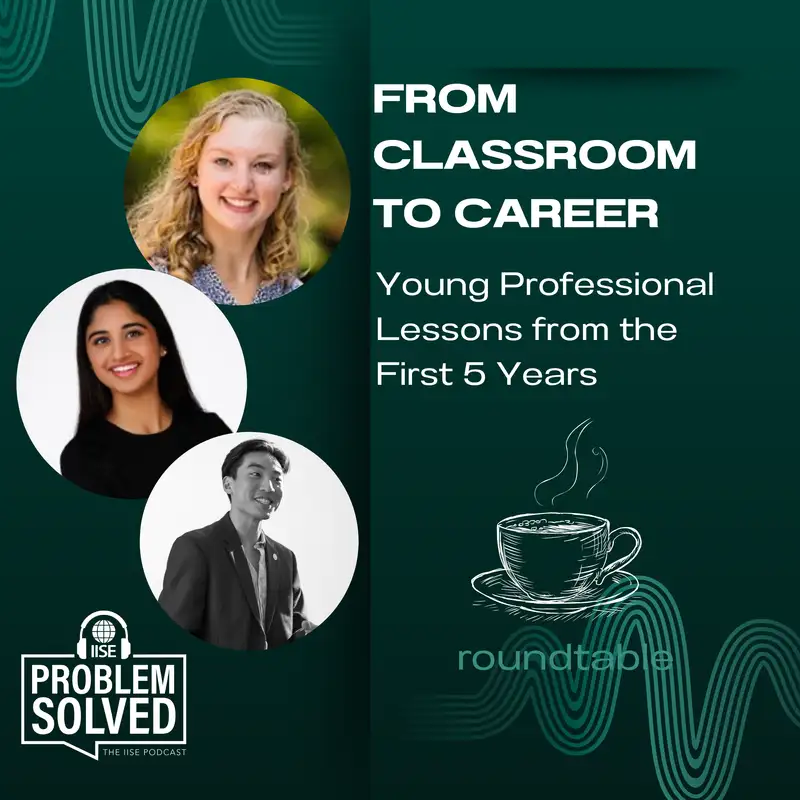
From Classroom to Career: Young Professional Lessons from the First 5 years
Download MP3Are you looking to sharpen your
skills, boost productivity, or
take your career to the next level?
The IISE Training Center offers
world-class professional development
built for busy engineers,
managers, and problem solvers.
Whether you're diving into analytics,
earning a Lean Six Sigma certification,
or exploring supply chain logistics,
our expert led courses deliver
practical tools with real results,
learn online or in person with options
tailored to every career stage.
Plus our training works.
Past participants have applied their
knowledge to save their companies over
$250 million in real world projects
and 90% of Lean six Sigma candidates
pass their exam on the first try.
Visit iise.org/training to explore
the full course catalog and start
transforming your career today.
Here's the problem.
The transition from the classroom to
the workforce can be one of the most
disorienting phases of an industrial
and systems engineer's career.
One day you're confident in your
coursework, and the next you're
navigating unclear expectations, imposter
syndrome, new cities, new teams, and the
pressure to prove yourself all at once.
So what's the solution?
What actually helps
during those early years?
Is it technical skills,
confidence, knowing the right
people, or is it something you
only learn once you're in it?
In this episode of Problem
Solved, we are exploring what
really makes the difference.
During those pivotal first five years,
IISE, young professionals, Helen Secrest,
Gordon Quash, and Jessica Alula join us
to share what surprised them most, what
they wish they'd known sooner, and the
lessons that don't show up in a syllabus,
but shape careers in lasting ways.
So join us.
All right everyone.
Today we're doing a bit of a round table
discussion with some emerging leaders
from the IISE Young Professionals group.
It's really great to have all
three of you with us today, and I
would love to start by just having
each of you introduce yourself.
So Helen, would you mind starting us off?
Thank you, Elizabeth.
My name is Helen Siegrist.
I am a graduate from the Rochester
Institute of Technology studying
industrial systems engineering.
I now am a continuous improvement
engineer at Qualitrol Corporation in
Rochester, New York, and president
of IISE, young professionals.
All right, Jess.
Hi everyone.
My name is Jess Aujla.
I graduated from Virginia Tech class
of 2023 in ISC, and currently work
as a consultant at Alpine Consulting
Partners, which is a Virginia Tech alumni
founded firm, based in the DC area, and
currently serving as social media chair.
And then, vice president of IISE YP.
Yeah.
Awesome, Jess.
Thanks Elizabeth.
overall just like humbled to be,
part of this fantastic group.
As you know, we have
like social media leads.
We have the president of IISE YP, so
a lot of great resources for today
as I'm five years into my career.
I feel super old, but I feel like this
content that you all will listen to
today, we'll have a lot of refreshing
insights for even someone like me.
So.
My name is Gordon Quach.
I also studied at Virginia Tech.
Fantastic.
ISE program ranked six
undergrad ranked seventh grad.
As of this year, since
graduation, I worked mainly
on the analytics side of ISE.
So you'll see the three of us talk to how
our ISE careers undergrad has really spun
into diverse careers across industry.
But the coolest thing is that I'm
currently doing data analytics for
a go-to market and rev ops team.
What that basically means is that
I'm essentially applying a lot of
the cool ISE data and analytics
skillsets to a sales team.
So with that being said, I learned
a lot throughout my journey and
I'll pass it back to you, Elizabeth.
All right, great.
Well, I'm really excited to get into this.
So all three of you have made the leap
from student life into professional roles.
So let's start there and
talk about that first.
Big transition, that first year out
of school, it can kind of be a shock.
So what was that transition like?
What were some of the big challenges?
How did you get through it?
And let's just start with that discussion.
Awesome.
I can kick us off.
so I've been post-grad
about two years now.
and I think one of the hardest parts is
just maybe the, the loss of structure and
like roadmap that I think academics gives.
I think kindergarten through college,
there's a good roadmap there of like
what success looks like in academics
of getting good grades and like
learning concepts and all of this.
And, and success is very predefined
of like, you know, what it looks
like in an extracurricular.
Setting versus a classroom, so on.
and so I think moving away from that
to when you go full-time and making a
decision about your career and then having
a lot of conversations with mentors at
work of what does success mean here?
What does it mean to
challenge myself here?
what does it mean to like
roadmap my, my career here?
I think asking a lot of those questions
are, it's difficult because you haven't
been in that mindset before, maybe in
like short bursts through internships,
but, Just having to take on a, a
much more of a proactive role in your
professional development, your technical
development, and making sure that
you're doing your best to drive that.
I think, I'm sure that this is the
first of many times we'll mention this,
but mentorship plays a huge part here.
I think for me specifically.
at the firm I work in, super small
company, but, I leaned a lot on
people who were the class above me,
or two classes above because they
really understood what it was like to
be there day one and not understand
what was going on and not understand
what it's like to work full time.
So definitely lean on your resources
and, and, and see if there's people
that, you could ask those questions
to, that were maybe in, in a similar
position to what you were in.
And I'll, I'll build off of that as well.
Coming out.
I've been out of school
for about three years now.
I was very fortunate to have a co-op
experience and stay with that company as
a full-time job, but that's also where I
got into young professionals because I was
not as involved with IISE as a student.
As much as I wish I had, I had
a lot of other extracurriculars.
Now I look back and wish I had a
little bit more of that connection,
a bit more of that mentorship.
When I got into IISE and specifically
YP out of school, I was looking
for more industrial engineers who
were going through my position.
To Jess's point, professional
life is not as structured.
That's not how it is.
When you come into the professional
world, you have certain
tasks that need to get done.
You are responsible for accomplishing
them in some set of time.
You may have a week to do it.
You may have two weeks to do it.
You need to be able to manage your
time in order to accomplish that.
That comes with asking the right
questions and knowing who to ask.
I didn't know these things when I
came into professional experience.
I'm, I had a general idea because of
co-op experience, but I did not know
what questions to ask, who to ask.
That's when I got into
young professionals.
I worked with Carl Salvato, who was
the president at the time, and I
really started meeting other young
industrial engineers to better see
what experiences they were having.
And how their situations
could have compared to help
me develop my early career.
I love from just this first
conversation, Helen and Jess, you
have displayed how like ambitious a
lot of the young professionals are
at ISE and one of the themes I've
gathered as I was listening onto your
points was the power of community.
Whether it's the power of community
and your upperclassmen slash upper
colleagues all the way to, and that
was Justice Point all the way to
Helen's point about like leadership
showing the are the possibility.
One of the things I struggle with a
lot, even in my internship, so this
is really cool to hear if you're.
Current college student or grad
student is the individual aspect.
I think when to Jess's point about,
you know, structure, processes,
one of the things too is identity.
When you're a current student, you
know, like what you're doing, how
you contribute to class, what kind
of leader you wanna be in a club.
But when you go into the workplace,
there's a lot of factors they
just can't control, such as age
disparity, experience disparity.
Et cetera.
So a silly story I had was outta college.
I worked for this company
called Her and Associates.
I had two fantastic colleagues,
Peggy Timmer and Barbara Anderson,
who were essentially directors
and subject matter experts.
And when you come in like ambitiously
driven as 20 years old, it's super scary.
The ambition just turns off.
It's like, it's like, what do I do now?
But I think the thing that a lot
of early professionals can do right
outta college to define their purpose.
To be visible in a company
is to have a niche.
I had a mentor named Andrew
Samuelson, and he spoke to how.
You want to be the person that's
known for doing something.
So maybe just as the expert when it comes
to S-A-S-A-P, Hyperion implementation,
and if I ever need like a process
improvement expert, I can talk to Helen.
That's the person you wanna be.
But at the starting point, right at
college, start with something simple.
It could be just the person who
takes really good notes, the person
who sends out really good email
recaps, even the person who helps
put together really good data.
It helps you stand out, you show
value to your colleagues and it's
a really good way to get started.
That's really good advice.
And Helen, you said that you had
wished that you had been more
involved with IISE during school.
I was just wondering, does
anybody else have advice like
you wish that you had been?
Something else during college that
you could pass on to somebody now?
Yeah, definitely.
That's a really good question.
I think just being really aware of.
As you carry yourself through your
academic experiences, whether that's
professional organizations like IISE
or research labs, and then also to your
co-ops and your internships, so on.
Just being very aware of the fact
that you're building your network
that you're gonna lean on in the early
stages of your career, that's outside
of whatever company you end up with.
And so really thinking about who are
people that you can go to for mentorship.
Maybe there are careers that
you wanna aspire towards.
Maybe like, okay, in 15 years I wanna come
back and I wanna work in manufacturing.
Who are my three people
I'm gonna go talk to?
So just being very aware of that,
cataloging that, really leveraging
LinkedIn to, to stay in touch with those
people, I think is incredibly helpful
because sometimes it's hard to know
what your resources are at a company day
one, when you start your full-time job.
And that's where that network that
you built over your college career
can really come in and be helpful.
So,
so it sounds like you, you know,
you're entering the field, it's.
It's exciting, it's a
little bit confusing.
It's a little bit of figuring things out,
and then you get over that transition.
Maybe at this point you're, you kind of
start to adjust to the professional life.
maybe you start to feel like
you're contributing more.
You find your footing, you're
feeling a little bit more confident.
Do you find that there's
a conscious shift?
Like, okay, I'm getting my rhythm now.
I, I feel like I'm getting my footing,
is, is there a point where you're
feeling more confident and you feel
like you've, you've got it now?
I feel like there is a certain point
that you get that footing, and funnily
enough, I feel like it was when there
was a new person who joined the company
and I was responsible for training them
because now I'm the subject matter expert.
I've been there.
Long enough to be the point person
to train this person, share my
knowledge of either projects or
manufacturing cells or pro the products.
That was, I feel very pivotal because
now someone is looking toward me for
my mentorship and I am now looking out
for them answering their questions.
And it gave me a bit more of that
confidence boost because someone trusted
me with me and my knowledge to help
them develop and accomplish what other,
what, what work they had to do here.
Definitely agree with that.
I think had a very similar
experience, onboarding somebody.
and I, it's such a good confidence boost
because as I, at least in my experience
when going through it, I, I was terrified.
I was so scared.
I was so nervous to be
onboarding somebody.
But as I started, you start to realize,
you know, a lot more than you think,
you know, and so it's, it's a good
confidence boost of like you feel.
Good about the position that you're in and
the knowledge that you've built up and,
and I think also that mentorship bit, I
think makes it very kind of fulfilling,
at least for me, filled, filled a lot of
the buckets of, of what I was looking for.
Yeah.
This is a great question.
You pose to us, Elizabeth, because
how I see it is that to get a
understanding of your footing, you
needed to feed the imposter syndrome.
Like, oh, I'm not good enough.
I'm not ready for this role.
Am I ever gonna be at the
state of my career goals?
And I think what I've noticed
from myself and just talking
to these, awesome folks is the.
To get past imposter syndrome,
you wanna accelerate your ability
to contribute to your teams.
So Jess and Helen, they talked about
how fundamentally, when you onboard a
new person, that is a great opportunity
to showcase your knowledge, really
assess how much you know and how
much you don't know yet, even on day
one, you can start that contribution.
So for example, at the end of the day.
You can always teach
someone something new.
So in my roles as a data analyst,
even though I'm learning more
about how I can be the best in
my role, you can still teach.
So for example, let's say if
Jess and Helen are on my team,
and you two Elizabeth, we can
teach each other something new.
And by doing so, you kind of build up your
confidence of that, Hey, I have something
to contribute as team and overall, your
team can do something better and that's
why you're employed in the first place.
And I think that's such a quick win.
Again, it could be within your
first two years as you're getting
more footing, but always find
the opportunity to someone new.
Something that my teams have
done and try to maintain is every
week they could do a brown bag.
Like you could teach like, oh,
here's something I learned,
and you share it through email.
You could set time with folks.
Just a way to build that community,
to build that confidence, and then
of course, overcome non positive
syndrome that gives you that footing
and a company, but definitely love
the conversation we're having on this.
I wanted to ask you about,
imposter syndrome specifically.
Did y'all have some experience
with that yourselves?
Can you talk about that?
Helen is shaking her head yes.
Yes, definitely.
When I, I feel like it comes with the
first promotion, obviously you, someone
gets promoted because they've been
recognized for doing better, performing
at a level above their current role.
Now when you get promoted
to that next role.
You, you question, did
I really deserve this?
Am I this expectation?
It's much higher and I'm now
collaborating with with colleagues
who are also a much higher level, do I
really deserve to be in this position?
And that was a big challenge
for me at first because.
Communicating in a way.
You have to think about what
information they're looking for, and
it may not be exactly what you used
to report out if it was a day-to-day
task versus long-term projects.
You're looking at much higher level
business point of view financials.
And for a little while I really
struggled with fitting in,
but to Gordon's point earlier.
Everyone can learn something new and
that reassured me of I am the only one
who knows this, type this information.
And it may not be, I'm the only
one who knows anything about this.
There are 100% other people who have
background knowledge of this topic.
But to put it all into one person.
I at least am able to share that
knowledge with someone in a conversation.
I don't need to go pull that
other person from somewhere else.
I hold that knowledge and
can assist in whatever.
Situation is going on.
Yeah,
I think also just reminding yourself
that you may not have done it yet,
but you figured out harder things
before, so you can figure this out now.
has been really helpful.
'cause like yeah, the exact situations
that you deal with, like obviously
you haven't done it yet, you're
just starting your career off.
There's so many things to learn, so many
people to learn from, but like maybe you
remind yourself of like a senior design.
Challenge that you had and you're
like, how did I navigate that?
What are some things that were helpful,
like communication or like maybe I
was really good at like this conflict
resolution thing and kind of picking
things out that you've been really
good at in the past and thinking about
how to leverage them in this brand
new situation where nothing else is
constant, I think is really helpful too.
Mm-hmm.
I think overcoming imposter
syndrome really comes down to
a mental resiliency practice.
So, quick story, I had imposter syndrome
throughout my entire life, but the
worst was when I had my first co-op.
So here I am doing well in school,
student clubs, all that stuff, and
I'm coming into GE Aerospace and I'm
working with these two colleagues who
were probably respectively 75 and 80.
Retire that year, and I was so scared
to ask them questions because I was
nervous that they didn't think I was
capable of actually doing the job.
That I would imagine me like set 18
or 19 years old, standing up for my
seat, walking around the corner to
their cubicle and then rushing back to
my seat and pretending I had to get.
hand sanitizer like 10 times in a row.
It was ridiculous.
And you quickly learn that.
Again, it's a mental resiliency game.
And then over time, as Jess and Helen
talked to you, build that confidence up
and you know that you can contribute.
But I think it's also important to
remember first who you are, your problem
solver, your industrial engineer.
You can do great things,
but then also ultimately.
You are where you're supposed to
be, you are hired for a reason.
There was actually like a hiring
process that actually identified like,
oh, Jess, Helen, Elizabeth Gordon
are capable of doing X. You already
have that foundation of doing well.
Now you just have to showcase.
You're a learner.
You can contribute more and
that's part of the process.
So just be patient with it.
You'll get there.
Yeah.
Very good.
I have another story very, I'll keep
it very brief, but to go off of that,
when I was younger, I. Love the movie,
the Devil Wears Prada, and I convinced
myself that that is how the workplace was.
I had to get everything done as soon as
possible without asking any questions,
and I had to work so hard night and
day I come into my first co-op thinking
that's exactly how it's going to be.
It is very much not.
There is a much better
work life balance of.
You are still a human.
Yes.
Get your work done.
But it is not the devil worst product.
I
love that.
Yeah.
And actually you bring up a good point
because I wanted to ask you too, you
know, when you're in college and you're
learning these very academic principles,
you know, ISE related principles.
Everything is very academic.
And then you get into the workplace and
it's kind of you, you kind of come into
a more maybe underrated part of ISE,
which is human factors, and you have
to learn how to understand people and
communicate with people and build trust
with your team and things like that.
So how do you, how do
you learn those skills?
You know, that's a good point about
communication and building trust with the
team because when you're in engineering
or taking like STEM classes, you're
focused on the mathematical principles
and science that guides the foundation
of a stable solution, a stable system,
et cetera, and communication as much as.
We praise that iscs are the foundational
pillars of strong communicators.
It's an art that's probably
developed our life.
So another example, going back to
the GE Aerospace example, we were
leading our first Kaizen events and
I was just super excited, wanting
to make sure everyone's on board.
So I wrote this probably
like 10 page email.
I know that sounds ridiculous,
but how can Outlook have pages?
But I kid you not, it was probably
like a little manual at that point.
I kid you not, when we met, no one
read the dang email and I was so upset.
I was like, I need to go home.
I can't do this anymore.
All jokes aside, that was a great
example of, Hey, look, you have
the skills, you have the aptitude.
Can you actually convince people and
convey your ideas clearly and succinctly?
Luckily, I know CL like universities,
Paul, like Rochester and Virginia Tech,
they have technical communication courses.
So for example, at Virginia Tech,
we have Dr. Kathleen Harper who
teaches that, where students are
gaining that foundation of how to
communicate very clearly and succinctly
and guiding the best principles.
I would say for my career, it was a lot
of trial and error, and I'd recommend.
People taking the initiative to learn.
And the way you learn that is by reading
books or pod going through podcasts.
some personal recommendations are
nonviolent communications, crucial
communications as a strong book as well.
And there's so many podcasts where
you can just see the style and you
just start emulating, practicing.
That's the best part.
Communication is something
you can wield outside of work.
With your colleagues, like all
four of us right now communicating.
And then over time you get better.
But it is a discipline that you just have
to practice and once you start seeing
those patterns and habits you wanna
do, it just gets stronger over time.
Yeah.
There was a, a practice that
we did, so at our firm we have
like a analyst retreat for.
At the firm and a practice that we
do during then is all of us take this
business chemistry test from Deloitte,
which I highly recommend taking,
and it basically puts you in all
these situations of like, how do you
communicate, how do you lead on a team?
Do, are you somebody who takes notes?
Do you lead the discussion?
Like things like that.
And it.
Ends up with you getting this profile
of who you are in the workplace,
how you show up, and it gives you
a lot of really good tips on how to
interact with the other types of like
business chemistry like profiles.
and that was like really actionable
because we had a lot of people at our
firm that took that and then we're like,
oh, this, this is why like, my manager
and I have been talking about this.
This is why I got this feedback point.
This is what I can do to adjust it.
Or like, this is what I should
bring up in like a one-on-one.
and so that was.
Really helpful.
I definitely recommend it, especially
if you're in a role that's very like
external facing, very client facing.
You're in a lot of meetings.
Communication is kind of one of the
core things of what you do in your day.
The business chemistry test from
Deloitte, is a really, really helpful
resource for just getting to know
yourself better and also how to
navigate, coordinating with others.
Yeah.
Great.
I also wanted to ask you in this
stage, what role does IISE's YP play?
I can get started on that
one.
For me, IISE YP is very
big for networking.
I am very much a people person,
but I joined young professionals
because I wanted to meet other
young engineers who were going
through very similar situations.
They might have had certain challenges.
They were even talking about salary.
No one talked.
Salary is a very hidden topic, and when
I joined young professionals, I wanted to
better understand what I should be doing,
what I should know, whether it's around
a business, whether it's a certain skill.
Right now, AI is a very common skill.
How are people using it?
And now I really try to.
Share that love for young professionals
and young professional development
and personal development with other
people because I've loved it so much.
We have a lot of people who graduate
college and go somewhere else in the
country or even out of the country.
My goal for young professionals,
and I share this with everyone
who has been on it, is to.
Connect them with other IASE members if
and when they do move around the country.
We have started bringing on regional
young professionals who will
communicate if someone is moving
from, let's say, Virginia to Colorado.
To ensure that we can still maintain
that connection with them and then they
can also maintain connection with IISE.
It's really ma keeping everyone
involved and keeping that relationship.
'cause it's, I mean,
it's a great community.
Everyone is super friendly.
We're like-minded speaking for at least
the three of us, four of us great people.
So we wanna, we wanna keep
everyone involved and.
That's, that's the biggest thing for
me with, with young professionals.
I of course wanna develop professionally.
I wanna develop others professionally.
Yeah.
Well, let's talk about that
then, 'cause it kind of leads us
into our next, our next segment.
Now that, you know, we've maybe found
our footing, the next hurdle is growth.
So let's talk about that next transition.
how do you keep the momentum going
and kind of turn your mindset
toward, A long-term career.
I think like this comes up like I
feel like at the IISE conference
so often, but this concept of like
personal brand, who do you wanna be?
How do you wanna be known in,
in your workplace, whether it's
your industry or your company
specifically, whatever it may be.
I think one of the best kind of, groupings
to fall into at the beginning of your
career is somebody who gets stuff done.
Like you wanna be somebody who's curious.
You wanna be somebody who gets
in, gets out, delivers good work.
And like clearly communicates through
all of that and is very invested
in, in, in the rest of their teams.
And I feel like that's such
an easy role to fall into.
'cause it doesn't necessarily require
technical expertise, it just requires
you showing up to the table and being
part of conversation, part of delivery.
And then slowly with that, I feel like
a lot of those additional things that
you build later in your career, like
the technical expertise, eventually
becoming a subject matter expert,
getting promoted, climbing up that.
Like career ladder, all of
that I think comes with it.
So once you show up at the table and
you're like willing to participate and
like, you know, that you wanna help
lead those discussions and, and, and be
a very proactive member of your team,
I think that really sets the tone,
for the rest of your career, whether
it's at that company specifically,
or, or your, in your into industry.
And Jess brings up a really good point
showing up, but Gordon, you brought
up the point earlier of communication.
If you can show up to the
table, get your work done.
And communicate, even if
it's asking questions.
One of my weaknesses when I was
coming early into my career and even
now is not asking enough questions.
I, I get really excited about
going to solve a problem.
I wanna get my hands dirty.
But it is so important to ask all
of the, even if like asking the
right questions, how do you know
it is the right question until.
You have the answer, there might
be some questions that really
are for navigating, and I think
being able to ask the questions to
communicate to others are also huge.
In addition to showing up to the table,
do you have any examples of
like what the right questions
might be for somebody listening?
One of the, my favorite questions
that I've started asking more recently
is, what is the success, the success
criteria, if I can, taking one from
the seven habits of a highly effective
person, beginning with the end in mind.
If I can begin with the end in mind,
I know what the expected outcome is.
I can better form what tasks I'm going
to do and who, if I need help with it,
who I'm going to assign to tasks if
I need to pull in any reinforcements.
But asking what the success criteria
is has been really pivotal for me.
And I just wanna emphasize for
the listeners, Helen said, like,
what does success mean for you?
And that's such a cool point because
the whole point of this segment
is talking about, now that we're
having a footing in our careers,
how do we discover what's next?
And one, there are two ways.
So this is actually a
great interview question.
Like how does su, how does
the measure of success.
Occur here at this company because
for some companies you're measured by
the amount of things you're selling.
So for example, if you're working
as a sales engineer, you're expected
to hit a certain quota like $10,000,
if not like multimillion dollars.
Does that stress you out?
Can you, do you believe that
you can actually achieve that?
Other companies, they do
utilization billability.
This is very common for consulting,
and you have to realize like what
does that metric mean can actually
succeed in that because that actually
determines and helps you establish that
sense of career stability and so forth.
But that's very underrated.
We also, we often think
of career chapters.
Compensation, et cetera.
But just wanted to hit on that.
Fundamentally understanding how you're
measured to succeed at a company is key.
'cause that also impacts your
promotion and other factors as well.
Another thing I wanna hit on before we
wrap up this section is talking about
how we talk about a lot of resumes, often
different technologies at the master.
I think a underrated aspect of your
career discovery and journey is just
understanding what energizes you.
So for example.
You could be an industrial engineer
at a manufacturing plant and you
do a lot of different projects.
You do five s, you do continuous
improvement, you do data analytics.
You maybe like lead events, but
maybe let's say you are someone who
doesn't like public speaking as as
much and you enjoy doing that capacity
modeling, that simulation simul.
You might wanna focus on that instead.
It's actually more empowering and
when you like to do something,
you're energized in doing it.
You're more self-driven to learn more.
And with the changing markets and
landscape, it's very important for
you to be a self-driven individual.
And of course, as you're navigating the
job market, understand what areas of.
Each company is measuring by to understand
how you can proceed in that company
and e even if it's yours at the moment.
Yeah.
what always surprises me, just as a
non-industrial systems engineer myself,
but what always surprises me is just how
many industries ISC covers and really
kind of like the world is your oyster.
And we just did a podcast recently with,
a guest, Dr. Joe Wilke, and one of the
things that he said was, in your career.
Stay open even, even later in your career.
Stay open to industries.
don't close yourself off even
if you think, oh, I would never
live in that part of the country.
Oh, I would never wanna work
in that kind of company.
Like, just stay open to it.
'cause you never know, like what might
be there for you later on down the line.
So that might be something
to think about too.
Definitely.
And to add to that, I think.
Of the best parts and maybe sometimes
the hardest part about ISE is we
can do anything and everything.
And so that's where I, I'll
give another shout out to yp.
I'll give another shout out to
the student chapters of ISE.
That's where they become so important
to leverage your networks because.
If you can do anything and
everything, who defines that?
Who can you look towards for
inspiration and what are mentors?
And so leveraging all of those
connection points and like, okay,
like this is somebody I know who
had a 20 year career that spanned
aerospace all the way to manufacturing.
Let me go figure out what that
career trajectory looked like.
Are there things that I
liked that I didn't like?
Is that gonna inspire
like my next job search?
So being very proactive on that because.
You're, when you're a career,
it's like a, what is it?
Like a, a marathon, not a sprint.
Like you never know where
you're gonna end up.
So being again, open-minded, right?
and I think the networking
part is a huge part of that.
So yeah,
definitely.
Let's leave our listeners with some
great advice that, you know, you
wish that you would've had early on.
And, let's see what you got here.
I have a couple of pieces of advice.
I, at least from my personal
experience, was afraid to ask questions.
Never be afraid to ask questions.
You can ask a hundred
questions if you don't.
If you have not gone the answer, then
you have not asked enough questions.
If we follow the same, the IASE
model of your five why's, if you
have not gotten to the root cause,
you have not asked why enough.
So that is my number one piece of advice.
My second piece, and.
I say this because this is exactly
the reason I got into young
professionals and have stayed with it.
Connect with as many people as you can.
It's not just connecting on LinkedIn
because they present it at something and
you're interested in their knowledge.
That's huge.
That's great.
You can follow their material, but
you never know at what point you
want to look into some other field.
If I wanted to talk to
Jess about consulting.
We've made a great connection.
I have some other friends in other
fields that they've used industrial
engineering for and it's great to be
able to reach out to them, talk to
them, even if it's not about industrial
engineering or the professional life.
It's so much fun to meet new people
and have that network of Of friends.
Yeah.
I think my big one might be sign
up for things before you're ready.
you will learn a lot in
the uncomfortable zone.
going back to you're hired for a reason.
You have people in your corner
that are gonna support you.
Your managers, your mentors.
You're not gonna be set up for failure.
Raise your hand before you think
you're ready because it will position
you very, very well in your career.
For folks who aren't watching.
I was like taking notes on these too.
I'm, I deeply reflect on these
throughout my career, but the
advice I'd like to leave you on is
simply don't be a people pleaser.
And if you aren't one,
you know one for sure.
The quote that my sister and I resonate
all the time is whatever you're saying yes
to, you're saying no to something else.
And that usually no to
something else is yourself.
So I'll give you a quick example,
and this usually stems from people
who are trying to be ambitious, but
also trying to make sure that the
people they care about are satisfied.
So when I started at one of my
previous manufacturing companies,
I wanted to get the ball rolling,
contribute as much as possible.
So I signed up for almost every
single thing possible, and it was
kind of cool, like I would give.
Good updates to my leadership
about how much I'm contributing.
But then first, a lot of these
projects weren't mentally
stimulating towards my career goals.
But then second, as there were
more opportunities to sign up to
actually contribute or to grow your
career as just noted out, I wasn't
able to sign up for them because I
had no longer the luxury of time.
But then it became disappointing
because then if you had to drop a
project, you're actually letting
someone down at that point.
So.
The brilliance of what you
see throughout leadership.
So in this podcast series we talked about
how we started off as early young careers
all the way to more mid-level career.
You'll start seeing your colleagues
or leadership, one of their most.
One of their greatest superpowers is
the ability to aggressively prioritize.
They know what drives value.
They know what's important to them.
They know what's
important to other people.
And when you're able to
prioritize and then negotiate.
Solutions for your colleagues about, Hey,
I can't get to this now, but maybe in the
future I'll help you out and so forth.
You're respectful as the boundaries.
You're not letting people down, but
you're still able to really make
sure that your needs, your colleagues
needs, and what's really prioritized
in your career and your team is met.
So just always remember, don't be a people
pleaser, and whatever you're saying yes
to, you're saying no to something else.
Excellent.
Very good advice.
All right, well, where can our listeners
who are interested in getting involved
in IISE, young Professionals, where can
they find more information about this?
We have a LinkedIn page.
IISE, young professionals, so
you can follow us right there.
And we are also on the IISE website
and those, sites will be linked in our
show notes where you can find those.
Alright, you guys, well, I wanna just say
thank you so much for this conversation.
It was honest, it was.
Energizing, and it was very, very wise.
So, Helen, Jessica, and
Gordon, thank you all so much.
I know that our listeners appreciate
it and I know that I did too.
So thank you all.
Yeah, thanks y'all.
Thank you for
having us.
Thank you so much.
All right.
A huge thank you to Helen Siegrist,
Gordon Quach and Jessica Aujla for such
an honest and thoughtful conversation.
And thanks to our listeners.
If you're looking for community
mentorship, leadership opportunities,
or simply a place to connect with
others who understand this stage of your
career, we encourage you to explore.
IISE Young professionals, you'll find
links and resources in the show notes.
Thanks for listening to Problem Solved.
Every great solution is
a story worth telling.