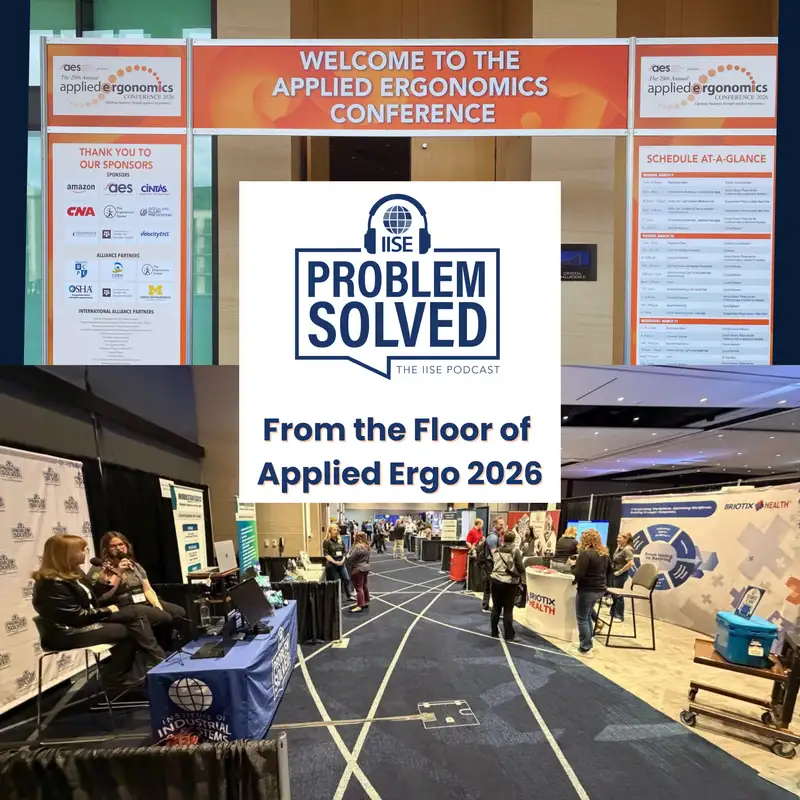
From the Floor of Applied Ergo 2026
Download MP3At the Applied Ergonomics Conference,
you'll find engineers,
safety professionals, students
and leaders from across industries
all focused on one thing
improving the way people work.
But what makes this conference unique
isn't just the technology
or the solutions, it's
the people behind them.
Their ideas, innovative solutions,
and their shared goal of making work safer
and more efficient.
In this episode of Problem Solved,
we're taking you on to the floor
of the Applied Ergonomics Conference 2026,
where we had a front row
seat to exhibitors,
keynote speeches, and Ergo Cup teams.
We hear different viewpoints
from conversations with attendees.
We explore what's changing and ergonomics,
what's being built,
and why this work matters.
At its core,
ergonomics
isn't all about tools or technology.
It's about people and what work feels like
at the end of the day,
whether someone can go home
the same way they came in.
I'm Justin from Denver.
I'm a I'm with Ford.
The, parts department.
So we pick the parts,
and we ship them off to dealers.
So we have a lot of cars that are heavy,
a lot of parts that we pick,
a lot of small parts, big parts, boxes
that are odd.
So we kind of look what's new on, on
how we can make our job safer.
So we go home.
The way we came
in. There’s a lot of the exhibitors
that have been here before, and,
and they've come up with new things
of that we can implement
or we can try out, through the warehouse.
Awesome.
I'm Doctor Joe Michels.
I'm the executive managing director
at Solomon Bruce
Consulting in Fort Worth, Texas, 44 years
as a IISE member, and I was made a fellow
a couple of years ago.
Excellent.
And what brings you to the conference
today?
We were short of volunteers
here for the conference,
and Donna Calvert called and said, Joe,
I need you to come help.
I said, I would love to come help.
What excites you most about,
industrial systems engineering in general.
With the people you work with
and the challenges and the opportunities
to be able to improve life
for human beings.
Perfect. Thank you. Perfect.
Thank you.
At applied, ergo, you quickly realize
you're not alone in that mission.
This is a community made up of people
from completely different
backgrounds, all coming
together around a shared purpose.
Whether this is your fifth time
at Applied Ergo or your first.
My name is Abby McCoy.
I work with Delta Airlines.
I'm based in Atlanta, Georgia.
I am a program manager
for health, wellness and ergonomics.
How has your experience been so far?
It has been very eye opening.
I didn't really know what to expect
when I came in, but I know we're all here
for one purpose of ergonomics
and safety in general, but for the vast
majority of backgrounds
and people's education and involvement
levels was very eye opening and great
to see those different perspective.
Have you seen anything so far
that you can take back with you?
A lot of really great conversations
working with people of different
generations,
building a program from the start
to finish,
like the different pieces that go into it,
and then meeting
great people of very diverse backgrounds.
My name is Nolan on that.
I am an industrial engineering student
at UT Arlington.
I'm here volunteering today,
and I just wanted to get involved with
these great IISE conferences, and I love
seeing everything that's going on.
I mean, there's robotics,
there's ergonomics, there's there's work.
I mean, there's everything here.
Next we hear from Maddie and Maya
and their friend Eileen, a skeletal spine
with a surprisingly strong presence
at the conference.
And yes, Eileen, as in, I - lean.
Are we introducing ourselves?
I’ll say, this is Eileen.
Eileen’s here.
You should definitely do that. Okay.
And here's why they
And she keeps coming back to applied ergo.
Hi, my name is Maya Peleg.
I am the global ergonomic engineer
for Copeland.
I am a co-chair for the work committee,
and I am a networking co-chair
for the conference.
My name is Maddie.
I'm an associate. Ergonomics
at human scale.
I co-chair the work committee with Maya,
and I also have the pleasure
of sitting on the Applied
Ergonomics Society board of directors.
And this is Eileen.
She's a little quiet today.
It's a lot of people around us, see, but,
she's working on it.
Okay.
What brings you guys to the conference?
I love coming to the conference.
I come every single year.
Just being around a group of people
that share the same passion for ergonomics
that I do is very refreshing.
Seeing all the Ergo Cup teams
and all the solutions are.
It's just a great experience
and great to see all the creativity
and see some old friends.
Yeah, I would just echo that.
I think the conversations that we have
here at the conference really are special.
It's rare that I think
we get to have these
passionate conversations with people
who are just as passionate as us.
And yeah, sometimes you make some
great friends along the way.
Eileen is I'm saying this now.
You've heard it here first.
Eileen is going to be the mascot
for the Applied Ergonomics Society.
So at the conference and you'll see
shortly we'll have some videos coming up,
interviewing some of our conference
attendees here who,
will meet Eileen as well.
And answering some fun little questions.
So that's just some part of what we do
at the work committee.
We also host lots of different events.
We have a discord to check out for,
so keep an eye out for those things.
And when you bring
all of those perspectives together,
something interesting happens.
People start
seeing their own work differently,
sometimes in really simple yet
brilliant ways.
This is Jena Peterson, an RN.
She's the medical professional on PPG’s Ergo
Cup team “Container Tugger Modification.”
Yeah, it's a lot to learn.
It's, especially as a nurse because
I normally see the after effects. Yes.
So what I've taken away
mostly from this conference.
What I've enjoyed the most is seeing it,
seeing the modifications
that they've made or the changes
that they've made and being like, oh, duh,
that makes so much sense. Yeah.
How long were you doing it
that really dumb way?
What a great idea!
Jena and the PPG team
at the end of the conference took home
an Ergo Excellence win
in the category of Business Impact / ROI.
Thank you for having me.
My name is Kristine Dungo.
I am the corporate engineer for,
specifically ergonomics engineer
at Cintas Corporation.
I am also the Applied Ergonomics Society,
president for this coming year.
So very excited for that.
And we are here
at the very first night of AEC
and we're sitting in the exhibit hall.
So what are you most excited about
for the conference this year?
I'm always excited to come.
Every year
I get to learn from all of these people.
My favorite part is the competition.
You get to see people from all different
companies create the simplest things
to the most complex things, and
you really get to learn from each other.
And I think that's what it's all about,
is really getting together with people
who have the same interest of
making the workplace better for everyone.
What do you think is one of the biggest
challenges facing ergonomics right now?
Things are moving pretty quick,
and I think when you think of advancements
for any type of whether it's technology
and anything like that, I think, there's
so many things out there and it's trying
to digest everything all at once.
And I think the applied ergonomics
Conference is the best way to go,
because there are so many places
and people to meet and learn from,
and they have all these different types
of learning sessions that you can actually
learn all of the different advancements
or just getting your program just started.
It's it's
an awesome place to be right now.
Cintas was an Ergo Cup winner
for Focused Workplace Solutions:
Manual Material
Handling Tasks for the “Trolley Tugger.”
Of course, many of the solutions
being discussed here are driven
by advances in technology,
AI, wearables and new tools
that are changing how we understand
risk and design better systems.
Julia Abate is not only an IISE fellow,
but representing the Ergonomics Center
at NC state,
a sponsor of this year's conference
and an organization that helps businesses
build those better systems.
Welcome to Problems Solved.
Can you introduce yourself?
I'm Julia Abate,
and I am the executive director
at their economic center at NC state.
Good. Great.
And let's see.
You are a pretty recent.
IISE fellow.
a long time
IISE member.
So what does that
recognition meant to you, and
how does that all play in with ergonomics?
What does that mean
for the future of ergonomics and IISE?
Well, the fellows are very recent
and as I was going through that process,
I did find out that there aren't
that many folks
within the ergonomics world
that have the IISE fellow.
So I've made it a little bit of my mission
to promote that within,
this organization or this
I should say, world
and, try and see how many folks we can get
in the ergonomics world to become
IISE fellows. Great.
NC state, we are an extension of NC state,
so we are housed in the industrial systems
engineering there,
but we are actually an extension
of the university
in that we work
mostly with companies out in the world.
Okay.
So we work with them to help them
develop their programs,
and ergonomics, training, analysis,
whatever they might need.
Kind of meet them where they're at
and then help them get where they want
to go within the ergonomics world.
Okay. Interesting.
So when companies come to you,
do you find that
companies are coming to you more and more
with like a certain problem
that you're seeing,
like kind of like a trend
that they're coming to
you asking to help solve there.
So there's typically two major places
that they come.
It's either when they're seeing an issue,
they've had injuries in an area
and they need help addressing it.
So we'll go out there
and and do an analysis
and give them some recommendations
for controls
and see if we can help them
solve that problem.
And then you have some companies
that are actually being very proactive.
So they're forming ergonomics teams.
They're working on developing
and growing their program.
And they work with us.
We do some coaching of their team,
some training, and can become long
term partners
to help them maintaining and grow,
their program into a culture, basically.
Oh, interesting. Okay.
So being in this field for a while now,
how has it changed?
Like maybe in the last maybe five years?
What does it look like five years ago
compared to now?
Definitely.
You know,
everyone talks about AI and that has
definitely been the technology side
between exoskeletons and wearables,
computer vision systems.
I think that
there's a lot of different products
and things out there that people can use.
I just always tell people, you know,
make sure you're doing your research,
talk to folks who are out there using it,
find out what their pain points are
to don't reinvent the wheel. There's
so many people out there implementing it.
Learn from the folks who are.
And make sure that you're
using the right product for your process.
Because not
every product is matched to that process.
But there's probably something out there
that will work for you. Okay.
VelocityEHS, another sponsor.
This conversation is focusing in
on a part of the body
that is often
overlooked by many ergonomists.
This is Rachel. So my name is Rachel Zoky.
I am a certified professional
with Velocity EHS,
and I am our product manager
for our ergonomics solutions.
So VelocityEHS,
we are a software as a service company
and we have a suite of softwares
ranging from chemical management,
safety industrial hygiene
and then obviously ergonomics.
And we've got an article coming out in ISE
magazine shortly.
And can you talk a little bit
about that article.
Yeah.
So that article was kind of prompted
by a new solution that we are going
to have coming out later this year,
which is about hands and wrist models.
So really what that is focusing in on
is the fact that
in ergonomics, it's
very easy for us to focus on back risk.
And, you know,
there's kind of large body areas.
They're highlighted in a lot of data.
They're easily discernible
in a lot of whole body ergonomics models.
But then you run into problems
with certain industries, you know,
such as like pharmaceuticals and things
where they work on very small things.
Yeah.
And those large models,
you kind of lose the hands
in those large, overall body models.
Whereas what our tool,
our new tool, is hoping to do
is kind of focus in on the hands
specifically and understand,
yes, we can still look at the whole body,
but we want to make sure we don't lose
sight of the hands.
So what I kind of
highlight in that article
is something it's a personal story for me.
You know, if you've hurt your back,
you've been through that.
Yes. It's it's a problem.
We want to address that, of course.
But you can still live your life
to some extent.
You know, you can still sit on the couch,
you can read.
There's a lot of things you can still do
if you lose your hands,
if you lose the functionality
because of carpal tunnel, or you lose grip
strength, things like that.
There's not a lot of things you can do
just in daily life.
You know,
my mom went through that personally,
and it was very hard on her mentally,
emotionally.
You know, she spent a whole summer with,
you know, carpal tunnel in both hands.
And that really,
really hindered her quality of life.
So the AI tool that we are promoting
and that we are working
on, releasing is basically to help
companies really understand the risk that
their operators are under for their hands
and not lose sight of that.
Can you talk. A little bit.
More about how that tool helps?
Yeah.
So it's motion capture
very similar to our whole body
model,
but it's focusing in on just the hands.
And then it uses the composite
strain index and the duet tool to actually
take the postures and the forces
frequency, all of those risk factors,
that the AI identifies and then runs it
through those two professional ergonomic
ergonomics tools
so that you have risk ratings for that.
You can, you know, use just like you use
all your other risk ratings.
So you have the red, yellow, green
that everyone's familiar with.
And you can prioritize and use that
as data for data driven decision making.
Okay. Fascinating. Yeah.
But even with all that innovation,
one thing became very clear
having the right solution
isn't always enough.
You have to be able to implement
that solution.
I spoke to Kristianne after that morning's
keynote speaker, Mark Benden.
Can you introduced yourself?
Yeah. My name is Kristianne Egbert.
I work with Briotix Health,
and I'm our senior corporate analyst.
I am doing the, beyond the data,
the soft skills of ergonomics.
So I came up with this idea.
I've been doing a lot of our ergo
launches, you know, going out and helping
safety teams, ergo, teams
learn how to implement
ergonomics programs,
and I can teach them the skills.
Okay, here's how you do, risk assessment.
Here's how you come up with solutions
kind of walking them through that.
But the soft skills, I realized was not
something that everybody had.
So I, you know, I go out, I have that
watch me do a risk
assessment first and collect the data
and talk to the operators.
And then when it was their turn to go out
and do it, they were kind of like,
what do I say?
I'm not sure where to start.
Well, these are your friends.
You've worked with them for 20 years
and they're like, yeah, but what do I say?
And they were a little stuck
with kind of where to go from there.
So there's kind of that side of it.
And then the other side of it was,
oh yeah, we implemented these solutions,
but it's sitting in the corner.
Nobody's using it.
Did you get a chance to watch the.
Keynote this. Morning?
I did, he was amazing.
Yeah I actually related a lot to that.
Just kind of being probably the kid
that was looking for
the looking for the things to do
and looking at those improvements.
I remember as a kid, my dad was
we like to go on canoe trips and say,
oh, I don't I don't know why.
I don't think we're going to be able
to carry another canoe.
And I'm like, well, what if you made one
that the cross pieces come off
and it fits over the top and he's like,
yeah, okay, I think we can do that.
And we did.
And from a young age, he was like,
you should be an engineer.
No, I don't want to do that.
I want to work with people
figured out a way to do both. Oh that’s awesome.
So yeah. Yeah.
At the end of the day, the most effective
solutions don't come from data or models.
They come from the people actually
doing the work.
Incoming chair of the conference,
Lisa Brooks.
Hi, I'm Lisa Brooks.
I am a principal at Nexus HSE
and I am making the connection
between HOP human and organizational
performance and ergonomics.
So really trying to,
motivate those in the ergonomics
and human factors
community to become involved
in their organizations HOP journey.
Because we are as ergonomics
and human factors practitioners,
we are uniquely skilled
and qualified to really help advance,
the, the, the HOP journey
of the different companies.
Okay.
Top human and organizational performance
is really changing,
the landscape of safety
and operational excellence in industry.
So, I want to make sure that,
the ergonomics are part of it
and leading it and,
helping shape it
because we have, a lot unique to offer.
And with it changing so differently,
what do you think it's going to look like
in the next couple of years?
You know, all this renaissance
that's happening in health and safety
in really operational excellence
has brought in a better appreciation
and value for the voice of the worker,
understanding that the workers have,
some unique are called
operational intelligence.
So intelligence about how work gets done
that no one else has.
And they have it because you only can
acquire it through doing work.
Yeah.
So and as ergonomics, we've known that
a whole careers, we've always appreciated
the knowledge that workers have,
the unique things they have to
do, adaptions they have to make
to figure out how to get work done.
Because with the best planning,
with the best
oversight, work is always
dynamic, is always changing.
So and workers find a way to get work done
despite how it gets presented to them.
Nowhere is that more visible
than in the Ergo Cup competition,
where teams from across industries
bring real world
problems and the solutions
they've built to solve them again.
Lisa Brooks My favorite part
of the conference every year is the Ergo
Cup team.
Yeah,
it is so energizing talking to the Ergo
Cup teams, having them
tell their story and to see their energy.
Some of these people have never been
to conferences.
They certainly many of them
have never presented before.
And to and they were part of making
a difference in their plant and had to
to get to listen to them tell their story
and the energy and the passion they have.
It's it's amazing.
That's great.
So I'm Virgil Watson, I'm here
with Lockheed Martin for the Ergo Cup
competition.
We are here to present
a, a Bora scope tool.
So if you need to look into something
that's really long and narrow and dark,
you can use a bora scope.
Think of a straw.
Okay. That goes on a helicopter blade.
So really long.
Really important to inspect.
And we used up really cool
tools, pole mounted, pan tilt cameras.
But it was ergonomically a nightmare.
So constantly I think of, like, a pool.
Like when you scoop out your pool,
you have to, like,
extend the telescoping pole
and they have to tighten it up.
You have to do that over and over again.
And the pole as it extends
in, it's all cantilevered.
So it it sways.
So you have to wait for the picture
to be still so you can inspect it.
And so it took, the inspector 16 hours
to do one of these inspections.
And by the end of the first day
back was hurting.
Doing this for 16 hours is not good.
And we brainstormed like,
what would you want?
And some of the things
that she pointed out is
because this took 16 hours,
you need logical breaking spots.
So don't just do a camera because you're
going to have to go to lunch,
you're going to come back
and remember where you were.
So we made a sled with channels
so you could inspect the first channel
and then take a break,
go do another inspection,
come back to it, know where you left off.
And she said, you know, be really cool
if we could design one tool.
So we took what we were thinking
might be two tools, put it all into one.
It looked like it was going to work.
Some of the work that I do is
with, machine vision and AI system
and those you're
always focused on getting the best image,
you know, the lighting and the optics,
because the computer
can't, can't strain at its eyes
or move over to the left or right.
You're stuck with what you've got.
We 3D printed a model. It worked.
And so we were able to make a couple
of working models that are pretty,
pretty strong.
And, the inspection that was, you know,
initially was 16 hours.
Now it's two hours
and it doesn't hurt to do it.
It's easy. It's fascinating.
Yeah, it's pretty cool.
It's amazing. Well,
good luck to your team.
Thanks.
That team did take home
the Ergo cap for New Product or New Job
Design Solutions for “Heavy Lift Rotary
Wing Aircraft for Scope Lighting Sled.”
Hi, I'm
David Clardy, I'm a maintenance manager
at the US10 Michelin facility
in Anderson, South Carolina.
We make giant mining tires at our facility
and we are here with a team
competing in the Ergo Cup.
This is our fourth year in a row,
so we make giant mining
tires, 12 to 13ft tall tires
that weigh 4 to 5 metric tons.
So with giant tires, we have giant
equipment to build these tires.
Our problem resolved around at the top
of one of our assemblies, 22ft in the air.
We had a shaft that would break.
There was some flexing to the shaft,
and with collaboration
between our reliability
and maintenance teams,
we came up with a solution
to be able to add in a new bearing
in the center of the shaft,
and then an adjustable mount
that was able to completely solve
that risk.
We also took it a step further and made it
to where the whole assembly is modular.
So instead of having to repair
this assembly at 22ft in the air,
we're able to repair it
at the ground level.
What does it feel like
to be part of this competition?
Oh, we love coming
to the AEC Ergo Cup
and being part of this competition again.
We end up building camaraderie
with the other competitor.
It's not like us against them,
but it's about what all of these 40
something teams that have come together
in the competition, part of the ROI
that we feel that we as a team
bring back to our plant
is we'll grab it, we'll get a brochure
from all the competitors,
and we'll build these three ring binders
and place them in different break rooms,
and we'll tell operators, maintenance
teams, engineers, quality teams
as your as you're taking a break, thumb
through these brochures.
See what kind of ideas other teams have
taken a problem came up with a solution.
What can we do to manipulate that
a little bit?
Still with pride,
and come up with additional solutions from
what others
have made progress in at our own facility.
Behind the
scenes, judges are evaluating
not just technical solutions,
but the impact, the collaboration
and the stories behind them.
My name is doctor Rose Figueroa, CHFP.
And what's the organization
that you're with?
Well, I'm here, of course, different hats,
but I'm here
representing BCPE as the president
of the board of directors.
I'm actually also part of.
Human Factors and Ergonomics Society
of the Executive Council.
So here we're presenting and giving
a shout out of course, and allied for ISE.
And then I'd Rimkus
I'm a consultant as well.
I saw you're wearing a ribbon
that says your ergo cup judge, correct?
Yes. I mean, like usual by far, the.
Ergo cup is the most interesting thing.
And we look always looking forward.
And I am blessed, being,
you know, part of the Ergo Cup judges.
So I get to, to see the fun
also behind the scenes, which.
Is pretty good. Done
judging before at their go cup.
Yes, that would be my second year.
What's the judge hearings
like? It's really. Fulfilling.
It's nice, I must admit, is really cool
to see the different groups.
All the work that they have done
that they need to accomplish, like just
by being here, they already have to pass
on certain levels, and that they now get.
To show will show their work.
The operators,
maintenance folks meet people that are not
necessarily from that ergonomics team.
I think it's a pretty sweet thing.
Unique for,
you know, this this. Conference.
From the exhibit hall to the Ergo
Cup stage.
One theme kept coming up again. And again.
This work matters.
Small improvements make a big difference.
Big innovations
transform entire processes.
It's like exciting, right? It's like you.
You do these little things
and it's like this doesn't make an impact.
It's like nursing, right?
Where it's like you just don't feel
you do the same things every day, right?
And it's like, well,
just going through the motions.
And then you.
Come to something like this
and you get to see.
How beneficial your idea was.
And like other companies are like,
oh, we want to do that too.
And it like lights that spark back again.
And it's like,
oh yeah, that's why we do this.
Thanks for joining
us on this special episode of Problem
Solved from the floor of Applied
Ergo 2026.
Make sure you're subscribed
so you don't miss what's next.
Save the date for next year's
AEC 2027, in Atlanta.
March 22nd through 25th.
Every great solution
is a story worth telling.