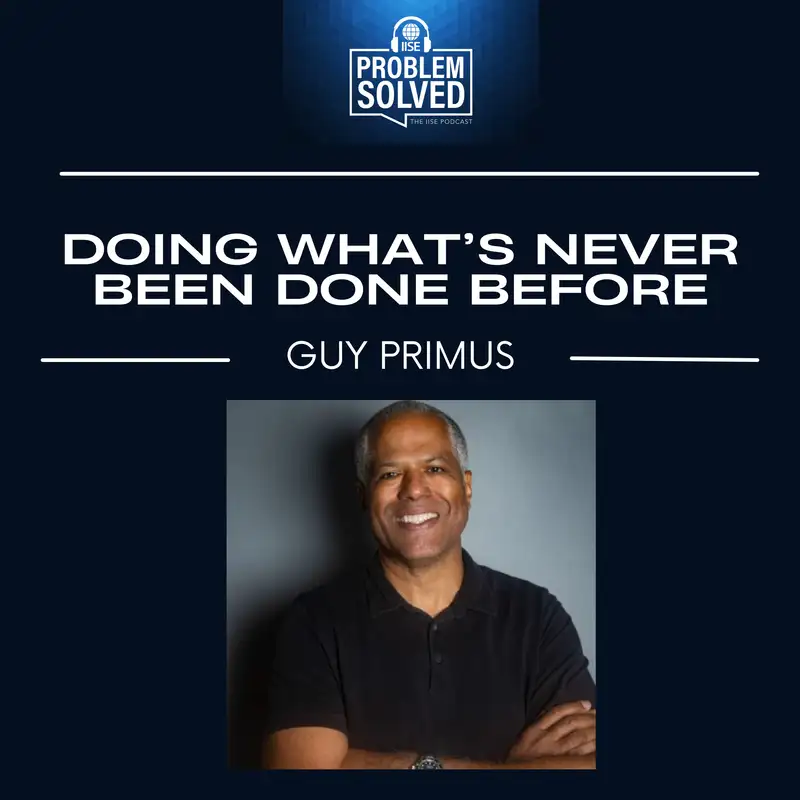
Guy Primus: Doing What's Never Been Done Before | Season 7 Premiere
Download MP3Our guest today has used
industrial engineering
to build a fascinating career
in entrepreneurship, technology
and storytelling.
Guy Primus began at Georgia Tech,
then on to Harvard Business School.
He's consulted at Kearney
and then went on to work with
some of the biggest names
in entertainment.
He helped shape
digital media strategy
at Microsoft,
Starbucks, and later
became the CEO
of The Virtual Reality Company
where he created
award winning immersive experiences
like The Martian
VR and Jurassic World VR expedition.
He's also a patent holder,
a startup advisor
and a current
managing partner of Thriller
Dome, where he helps
startups turn
storytelling and technology
into movements
beyond his work
in business and entertainment.
Guy is deeply committed to mentorship,
supporting African American entrepreneurs
and helping create pathways
for underrepresented talent.
He served on several advisory boards,
and he's a 2013
Captain of Industry
honoree from the Institute
of Industrial and Systems Engineers.
Guy Primus welcome to Problem Solved.
And thank you so much for being here.
It's great. Great to be here.
All right.
Well, as people can probably tell
from that intro,
you've led a very unique career
and a life
that does not follow a roadmap.
But when you look across all of it,
you've got industrial
engineering
technology, entertainment,
entrepreneurship, all of that.
What is the thread
that connects all of
that together for you?
For me it is.
I love technology, and so,
problem solving is the basis
and the foundation
for my interest in technology.
How do you,
solve problems
that haven't been solved before?
And that's what engineers do, right?
You know, so the problem
solving and the technology
are a foundation and a bedrock.
But I also.
How do I say this?
Probably introverted to a certain extent.
And communicated through content.
Right.
Whether it was television or music,
because it gave me a common
frame of reference to communicate.
And so as I've
matured in my personal
and professional life,
you know, that
that language of content and,
you know,
the creative industries
are a way for me to express myself
because I'm not
the most eloquent speaker.
And, you know, it's not what came.
And I found that that's common
for a lot of engineers. Right?
You know, we'd
rather be in the basement, right?
You know, or
as Doctor Gray said in the lab. Right.
You know, that
that's really where I reside.
And, you know, the the,
connection of content
allows me to express myself
in a way that is comfortable. Yeah.
So in all of the
worlds that you've been in,
or that you're in now,
where do you see,
like, the fingerprints
of industrial engineering the most now,
where you are?
Yeah,
I there's always a need for analysis.
Right. You know, and so,
the analysis, you know, most recently
of how AI is used to solve,
you know, kind of society's problems
or your day to day, you know, problems.
Again,
I would mention that you know, kind of
not the most,
direct communicators
kind of goes back to my, my previous,
where I was right
before you and I go, you know,
so I'm learning to communicate better.
I'll just say that.
But, you know,
so that, you know, for me,
it is the ability to analyze
and then communicate
is, you know, kind of where I think
industrial engineering
lives, where I thrive. Right?
You know, it's in spreadsheets.
And then being able to articulate
what's in that spreadsheet
in a narrative format, in a way
that is well understood
by people and can result
in the desired action, right?
Whatever that desired action is,
whatever the problem definition is.
And again, that's where,
you know,
hopefully in our discussion, I'm
going to say it now,
but I hope it comes up time
and time again.
Defining the problem
and really understanding
what is your objective function.
And you kind of
industrial engineering speak. Right.
You know, so
a lot of us
operate in the constraints, right?
I always try to understand
what is the objective function
and then solve the problem
based on that objective function.
And sometimes there isn't one,
you know, problem to be solved.
There's a series of little problems.
But if you roll it up,
what's the,
you know, kind of in business, right.
It's income.
Right?
It's not revenue, it's not expenses.
It's income.
My friends or private equity people,
they would say it's not even it's
not even income, right. It's valuation.
And so, you know,
how do you define that problem
and make sure you're
solving the right problem.
But that's where industrial
engineering thinking and systems
thinking comes in.
For me,
it's like it's all connected to
whatever that objective function is.
Is that what led you to
industrial engineering
in the first place?
That need to like,
define the problem and solve the problem?
No, no, I'll say this
I started off as a physics major.
I told the story.
You know, I apologize
for people that have heard it
before, but,
I started off as a physics major
because I wanted to be Amar Bose.
Like,
I wanted to create
speakers and loud systems,
loudspeakers and, auditoriums and really,
you know, have the sound be,
you know, it was in the, in the band
and everything when I was in high school.
And so sound to me
is really, really important.
Probably because I don't see that.
Well. Right.
I've been wearing contacts since.
Yeah, I remember being in third grade
and they had to move my desk
to the front of the room,
and then I was a catcher, my.
So I was a good catcher
because I probably couldn't
see how close I was to the batter. Right.
You know, so,
because my sight is compromised,
I have a, you know,
and highly attuned to,
you know, kind of sound.
And so that sound is something
that I really wanted to perfect.
And so I came in to Georgia Tech
as a physics major.
I mean, you go to the football games
and they're singing,
you know, I'm a ramblin right from,
you know, Georgia Tech
and a hell of an engineer.
Like, they're not saying I'm
a hell of a physicist
or I'm a hell of a,
you know, an acoustic designer, right?
You know, they're saying engineer.
And so for me, I was like, okay,
where do I find myself to fit in?
Like, I, I enjoy the problem
solving, right?
I didn't realize how much I like
building.
I probably would have ended up
a mechanical engineer, honestly.
But I really did enjoy the problem
solving and I enjoy being around people.
I can't not be around people, right?
Even if I'm not,
kind of always articulating my thoughts,
you know, kind of eloquently,
I love the, you know, the,
community feel.
And that was industrial
engineering, right?
So when I looked at it,
I chose my freshman year
to be an industrial engineer,
and I didn't understand
what industrial engineers
did until my senior year,
which was a problem. Right.
And so hopefully that's another thing
that we can get into, because I think,
I'm sure it's changed over the years,
but there was a chasm
between my selection
of industrial engineering
and finally, Don Ratliff
coming into my class and saying, here's
what we're doing, here's
a problem that we're solving,
you know,
and so that was the thing
that really led me to loving
industrial engineering was Don Ratliff
coming into my classroom and saying, hey,
we're solving this Olympic
transportation problem.
And, you know, the visualization
that they brought before
MapQuest or anything else
was something
that was super appealing to me.
Again, loving content
because I saw the visual data
visualization as content.
Well, go ahead and tell us about that.
Don Ratliff, I think you've said
is your mentor.
So how did he kind
of introduce you to this,
and how did he introduce you
to the your love
of industrial engineering?
Let me think what year it was.
I'll say 92
because that's when I graduated,
but let's call it 91
because I was a senior.
So in that 1991,
Atlanta had been awarded the Olympics
and they were planning.
Right.
And so Don Ratliff comes in
and says, hey, here is, a manifestation,
I guess, with a senior seminar,
I don't know what class it was.
You know, but but,
let's call it a senior seminar.
Here's a manifestation
of all the stuff
that you've been learning for for years.
In my case, five years. Right.
You've been learning this stuff for,
this time. Here's how to apply it.
It was this map of saying, here's
the problem we need.
We have all these Olympic venues,
and we're not even talking
about the people moving.
We're not talking about the athletes.
We're just talking
about getting the trash from the venues.
Because otherwise
we're going to have
New York style problems with rodents.
Right?
You know, so
how do we move this stuff
from point A to point B?
And again, you can talk about it.
But seeing it was different for me,
it was oh like wow.
And then you see the,
you know, the nodes and
arcs getting larger with the volume.
And that to me was revolutionary again
before MapQuest existed.
And so for me,
that was a way of telling a story
without having to say a word.
A picture
is worth a thousand words, right?
And when you're talking about operating
in a, consulting realm, you know,
people's, their salaries are very,
very high.
The rates are even higher. Right?
So you're only getting a fraction
of what they're charging for your time.
But, you know, imagine
spending all this time
and money to solve a problem.
And the person
that you're talking to doesn't
even really understand
the solution to the problem. Right?
So when I saw that, I was like,
wait a minute, there's something here.
And that kind of opened my eyes.
And I went to work for
for Don at Caps logistics.
And I've always taken that analysis
and using visualization
as the key for successful communication.
You know, henceforth and forevermore.
Right.
So that's really
what attracted me
and made me fall in love
with industrial engineering.
So you are a patent holder,
for emotion based experience feedback.
Would you mind just briefly
explaining what that is
and how it's used?
Yeah.
So,
this is this goes
to the power of observation.
You know, one of the other points,
I think is really, really important,
you know, so, Lincoln and his book,
wasn't his book, but in his career
used to be
known for getting out on the battlefield
and walking around. Right.
And that philosophy
of management, management
by walking around
is something that I ascribe to.
And so for me,
I was sitting there with one of the,
the quality engineers for me.
I'm sitting there
debugging this experience.
It was called Raising a Ruckus.
It was, an idea
that Steven Spielberg came up with,
and we hired Nicole Perlman to write.
And, you know,
within this experience,
your path is really based on your,
where you're looking at a certain point
in time in the story. Right?
So that's what
that was, the manifestation.
But the way I got there was we're sitting
and watching this experience.
And what would happen in VR
is if you have the debugging screen,
you would see x, y, and z coordinates
as someone is looking around. Right.
So you can see
exactly what they're doing.
And my thought it was almost like,
and I don't know,
it's probably overstating it a bit,
but remember,
it was a Beautiful Mind
and Russell Crowe's character
and they start showing all these charts
and graphs and the arrows
and how they're connected.
That's what happened in that moment
for me. Right?
It wasn't that black and white,
but it was like, oh, wait a minute.
So you're saying that these x, Y
and z coordinates really are reading the
through the gyroscopic?
Mechanism on the headset?
They're telling me where I am in space,
and if they're telling me
where I am in space,
or telling me where I was,
where I was and where I'm going,
and there's an acceleration
and a velocity
to this, you know, kind of, this movement
and if I'm shaking my head
that is directly translatable
into my agreement is translatable
into an emotion of,
yes, I agree with you,
as opposed to shaking my head. Right.
You know, so when I saw that,
saw the x, y, z coordinates to me,
I was like, wait a minute,
I can take someone's emotion
at that point in time
and I can interpret
what they're
what they're thinking, right.
If they're agreeing.
And I use a bit of a morbid, example,
there's a scene in,
I think it's called
American History X, you know,
Ed Norton's character plays,
you know, kind of a racist
and a black man
comes into his neighborhood
and there's a scene in there.
It's very graphic.
But, you know, my belief
is that most
people would be repulsed
by this kind of
what happens in that scene.
But there's a segment of the population
that would take that
and actually deride, you know,
it's as, perverse as that is.
And in that moment,
you can tell what they're thinking.
You can tell who that person is
based in their emotion
based on these x, y, and z coordinates.
You know, the,
the delta from time to time.
And so that's what
the pattern is based on.
And so,
the pattern basically says
I can not only interpret that,
but then I can feed you
more of what you're interested in
based on your,
your emotion in that moment.
That's amazing.
So I mean, it becomes
more and more capable of like,
making the user
experience basically more personalized
based on feeling
and how they're reacting to something.
And I read a lot of,
you know, choose your own adventure
books, right?
You know, when I was growing up that
that was anytime you come around
with the Scholastic book list, right.
That's what I bought,
you know, The Lion,
the witch and the wardrobe and,
you know, kind of, Encyclopedia Brown
and those choose
your own adventure books.
So there's a lot of potential with,
with that kind of thing.
The, the,
you know, making the,
the user experience
more and more personalized.
Do you have any concerns about that?
Well, I, I didn't,
but then I went to I have
and I won’t name the company.
Yeah, I wont name the company,
very big Silicon Valley social network.
But, you know,
I went in
and I said, hey,
we'd love to partner with you on this.
And he said, we can't touch that
with a ten foot pole. Right.
And so at that moment in time,
I was like, oh, wait a minute.
Okay, I understand
because if someone
if you have
this entire, population of the world
that's on your social,
you know, kind of platform
and you can tell what they're
thinking in the moment,
that might be a problem. Right?
So I do see the problems in that.
And again, it's one
it's it's
kind of like AI in the wrong hands.
It can be used for various purposes.
But I do see the benefits,
especially as relates to entertainment.
Right.
You know,
it's like let me again, algorithmically
give you more of
what is going to connect you
to this story,
and this character based on, you know,
kind of what the,
what the possibilities are right
for this narrative arc.
The, the AI and the VR getting big
and entertainment, obviously,
but it's also getting big
everywhere else.
You know, in education
and hospitals, it's,
you know, it's everywhere.
So everyone's getting excited about it,
but you've got excitement
and then you've got the actual
implementation of it.
There are two very different things.
How do you think that ISEs
can be most valuable
when organizations are moving forward
with implementing this new technology.
So, I'll say simulation,
and it's one of my favorite tools.
I probably overuse it to a large degree,
but if you can,
ascribe a path and,
be able to kind of model
what the future might look like,
you know, kind of in each scenario,
I think it helps people, you know,
kind of understand.
So like, and again,
I, I put a number against everything.
I drove my wife nuts
when we were looking at schools
for my kids
because I'm like, you know,
here, here are the factors
that we're going to consider.
And I put a number
against every single thing.
And so I think in the similar
vein, understanding
what is the likelihood of someone
adopting AI technology and,
you know, understanding it, what are the,
possible paths of, both our use and our,
you know, ability
to master the technology versus
these are the, the competitors
and what their,
possibilities of mastering this are.
Right.
So for me,
everything comes down
to a spreadsheet model.
Even in,
even in AI,
I feed my spreadsheets to AI
and ask it to interpret it. Right.
And then I tell it why it's wrong.
But I think that's really
if you have that level
of thinking and say, I understand
kind of what
the again,
the objective function is for, for a CEO,
for a department
head, for a company, you understand, and
again, that's another,
conversation because
sometimes the stated problem
isn't the real problem. Right.
But if you understand
what the real problem
is for the organization,
and then you can,
you can actually analyze that problem.
I think, you know, that
that helps make AI stronger,
because I is really good at repetitive
tasks and analysis
and it's not as good
at rational thinking.
It will it will become bad.
But, you know, it's
that's what we have, right?
We we understand
what the human costs are.
We understand what, stories resonate.
We understand how it's going to be taken
when, you know,
one of my friends
reminded me that when I was a senior or,
you know,
working on my master's at Georgia Tech,
we were part of a facility
rationalization study
as it related to closing schools.
You know,
and now I think about as a parent,
and I look at that totally differently
because the emotional connection
to your local school is so high.
We knew there was going to be conflict,
but I didn't understand the nature of it.
Right.
But that's what we understand.
As opposed to you telling AI,
hey, we need to close the school.
Which one should I close?
And you know. Yeah.
And they're like, oh, well,
the parents are going to be upset.
Well, you don't understand that
this neighborhood has a history of that.
Their school has been taken three times.
And so they're going to come out
with the pitchforks and,
you know, the torches. Right?
So all of those things are
things that we can,
you know, kind of
bring to the table,
even if we're benefiting from AI.
How do you deal with that?
Because you said you're
you're very much a people person,
but then you're very much tech and AI.
So you do have two worlds collide.
Quite a bit.
So I mean, do you ever find that that,
that exact problem,
how do you deal with that exact problem
in your in your work today?
Because you must run
into that quite frequently.
Yeah. Just yesterday.
So I'm
I've started a
new company with, you know, well known,
you know, I'll say my age, right.
Mid 50s hip hop group. Right.
That's been around for five,
but been in music for five decades now.
Right.
So total of, you know, almost 40 years.
And I'm trying to use AI to move
the creative process along
and saying, hey, I heard your idea.
Here is a comp of what I understood
your idea to be right.
And I can do that in two minutes.
I can do it in two minutes.
And I can,
put it in front of you
and you can respond.
And the response to me was, well,
I don't think like that.
I need to be able
to talk through something.
I need to be able to,
you know,
kind of not
have my ideas tainted by
what a computer is saying it,
you know, kind of it is.
And I'm trying to understand, explain.
Like,
this is no different
than the creative process right now.
This is a comp.
The designer is going to do
the exactly the same thing.
So let's cut
three weeks out of the process
while you explain.
Try to get him on the phone.
The emails are bouncing back and forth.
You know,
you have to get
the updated communication.
He's on vacation.
Like, let's
go three weeks out,
a process in here in two minutes
is something for you to respond to.
It just didn't resonate right.
And so for me it is
it's a it's an understanding.
That's why I said
solving the real problem
and understanding
getting behind the emotion.
Because most if you were a consultant,
the problem that they tell you
is that they
want to optimize income, right?
You know,
they want to be
the most profitable company.
That's not what it's about,
but it's about the legacy of the CEO.
And, you know, at that level,
most of the time, it's like,
I want something
that people can remember me by.
So if I have to make a change in order
for that to happen,
right,
we'll see what happens with Tim Cook.
Great.
I think most people,
you know,
industrial engineer,
you know, great leader
for all intents and purposes.
But what is he going to be known for?
Is that will there be a leap from,
you know,
from jobs to
and I don't even know
the name of the next CEO.
I should be ashamed of myself.
But, you know,
I think really understanding
what problem you're solving
and making sure that,
your solution talks to that problem,
right?
You know, so really,
what happened is the person
didn't want to be accosted by me
for being a procrastinator.
That's that's really what I was saying.
Like, you're taking way too long
because I
saw you come up with a design for,
you know, one of these products in a day.
So let's just cut out
the three weeks that led up to this
and, you know, do that.
But that's not
you have to kind of really
confront people
and meet them where they are.
And so,
developing, you know, right
now, communication, framework for using
and this is something I developed
many years ago,
but using graphical representations
of a current status
and letting that articulate,
we're going to miss an opportunity
or we're going to be behind,
and that's going to cost us
X amount of dollars. Right.
And you don't have to hurt anyone's
feelings in doing that.
But if they see it,
they can respond to it
and if everyone else sees it.
So I'm a big fan of dashboards
and publicly displayed dashboards.
When I used to walk into,
you know,
Epic Games,
they had a big dashboard
of who was playing Fortnite at any
given, you know,
kind of moment
in every region
of the world and up
times and average time, you know, spent
and you know how long
the campaign lasts,
all these really incredible data,
radical visibility
is something that's
and transparency is something
that's super valuable, right?
Everyone's not prepared for that.
But again,
it's it's really for me
as an industrial engineer
working with creatives,
how do I tell them that
they're taking a long time
without offending them?
It's not easy, right?
You know, so
I could say, hey,
we need to get this creative done
as quickly as possible.
And then they're going to say, well,
the creative is not going to be as good
if I don't have as much time.
And I, I call B.S. on that.
It's really about the pressure.
So you can
you can kind of take three weeks and,
you know, jam
everything into that last day
and turn everything around
in that last day or but,
you know,
front load that, that last day
to at the beginning of the process.
Right.
So there was a book called The Goal.
I'm sorry, I'm
rambling on a bit here,
but there was a book called The Goal
that talked about front loading the,
you know, kind of,
the most constrained process
to the front of the process
because there's a problem
with destroying work in process goods.
Right. And that's no good for anybody.
So front load that process.
And so that's what I'm trying to do.
Let's front load the creative process.
Let me handle the manufacturing,
the sourcing and the marketing
once we do that creative.
But let's get it
to the front of the process.
So let's let's not waste three weeks.
Yeah.
Interesting.
Kind of. It's own.
It's kind of its own specialty. There
it is. You know.
But that's a world that I live
in, you know, for better or for worse.
I think that's kind of the whole
entrepreneurship world,
as you kind of
have to
be a little bit of expert at everything.
Yeah, I would say so.
Jack of all trades, master of none.
Right.
So I was wondering,
just talking about entrepreneurship now.
So with AI being sort
of a database of basically everything
that's ever come before,
do you find that
it's getting harder for people
to come up with new and original ideas?
So before I came along,
I always used to say, there's
nothing new under the sun, right?
So I think really the important thing,
assuming everything's been discovered
in some form or fashion. Right?
They're they're now looking at AI
and the way I saw problems.
And it's very much like the human brain,
you know, interestingly enough.
Right.
You know, so,
and no one told it
to be like the human brain.
They're just training it.
And again,
and it's training itself
and it's thinking,
okay, I made this mistake.
You know, I can't do that.
And you can see it now.
And, you know, these algorithms
and it's telling you how it's thinking.
And again, it's it's
it's probably not entirely
accurate,
but it's trying to communicate to you
what process it's undergoing.
And so I think, it's not getting harder,
but it is I think it's getting faster.
And so let's, let's assume
that the number of new ideas are the same
no matter what.
The density is,
you know, kind of decreasing.
And so you're getting
all the ideas up front.
Now, what everyone is counting on
is that leads to revolutions
and new, even ideas
that we hadn't thought about.
And maybe we're getting to it
more quickly. But I would say that,
the density of ideas is, is much greater.
You kind of now.
So I guess, by definition,
you know, over time, fewer ideas.
Yeah, that makes sense.
Everybody's on
kind of a different learning
learning curve
with AI in this new technology.
But what do you think that,
ISEs should be learning right now
for the future of new technology
to be prepared?
The best thing for me again,
and this goes back
to some of the challenges
I've talked about before,
is just communication.
And so I think,
for me, it is the iteration through,
the solving of a problem.
And, you know, again, I,
I've been in the classroom
in many years, but,
you know, I'm
vaguely familiar with the
with the problems that are being solved.
And so I think,
if you can work through a problem
by engaging in a conversation,
an ongoing dialog with, a model,
when you get into the real world,
you're going to have
that much more practice in engaging with,
you know,
kind of someone in the real world.
And so I think it's it's really
just the iteration,
using that, model, those models
to solve a problem
that is relevant to
whatever, field
you choose to be in health systems,
you know, kind of decision
support systems, whatever it is.
But, you know,
just engaging in the dialog
and the thought
because then you're going
to get to the answer faster.
And again, to your point,
you said it's a very,
very specific problem, right?
It's my life. Right.
So if I can solve
those problems more quickly,
you know, than I am Ted
Turner in a lot of ways, right?
You know,
and if I don't, then, you know, kind of.
I'm some guy
that had an idea that you've never,
you know, kind of heard of. Right.
And so I think that
it's almost like the proliferation
of cable television,
you know, to go back to the Turner
analogy is I watch an internal model,
I watch three shows basically,
you know, pardon the interruption.
I watch Antiques Roadshow
and I watch, you know, kind of,
you know, whatever's on HGTV
at the time, right?
Not not a lot of television.
I watch it, but,
you know, I was paying for hundreds
of, shows when I had cable.
Right now I'm paying for just a few.
So I think similarly,
there are problems
that people need to solve
that are broad,
and then there are problems
that are super specific based on,
geography, based on the demographics,
based on psychographics,
based on histories of organizations.
And so
if you can iterate
through those problems,
you can solve a very,
very specific problem that isn't a,
you know, one size fits all.
I'm a hammer.
Therefore every problem is a nail, right?
You know, so
and I know this
because I watch a lot of HGTV
and I have like seven different types
of hammers.
Right? I didn't know that in high school.
I had no idea.
But I literally have seven,
at least seven
different types of hammers.
And so I think that's the analogy
that I would use right now.
You're you're a hammer,
but you're solving
a very specific problem, right?
I don't need to pull the nails
out of the floor,
so I don't need to call right
on my hammer,
you know,
or, you know, hey,
I have a rubber mallet
because I need a hammer.
You know, kind of this
this hardwood,
this engineered hardwood, and,
you know, together.
So I'm going to use a rubber mallet.
And I would say that
that's the analogy
for industrial engineers right now.
You don't have to solve
everyone's problem.
Solve this problem
very, very well and you'll be rewarded.
That's good advice.
I want to
transition a little bit
to a little bit more in-depth
into your entrepreneurship journey
and into your leadership style,
if you don't mind.
I was, I was stalking your LinkedIn page
and I noticed that you still have Paper
Boy listed
as one of your job positions from 1981.
Why?
Because it allows me to talk
about the way that I approached
being the Paper Boy.
Right.
You know,
so I live in,
grew up in a place called Penn Hills.
Right. And as the name would suggest.
So Penn
Hills was a,
people that went to my high school
that people are know. Right?
You know, George
Karl went to my high school.
Aaron Donald went to my high school.
And the predator,
the actor that played the predator.
And then I'm like fourth
on the list of most famous. I'm.
I'm exaggerating, but, you know, like,
it's not a big school, but,
you know, kind of,
very interesting place,
been written about a lot.
No sidewalks in my my neighborhood.
Right.
So I'm a paper boy
with these hills,
steep hills, 30% grade hills.
And I don't know that
I didn't measure it, but,
you know, it's a pretty steep hills,
delivering papers.
And so
the way that I approached it,
I really didn't know
I was doing it,
but route optimization
was something that I was doing
kind of very,
very early on
because it's like, how do I get home,
get all the papers
to the guy to deliver the paper,
His name was Mike Vento, right.
Mike would drop the papers off.
I would spend the time to wrap them in
rubber bands
so I could throw them,
go on the optimal route
and over time, it.
Right, you know, so there's a,
you know, kind of a study around that.
Our time it
because I needed to make it
the baseball practice
you know in the summer. Right.
And if I didn't
I wouldn't make it to baseball practice.
So that was one thing I was like,
you know, the route optimization
and the other industrial
engineering aspects.
The other element was
I had at the end one paper route,
but actually what I did was I wrote up
three different paper routes
because, you know, someone would,
you know, graduate.
They're like, hey,
you want this paper route? Sure.
You know, so I had,
it was a pretty big paper
route, especially
for going up all those hills.
And I had a little red wagon and,
you know, kind of Lisa rider wagon
with no brakes down the hill was crazy.
Like, I'm looking at it right now.
I'm like,
how did I make it to 57 years old?
Like, it doesn't make any sense
that I'm here
because of the danger I put myself in.
But that's
it just gives me a chance
to talk about it.
You know, talk.
It lets me talk about,
you know, one of the things
I'm, I hold dear
is that, you know, being from Pittsburgh.
So everything like
when I was working at Bad Boy,
they call me the Efficiency Pittsburgh
because I was always
talking about Pittsburgh.
This was before Wiz Khalifa
and, you know, kind of anybody else.
But I'm
very proud of being from Pittsburgh.
And so I delivered the Pittsburgh
Press in the Pittsburgh Post-Gazette.
So again, it's
that it's
the content that allows me
to communicate my background
in a way that is comfortable to me.
So that's awesome.
You've also been incredibly intentional
about creating pathways
for African-American entrepreneurs
and underrepresented talent.
From your perspective,
what kind of support
makes the most difference
to young entrepreneurs? Is it mentorship?
Is it networking? Is it capital?
What do you think it is?
I would love to say it with capital,
and I think a lot of people
this goes back to the like,
what problem are you solving right now?
Dave Chappelle did a brilliant job,
brilliant, brilliant job of
of kind of articulating
what happens when you get capital
and you don't have the,
you kind of the background
for how to apply that capital. Right?
You know,
so the richest man in the world
was somebody who was playing dice
and, you know, kind of
took everyone else's money.
Big bang, take little Bank, right.
You know, so
and that's, you know, kind of was a skit.
But I think as it relates to,
you know, kind of
how do you,
you know, what's most important?
It really depends on the stage. Right?
So it's really,
really important
for people to understand
what the environment is. Right?
We have a challenge
as African Americans, as women,
because when you go to Silicon Valley
and you pitch, you don't look like them.
They can't relate to your background
at all. Right.
So, the people that invested in me
have been
I mean, they have like
there have been a handful,
but they've been
a Taiwanese investor
invested in a previous company,
a Chinese investor,
investors in the previous company,
a South Asian investor.
But my most recent company, you know,
wrote the check. And so,
understanding what the
environment that you're operating in
and you're not playing by the same rules,
you're not playing,
you can't play the same rules
that someone
would articulate in a, typical,
you know, kind of venture capital pitch.
Right?
And there's a guy named Michael Seibel
who is,
at Y Combinator and, you know, kind of
did Justin.tv and social cam,
great entrepreneur.
You know, Twitch.
Brilliant.
He's one of the few that
thrived in that environment.
But even he,
I think recognizes you know, like he,
he, succeeded
because he played the game
slightly differently, right?
You know,
so he had the relationships
that allowed him to go into those,
those rooms.
And Justin and, you know, kind of,
with Justin.tv etc..
So, education
and understanding
that the rules of engagement, you
know, and people don't like that
because they think that there should be
one set of rules.
There aren't
there's not one set of rules. Right?
If you don't understand the rules
and how they apply to you,
you're going to fail
almost, you know, 100% of the time.
And then,
letting people understand
because I got very frustrated,
you know,
when I was running Valence,
you know,
there was one,
I'm not going to call it
the name of the company,
but one company
that had a $750
million valuation, everyone
celebrating them.
And then the after
they raised the money for the last round,
the guy goes on and he's doing these,
you know, this roadshow
or all this press.
And he has an iced out Rolex, right?
He has a Rolex watch with diamonds.
In the face of it.
You haven't earned that money yet, right?
You know,
your company might be worth
a certain amount.
That's not liquid.
It's you haven't exited. Right.
And so
and that sends a message
to people that, you know, you
the money
that they trusted to you to invest,
to grow your company.
And again, whether that's
even if that's how you spend your money,
even if that's how you spend your money,
that's good.
But if you can't be an ostentatious,
you know, kind of display of that,
that capital.
So I'm going down this rabbit hole
for a very specific purpose,
because you have to take people
where they are.
If you're talking to someone,
like Robert Smith,
who has you know, as an entrepreneur,
chemical engineer,
you know, but but has succeeded.
He can do whatever he wants to.
He walks on water.
But you're not Robert F Smith, right?
Yeah, I'm not Robert F Smith.
And so letting people understand
the process, to getting to have an exit
and then being a repeat entrepreneur
and then being able
to set your terms for your valuation
and who you're taking money from
if there's a process. Right.
You know, so,
Hewlett Packard went through it
many, many decades.
And then being who they are,
the Silicon Valley
and we're Silicon Valley is located.
People started looking like them.
And that's, you know,
venture capitalists are attracted
that because they know it's familiar
high level pattern recognition.
Someone like me
walk in the door
like like me walks in the door
with hip hop and,
you know, wearing a jean jacket
or whatever.
It's a different, model
that they're not familiar with.
And so for me,
the education starts with it's
not the capital necessarily, it's
the process that leads to the capital.
And then what
you do with the capital, right.
So there's a it's an, evolution,
an iteration on a thing.
Interesting.
I read in a
previous, interview that you did.
I don't remember which one.
But you said that what inspires you most
is dealing with young entrepreneurs
who have not become jaded yet.
So is that still what inspires you and
how do entrepreneurs
keep from becoming jaded?
You know, I think that,
again, knowing the rules of the game
will keep you from being jaded
because they're not fair.
They're not the same.
You can't expect the same results
by following a playbook
that wasn't written for you.
And so, you know,
I think if you're thinking
that it's going to be easy
and people told me like,
I shouldn't take venture capital,
you know, kind of
because that game wasn't
created with me in mind. Right.
And I think that's
that's silly
because in your you're fighting with one
hand tied behind your back
because it's really hard to grow
if you can't scale.
And you need cap
generally need capital on the scale.
You might not need a lot of capital
like this
check that I took for
my current venture is relatively small.
But what I can do is prove
and then I can, you know, kind of,
get more capital
because this, venture firm
that invested in me also backed
these three recent unicorn decker
corn companies, right?
You know, and publicly traded companies.
You know,
then I have more evidence to say,
okay, yes, I'm worthy of being back.
But, you know,
the jaded comes
from thinking
that you understand the game
and you really don't understand the game.
It's unfair,
but there have been people
that have been successful, right.
And there,
a lot of times
lie under the radar
because they're not the most high
profile, ostentatious, an entrepreneur.
There are people that have,
you know, kind of gotten and exited,
you know,
the names
that people, can, can write off
aren't
the ones that have been most successful.
I mean, roll off,
you know, the roll off the tongue.
And so,
letting people know,
hey, here's
an example of someone
who is ultra successful
and you've never heard of.
And so that's really, you know, kind of
what is important to me
because again, pattern recognition,
one of the other patterns
that I had in process.
And you know, when I left valence, we,
let it be was really identifying a,
yeah, I'll say professional fingerprint,
like a professional DNA,
saying I like these things.
Here's how I approach people.
Here's how I,
you know,
my leadership style
and here's someone
who has been successful,
with a very similar background. Right.
So for me, luckily, I know that person.
His name is Rodney Atkins right now.
So Rodney
is, you know, kind of
on the board of PayPal
and Granger and UPS and,
you know, chairman of Avnet
and a whole bunch of other things.
He happens to be
one of the founders of the chapter
that my fraternity at Georgia Tech.
And so I was able to see that very,
very early on.
But most people don't have that role
model, right?
That mentor that
and not even mentor, right,
that, that,
example of something,
a blueprint that they can follow.
And so for me,
that's one of the things is like,
you know,
the entrepreneurial journey
is not the same thing
for someone coming from
the South as it is
for someone in the North.
It's not the same thing for someone
going to school in Boston
as it is in Silicon Valley or Atlanta.
It's different.
And so understanding
the specific circumstance.
And again, here's where I comes in.
Because if you feed all those data
into the AI model, it can tell you okay.
Yeah I see what you're doing.
Yes.
Here are some examples
of what you might be able to do.
Because,
you know,
the Georgia Tech has has produced
this amount of,
you know,
small fraction of the billionaires
that, that, you know, MIT does.
But the ones that have
come out of Georgia Tech, here's
what they've done. Right.
And so, just like,
I say, these things are lemmings
in a lot of ways.
They follow the patterns.
You know,
entrepreneurs should follow the patterns,
but the pattern should be very tailored
specifically to your circumstance,
your passion,
your background,
your education, etc., etc..
That's great advice.
Is there
maybe a failure
of yours that you can share with us
that you learned something from?
You know,
I would say the biggest failure.
And I prepared myself
because, you know,
I'm on the
board of a publicly traded company,
and I've had, you know,
several conversations
and, you know, that's a common question.
I would say that
I always, like, look inwardly
right and say,
I didn't in valence
and in particular, right.
I didn't pivot quickly enough
when I saw
the things that were happening.
We were the canary in the coal mine
for the, retreat from the I,
you know,
because we saw corporations
that had pledged and, you know, like, I'm
not going to name
the names of the companies, but,
you know,
the ones that still have a Dei group
are the companies that, you know, we were
we were having conversation with those.
And then there are a lot that,
you know,
kind of stood up and,
you know, kind of be purchased
and said, you know,
we want to get behind this effort
and they're nowhere to be found.
Matter of fact,
they were the first to retreat
when the, the administration
changed, right? You know, so,
when we were the canary in the coal mine,
I saw that happening and didn't respond
quickly enough.
And I would say that,
the other thing I learned
is that people are human, right?
You know,
so the reason why
I didn't respond quickly enough
is because I thought I had more time,
because my investor told me,
hey, things are changing.
You know, I'm going to give you.
write you one more check
and then you're going to be on your own,
you know, they you know.
So that was in November
and then January came
and they're like, yeah,
we can't write you that check.
So it was like,
so I didn't pivot quickly enough.
And I believe what someone said to me
and I cast the check in my mind
before what money was in the bank. Right.
Never again will that happen, right?
I'm preparing for, catastrophe
and a phenomenal success every day.
Right.
So you talk about control limits, right?
You know, and,
you know, in industrial engineering,
I don't want anything out of those can,
you know, outside those control limits,
even though I'm really gearing toward,
you know, phenomenal success at busting
through that upper control limit.
But in no circumstance
am I ever going to fall
through the bottom right.
So that's the way I look at things.
Yeah.
Would you share
one of the highlights of your career?
Like a big success,
where you just looked around
and you're like, wow, this is awesome.
So when we were doing,
at the
virtual reality company,
we did Jurassic World VR expedition.
And, you know, we put it out,
you know,
took a long time and, you know, like,
it was a lot of, late nights again,
you know, testing, right?
You know, beta testing, the software
and user acceptance testing, etc., etc..
But because it was successful,
two things happened.
One, we put it out
and then,
Dave and Busters,
who was our partner on that,
first of all, was able to write.
We were able to write $1 million check
to universal for the licensing. Right.
We were able to write that check.
No one else had ever done that before.
It was always a small game.
So we were able to write
a seven figure check
to this major studio
for the use of their IP,
and I was very proud of that.
So that was great.
We became successful enough
that when Dave and Busters announced,
and I don't know, the numbers,
I've written this down somewhere,
but when they announced
that they were doing Jurassic World VR,
traditional stock jumped up.
I want to say over 20%. Right.
It was
it was remarkable
how, you know,
kind of under stock went up.
But then what was really,
really cool to me
was because of the success of that,
we were being called on by other,
you know, studios.
And I remember
going out to the Warner
Brothers lot
and reading the script for Dunkirk,
and going into Christopher Nolan's office
and sitting down, not at his desk.
I wouldn't be that disrespectful,
but sitting down and reading Dunkirk.
And being in Christopher Nolan's office
and seeing the Steelers helmet.
But it wasn't the Steelers helmet,
but it was a helmet from,
Batman, the Batman movie
that was filmed in Pittsburgh
that was signed by,
you know, kind of a lot of the Pittsburgh
Steelers, Hines
Ward, and,
you know, Ben Roethlisberger
and, you know, kind of a Hall of Fame
caliber talent.
And, you know, for someone who grew up
watching Franco
Harris and Mean
Joe Green and Jack Lambert and Jack
Ham and Donnie Shell and all these guys.
So, you know,
it was really, really remarkable
to be in that situation
of dealing with technology and content
and the presence,
you know, the spirit of these,
Steelers legends. Right?
So and Christopher Nolan,
you know, it was brilliant.
And and it's funny
because you said,
my LinkedIn page,
I was actually going to write about
this was going to be my post
of the week once,
you know, the Odyssey came out,
you know, but yeah, that
that was a highlight.
You know, those kind of three activities,
you know, again, it's
not a monetary highlight.
It's not,
you know, I have patents, right?
You know, that the,
that that was that was great.
You know, it's great to,
you know,
kind of have the patent on the wall
in my mother's office, right?
You know,
and my brother worked on it, too.
So both of our names are on this patent.
That's great.
But, you know, kind of
sitting in Christopher Nolan's office,
I was like,
you know, kind of a I made it moment,
you know, in that regard. Right.
Well, speaking of that, I mean,
in your career, you've spent
you've spent a good time
in a lot of spaces
where there is like a lot of influence
and power and money.
And I was just thinking
that takes a great deal of confidence.
So where does your confidence come from?
Let's see,
I've mentioned Penn Hills,
you know,
grew up in a and again, there's
one of two ways
you go in that environment.
It's like a cauldron.
But, you know,
I rode the school bus every day,
and it was not a, warm
and welcoming place.
I grew up.
My mother has ten brothers and sisters.
You know, again, another cauldron.
But I would say that
my confidence came from my mother
and my father
spending a lot of time with me
when I was younger.
And developing my strengths.
And so I never really thought
about my weaknesses, which,
you know, in some regards as great,
but I always thought about my strengths.
I always knew what I was capable of
because I started reading when I was two
and I was, you know,
I was on the all star team,
even though the,
coach's son also played on the team.
Right.
He was like, yeah, well,
we're going to put him in this game,
but you're going to go to the Oakmont
tournament.
You know,
Oakmont is where they played the U.S.
open, right?
So you're going to go to the Oakmont
tournament
and you're going to be on the team.
And so I always kind of,
was treated in a special manner,
but I never really tried to
articulate that.
I don't like talking about myself
just to be honest. Right.
You know,
you ask me here,
and I realize it's
a branding opportunity.
And I get to impart some knowledge
that I don't really like
to talk about myself. Right.
I don't,
you know, it's
just not comfortable to me.
But the confidence comes
from being in a place where,
knowing what your strengths are
and really embracing your strengths
and not having people tell you
what your weaknesses are.
Right?
I, I'm
still I'm still struggling to figure out
how do I overcome
some of the things that I'm like,
oh, wait a minute,
I shouldn't be doing that right.
You know?
So, but.
Let me say this right.
And I'm going to
please forget
we have the question that you asked me
about, you know, kind of my, confidence.
But what I've realized
is that great
people have a lot of shortcomings, right?
Literally.
And, you know, like,
if you look at some of the best actors,
they're, they're overcoming something,
right? My friend,
I have a very close friend,
you know, business school, probably.
It was the first billionaire
in our class, right?
He had to overcome some things.
He was an independent miner.
Was 16 years old. Right.
Emancipated minor, I should say.
You look at DJ Jazzy Jeff. I was a
DJ, when I was in high school
and college
and the reason why DJ Jazzy Jeff
And it's funny
because Grandmaster Flash tells
almost identical story.
Grandmaster flash
says he was afraid of girls,
so he used to kind of,
he was a DJ to kind of overcome
that fear.
Jeff's mother
wouldn't let him off the stoop.
So when everybody else was out playing,
you know, in my case,
wiffle ball,
stickball, whatever in Philly basketball,
he wouldn't be allowed off the stoop.
So he was down
in the basement practicing. Right.
And so these, you know,
and again, Elon Musk,
there's you can't tell me
that Elon Musk doesn't
have some neurodiversity,
you know, kind of challenges.
Right?
But, you know, in a lot of
ways, he's brilliant.
You know, you can go
go down the list there,
all these things that, you know,
kind of people overcome.
And so,
I think that's where greatness comes
from, is that crucible
of having to overcome something and then,
hyper focus on what you're really,
really good at.
And again,
when we were doing balance in our,
we call it a bonds program.
That's what we focused on.
Most programs talk about, you know,
how do you overcome
your lack of communication?
Well, you know, maybe you don't.
Maybe you kind of just focus on creating
and being Doctor Dre.
Doctor Dre is one of the,
you know, most prolific,
you know, producers in the history of,
hip hop,
you know, especially, but,
you know, music in general.
But, you know, when he puts out one
album every ten years,
you know, so, you know,
let's not try to make Doctor Dre fast.
He's brilliant and doing what he did.
Right.
So, you know, just,
you know,
not trying to overcome your challenges,
but focusing on your strengths,
is where the confidence came from for me.
Yeah, well, I want to bring it to back
to industrial engineering
just for one second.
Do you have some advice out there for,
industrial engineers who maybe, like,
you don't want to focus
on a traditional career path,
but they want to do something different,
like you've done
either on in entrepreneurship
or going to entertainment
or something like that.
Do you have some advice
that you can pass on to them?
Yeah, so so I remember
being in business school
and one of my professors,
his name was Carl Sloan. You know, his,
you know,
he was a
well respected consultant, right?
You know, one of these kind of top tier,
you know, at AT Kearney,
you know, McKinsey level consultants.
He was, you know, really,
really brilliant guy.
And he said,
follow the passion
and the money will come. Right.
And you've heard that?
I've heard it before.
I don't know if I necessarily believe
that anymore,
but what I do believe is that if you use
your passion
in which are really good at
and apply it to the field
that you're going into,
then you'll stand out, right?
Because I came out to California
and to Hollywood
because I, you know, and again,
I was proven my
my hypothesis wasn't right,
but it was more right than wrong,
which is if I
if I'm an engineer
and I have a business degree
and I, go into this creative field,
I can,
innovate in a way
that most people aren't thinking about
because all they want to do is,
sit on Sunset Plaza and write a script.
Right.
Or they want to market something.
And so,
you know,
I'm thinking of,
things in a different way.
And this was born out.
I remember doing a consulting,
project with, with NPR.
We were working on the program
pricing strategy.
And this is where
the kind of light bulb went off
even before business school.
But I'm sitting up there
doing the analysis that I know
to do as an industrial engineer, right.
The spreadsheet model.
And,
the great thing is that I was also
creatively inclined somewhat.
And so the model
that I put together, again,
it wasn't just a spreadsheet.
What people saw was me
put in a bunch of numbers, but,
that you could tell me, okay, well,
what happens
if you raise the price of Morning Edition
and All Things Considered to this level
and you press the button,
what does that
what happens to this group of stations?
Well, people saw the numbers
changing in real time.
And like,
you would think that
people lost their minds.
Could they never seen it before. Right.
You know, so,
the the application
of industrial engineering principles
to a field that I was interested
in, which was media was,
it allowed me to stand out,
you know, kind of very, very similarly,
you know,
I mentioned the patent
that I have in VR and immersive media,
the most recent example
I did the business plan or,
you know, kind of
worked on the financial model for,
beverage company called Juice Runners.
Juice runners is,
you know, there's a really incredible,
hip hop group, right?
You know,
LP and killer Mike,
you know, Run the Jewels.
And so they have a beverage
called Juice Runners.
So, when they were going out
to raise money,
they they called me
to put together the model.
But I didn't just do a spreadsheet model
that someone would send
to a venture capitalist.
Actually.
I said, well,
what what actually helps convey
the idea that this is a premium cocktail
and it's worthy of an investment.
So I took the, the pro forma model,
and I put the,
the numbers on the back of a,
on the nutrition label
on the back of the can.
It was real. It worked. Right.
So if you change a variable,
the numbers on the back of the
can would change. Right.
And so seeing that visualization
and actually,
connecting the idea of an investment
to a beverage company
and the label on the back of the can,
and this being a worthy investment
all made sense. Right.
And now, hopefully the rest is history.
But, you know, they raise the money,
they're going out and, and,
you know, if not for,
aluminum cans shortage, you know,
there'll be a lot more,
you know, good news.
And hopefully that's coming soon.
But you know, that's you know,
what I would say
is that, again,
I applaud my creativity
and my interest
in solving a problem to a field
which was, you know, interesting.
And using my talents of analysis
as an industrial engineer
or an engineer in general
was the thing that I would,
you know, recommend
for, for anyone,
whatever that field is,
apply your skills of analysis to that
and do it
in a way that is authentic
to who you are.
I just got maybe 1
or 2 more questions left,
if you don't mind. But I'm here.
You also said in another interview that,
you hoped that your kids
and people
that you have mentored in the past,
that you hope
that they will eclipse your success.
So what do you imagine
that will look like?
What do you think
the next generation will look like
when you imagine that success
eclipsing yours?
What do you think
that future is going to be?
So I probably said that
before I understood
who I was as a parent, who my kids were.
Right,
because they're not going
to follow my footsteps.
My son is,
my son would be in the ball pit, right?
You know, I'll say Chucky Cheese.
We never went to Chuck E cheese, but,
you know, you get the visual, right?
Could he be in the ball pit
and people would come up to me
and say, oh, he's going to be a CEO,
right? And,
or we'd be in line.
I remember we're in line at,
I think it was Starbucks in, Malibu.
Right.
And we're line at Starbucks
and my son is talking
and the guy in front of us,
a line turns around is like,
what are you teaching him? Right?
We're not talking.
It's who he is.
But, you know,
so I would have said
my son would be a CEO.
He's not going to be a CEO,
but he may be a senator.
He may be the president
of the United States.
You know,
the thing is that,
it's important for me to be his interests
and allow him to be who he wants
and not who I want him to be. Right.
That's one of the things that,
you know,
we stand as parents on that principle.
My daughter
is, you know, very, very easily.
Could be a, Broadway producer.
She, you know,
she wants to act,
and she likes, you know,
she has this,
shyness about her
that being on stage
kind of helps her overcome.
But she's super.
She's all.
She's been writing
these songs and jingles
since she was five years old,
and she still does it.
And her
her focus on these musicals is maniacal.
Her, you know, she's reading,
you know, she's going into eighth grade
and her reading list.
I'm like, wait a minute.
Like,
you're not supposed
to be reading that stuff
into college, right?
It's it's kind of crazy.
And so the point is,
I don't know what it looks like.
I want to feed their interests
and have them shoot for the stars.
That's really what I aspire to for them.
Yeah.
And so,
what are you working on now and then?
What is next for you? So.
I didn't I think I
alluded to it a bit earlier.
I didn't realize
it was my life
that I have pretty significant ADHD.
You know,
and, you know, again, I the story
I tell is
my brother was a math whiz, right?
My my brother was,
you know,
I think he took AP calculus
in 10th grade.
I'm not sure,
but something to that, you know,
kind of level where he was like,
he won the state competition for,
math counts in Pennsylvania.
And he's like, really,
really, really good at math.
So, my trigonometry teacher, when I was,
I guess I was a senior in high school,
I trigonometry teacher said, to me,
he said, your brother's so smart.
What happened to you?
Right? Know
that?
It's kind of like,
you know, like, you shouldn't
you shouldn't be allowed.
Like you should.
You should have to, you know,
be put in timeout or something
if you're going to
talk to kids like that.
But I realize it's it's universal, right.
You know, so that's kind of how it is.
But I think for me to understand,
you know, kind of ADHD and, you know,
what I need to really focus on
is doing something
creative and different almost every day.
And so for me,
I, I mentioned that problem
communicating with the,
you know,
with, with the creatives in the company,
the other founders of the company.
For me,
that's a challenge
that if I solve it,
I can like, you know, not only,
our company will be,
light years ahead of everybody
because we already have
the creative down.
We have the technical piece down.
We just need to put those two together
in a way that allows people to connect.
Right?
So for me,
I'm looking at myself as a Rosetta Stone
at this point in time, like,
how do I communicate?
And I've always looked at myself
as a bridge builder,
but I'm
taking a different framework of now,
how do I translate
these various languages, into success?
Because, you know, again,
if we're able to communicate globally
and not just locally,
then we can optimize on that, you know,
kind of objective function,
that global objective function.
And that's, you know,
kind of the way that I'm thinking and so,
but but I am who I am, you know,
and you kind of to,
to extrapolate Popeye's words,
that's all that I have
and, and,
you know, kind of
so understanding my limits.
But also understanding,
I know certain things.
So I can look at a problem
and I can solve it in my mind
and I can articulate it very quickly.
And so that's what I'm
just kind of really trying to master.
How do I launch the company
that just took the first,
seed round of investment for last week?
And I'm not going to mention it
here, but,
you know,
working with some notable
musicians, right.
You know, been doing this for decades.
How do I take that and get to market
with you were,
missteps
taking bigger swings
and do it more quickly
than has ever been done before? Right.
So that's that's the way
I'm thinking about this right now.
And I again, it's helping me do that.
I'm telling it,
here's the algorithm I want.
Please build this algorithm right.
The spreadsheet model for that.
And now, you know, like again,
it would take me two weeks to do that
because I've done it before. Right.
You know, and I've done it in,
you know, 20,
20 days, you know,
kind of
from the startup concept to the idea
to launching the product
and getting the check in the door.
So that's really,
you know, kind of what
I'm, what I'm working on.
And, and again, I'm just trying to,
minimize the time,
you know, kind of to success.
Yeah, I love that.
Well, is there anything that,
I've left out that you wanted to say
or leave our listeners with?
I think we're good.
I mean, honestly, you've had some
really
I appreciate you, the background,
research that
that's always super helpful.
You know, because sometimes you walk in
and people just want to chat,
but you being thoroughly
prepared is amazing.
So I think we've pretty much
covered everything.
Well, you're really fun to chat with.
I would chat with you more if I,
if we had time, but, I better let you go,
but I, I can't
thank you enough for
for being with us today
and I really appreciate it, Guy.
And just all the best to you.
We really we're really.
Happy that you’re here. Well you have my email.
So you know I'm available.
Absolutely. Well thank you so much.
Thank you. Take care.
Thanks for joining
us on the
season seven premiere of Problem Solved.
Make sure you follow wherever you listen
and we'll see you next time.