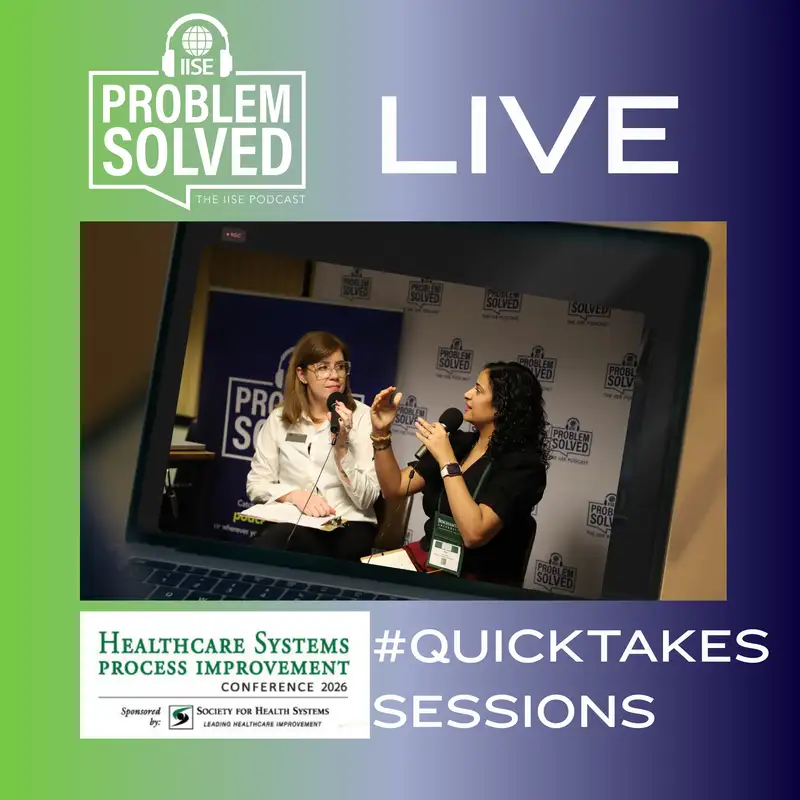
HSPI 2026 #QuickTakes Sessions
Download MP3I really love the energy here,
energy around the improvement.
Any room you go into, the people are.
Really curious about, really interested
in making the systems better.
And if you could describe the conference
in one word, what would the one word be?
Collaboration.
Oh, good.
A hundred
percent.
That's a great word.
It feels very warm and welcoming.
Everybody, they, it seems like half
the group has come here forever.
They, they kind of know the ins
and outs and everybody knows each
other and they're reconnecting.
And then the other half is a
family new crowd coming in.
Healthcare Process Systems improvement
is one of those conferences where you
feel the momentum the second you walk in.
People trading their ideas in the hallway,
swapping notes after sessions, and
genuinely rooting for each other's work.
So for this special recap
episode, we're bringing you inside
the Problem Solve Live Booth.
Short on the ground, conversations with
people who make this community what it is.
You'll hear the themes that kept coming
up, the questions people are wrestling
with, what's inspiring the next generation
and what attendees are taking back to
their organizations, starting with the
topic that was everywhere this year, ai.
So my name's Cody Hall.
I am the director of process
improvement, with, some of the Vandalia
health facilities in West Virginia.
I'm going to be the president
of SHS for this year.
So looking forward to that and
having a great week here at HSPI
and getting everybody involved.
And how many HSPI
conferences have you been to?
Two, I'm gonna say 12,
maybe something like that.
10 to 12, somewhere in there.
Is there a reoccurring.
Theme that you're hearing, either in
hallway conversations or in sessions.
Can you tell us about it?
Yeah, it's ai, a hundred percent ai.
People are wanting to know about it.
you know, we're hearing loud and clear
at the board level that, you know,
what is the healthcare improvement
professional's role in AI going to be?
What's the feeling around ai?
Does it feel like there's
urgency around it?
Or what, what does it feel like
in, in healthcare right now?
I think urgency's a good word.
I think, I think a lot of people
still don't understand it.
And, you know, it depends
on where you are too, right?
Like some areas are more quick
to adopt and others are a little
more, you know, I'm still afraid
of it, frankly, in, in some ways.
And so I think.
It put, it positions us uniquely as
improvement professionals to really
understand, hey, this is what AI
can do, this is how it can help us.
You know, in terms of patient flow
or clinically or in terms of managing
quality and outcomes or improving
patient care, whatever it is, we are
uniquely positioned to help bridge the
gap between understanding the technology
that's available to us and helping
our clinicians and administrators
understand that and use that.
And I think that's gonna be a big
role for us over the next 10 or
15 years, within the industry.
So I think that's what
we have to get right.
Attendees weren't just talking
about AI in hallway conversations.
They were eager to talk about it at
the problem Solved Life Booth as well.
My name is LJ Gearhart.
I am the Robotics automation and
innovation manager for Mayo Clinic
in their food services department.
We definitely wanna hear
more about robotics.
So
that's all the buzz with ai, right?
It really is.
myself and a few other colleagues with
Mayo Clinic, we call ourselves a big
six, but we collaborate in support
services, EVS, supply chain, linen
central services, food services.
The patients always come first, right?
In healthcare, and that's the
first thing that we look at.
If we can really.
Focus and synergize towards bringing
solutions that support patients in maybe
a direct or, or really non-direct way.
We are contributing in a positive
manner to the entire organization.
Okay.
So you do that through robotics?
Yep.
Absolutely.
Okay.
Describe that for us.
well, it's not like the Jetsons.
By no means, but don't
tell my kids that, right?
Yeah.
So not all solutions require automation.
I think it's the first thing is you
have to step back and think about
whether or not something really needs
to be automated through robotics.
There's a lot of travel paths
that can be push pull, point A to
point B, but everybody's moving
in this sort of secular motion.
What if we all do it together?
And that's a lot of our philosophy
when we look at automation.
AI is a really big piece of
the solution, but it's a piece.
It's not.
Not the full solution.
Yeah.
And I love the fact that we're all
thinking of that in different healthcare
systems and bringing forth technology
that's going to enhance solutions.
My name is Beju Rao.
I am the founder, CEO of Amitha, Inc.
Where we operationalize explainable
AI at healthcare systems and more.
My focus has been mainly on, AI data
and machine learning applications in
healthcare, both on the clinical side
as well as on the operations side.
Okay.
Tell us about it.
You said you conducted a survey.
Can you tell us about that?
Yes, yes.
So we have, done survey of healthcare
leaders on the use of AI and machine
learning turns of that, 80% of the
healthcare leaders are actually using
AI in either within the EMR systems or
outside EMR systems, and they're doing it.
To, improve the, obviously the
patient satisfaction, revenue
throughput, and also most importantly
to reduce the clinician burden.
Right?
And 60% of the folks said that they're
actually seeing measurable results.
So that is to me, very fascinating.
You know, it's great to see 60% of the
people that are seeing the ROI on ai.
So, my name's Chris Mensah.
I am an industrial engineer and
I'm a a project manager at, UPMC
in Pittsburgh, Pennsylvania.
What do you think the future of
healthcare is gonna look like?
I know AI is the big phrase.
Yeah.
And term right now.
It is
how we, enable that, you know, the
ecosystem that it has to play within.
how do we do that in a safe, you know, and
useful way for us, will be interesting.
I think we gotta make sure it.
A tool that helps us versus us
adapting to something that we
don't necessarily want or need.
And at the same time, right alongside
all the urgency around ai, there was
a second message that kept surfacing.
None of this works if we lose sight
of the human inside of the system.
Okay.
I've been to this workshop where
the lead, Dr. Lucas Maur, he
just stole this phrase like.
If you build the people, the people
will build the processes for you.
My name is Anna Smitha and I've recently
finished my master's in Health Informatics
and I work with the Division of Healthcare
Engineering at UNC Chapel Hill, and
I work on the process improvement,
quality improvement projects within
the healthcare system at UNCI think.
So a lot of times we
fall into this trap off.
Efficiency, outputs, metrics, but at
the end of the day, it's the humans
who build these systems and, when these
people feel heard, supported, and valued,
I think the systems will be better.
This is something.
The human factors thing, it's not just
a side thing, it's the core value.
Going back, I will always keep in my mind
that it's the humans we are dealing with.
Is there a place where human behavior
and systems design collide in your work?
Yeah.
I've recently been a part of trying to
improve the phlebotomy morning workflow
where we try to involve a lot of frontline
people, listen to their voice and try to
implement changes from their perspective,
not just leadership overtaking it.
So I think that really hit something.
Can you introduce yourself?
Sure.
I'm Lee Erickson.
I'm a family physician and CEO
of Adaptient, which is a small
boutique advising and training
company, primarily in healthcare.
You are one of our
exhibitors here at HSPI.
We also gave one of the intensive
workshops while we've been
here, and that was a blast.
The audience was amazing.
We did a workshop on closing the
implementation gap when you do root
cause analysis for serious events.
one of the things we've noticed, and
you know, I've been a healthcare exec
for many years before I started doing
this, as my partner was as well.
Most of the time in healthcare
we do a root cause analysis.
We don't go very deep.
We invent a few really superficial
action items that really
only affect the front lines.
Mm-hmm.
And management and executive leadership
never seems to have a job to do and
as a result, and so we did a workshop
on why you need to go deeper into the
organization and look at supervisory
factors and leadership factors.
'cause if you don't change those.
Everything you change near the front
line is just gonna slide back to
the way it was in the first place.
So I think we have a huge opportunity in
healthcare for organizational learning
and development at the management and
executive leadership and even board level.
'cause board members
don't know how to govern.
Quality and safety either.
and so we, we presented our very simple
framework for doing an RCA that really
makes you think as a systems thinker,
don't lose sight of the people
that created the system.
That's huge.
People will never be able to be replaced.
I really enjoyed, going to
one of the intensive sessions.
It was a cognitive empathy for
performance improvement and I just,
it was such a wonderful presentation.
It was really great seeing that
side that's really human, especially
with all of the talk about ai.
Mm-hmm.
as much as it is really, really
important, it's also has a lot of
negatives and a lot of people focus
on the positives and sometimes as a
student especially, it's really hard for
me to kind of like get on that train.
So it's nice to see that
people still think about it.
Talk about the fact that you need to
be human to be working with people
like Period, no matter what industry,
when standup voice was this year's Society
for Health Systems Scholarship recipient.
I'm Aila Julian ela.
I am an industrial engineering student
at the University of South Florida.
I'm currently in my senior year, so
this is my first conference where
I've seen the collaboration between
clinicians and individuals that work
in healthcare as well as engineers.
So I think it's very interesting
to see the different.
Perspectives that we have.
What made you decide that you
wanted to go into healthcare?
Well, I was kind of iffy about
all the other industries.
There's just so much out there
for an industrial engineer.
Yeah.
I do think like ISE has given
me the opportunity and the
platform to learn a lot, at.
The university level.
So I think it's been really great
to have something like this that's
specific for health systems.
As I was going through everything
and trying different internships
and different opportunities, I found
that healthcare was something that
really, you know, I fell in love with.
It just really became something
that I could see myself in and.
I just love hearing everybody's
stories and everybody's projects
and like what they've done and
who they've been able to help.
Ayla wasn't alone this year.
The student and young professional
presence felt stronger and that matters
because they're not just attending,
they're building the future of this field.
More from Cody.
And is there something about this year
that feels different than other years?
Different than other years?
compared to, I'm gonna say since COVID,
we've got more students this year.
Then we've had in several years, which is
great to see 'cause they're future, right?
and that's what helps us grow.
And, and seeing them get involved and
seeing them want to work in healthcare
as industrial engineering or other
types of students, it's great to see.
So we wanna continue that
growth as we move forward.
My name is Avi Fishman.
I'm the director of capacity Management.
And data analytics at
Baptist Health South Florida.
Okay, great.
I have a session which relates to
the mentorship program of, SHS.
we revamped it Two years ago,
we doubled our enrollment and we
basically geared it to what the
students and young professionals
wanted, which is really cool.
They wanted to.
Get help on rewriting a resume.
They wanted help on
doing an elevator speech.
They've never done a quick two
minute presentation, but they
needed help in doing presentations.
So we revamped the program in order
to meet their needs, and we just
looked forward to continuing to help
students, learn what they need to
in order to advance not only in the
society, but in the world in general.
This is Kayla, Trahey, and you'll
hear more from her in a minute.
But first, she shares some thoughts.
As a young professional, do you
have like a really solid piece of
advice for young professionals?
yeah.
I mean, I was a little nervous, just one.
Being an industrial engineer in
healthcare is already kind of niche.
I think it's just lay it all
out there for your mentor.
That's what they're there to do.
They're not gonna tell you
you're doing something wrong.
It's your first time like living so
mm-hmm.
They're not gonna be rude
or hurtful and it's just.
Tell them everything and
then they can help steer you
where you're supposed to go.
Tips for finding a mentor,
just come to events like this
or, yeah, I would say
come to events like this.
I also, as a student, there was a
resume workshop, so actually funny
enough, the woman who reviewed
my resume is now my mentor.
But yeah, they do a whole thing with the
networking committee where the mentors
all share bios and things like that.
Of course, the heart of HSPI is
what happens when people share
the work, posters, presentations,
and hallway conversations
that turn into collaborations.
Here are a few snapshots from attendees
and presenters about what they're
building, studying, and improving.
Right now.
My name is Sarah Abida.
I am.
A postdoctoral fellow and another
name, bridge to Faculty Fellow at the
University of Texas in San Antonio.
I am presenting two posters, so,
both of them about my research
for, reducing health disparities
and treating opioid use disorders.
What do you hope to take
away from the conference?
I'm trying to build, industry
partnerships because those are.
Valuable for us as academics because, a
lot of grant opportunities that we'll be
looking for, especially in healthcare,
would ask you for people from the
clinical side, but also if you're trying
to introduce certain, type of like a
device or something they would like to
see if, if it's applicable also from
industry, perspective, if you will.
So those are like.
The kind of the conversations
that I'm trying to take.
in addition also meeting, my other
colleagues from the academia and
see what we can do all together.
So my name's Kayla Trey.
So I live in San Antonio, Texas right now.
I work for Infinity, so
we are a little different.
We actually do energy commissioning
in the heating, ventilation, and air
conditioning systems in hospitals.
But I have my undergrad degree
in industrial engineering.
Okay.
That's interesting.
Tell me more about like what you
do with the ventilation systems.
Yeah, so we pretty much just optimize
like the central plant in hospitals.
and so what that does, and
actually, shameless plug, we have
a poster, but it has system-wide
benefits across the hospital.
So initially you might think, okay,
they're gonna make the HVAC system
optimize, that's energy savings.
But because of that, the.
Patients are more comfortable,
so there's less hot cold calls.
Clinical staff doesn't have to go
bring blankets or things like that.
You said you had a poster on that?
Yeah.
Okay.
So looking at all the synergies, it's
actually kind of hidden message because
if you look through your just singular
lens and you only see facilities
benefits, you would miss out on all of the
clinical and patient experience benefits.
If you put on your IE lens, you
see only through that one and
you miss the facilities benefits.
So when you look at the whole
picture, you can see that.
Fixing the heating, ventilation,
air conditioning system to run
optimally actually is rippling effects
across the entire hospital system.
Yeah, completely.
Is there something that you've
learned here or that you've heard
here that you're going to use
like right away when you get back?
so.
It.
Power BI is a new tool we've been
using at our like company, and
I've been the one to pilot it.
And so there's been some people here that
are very expert in Power bi, so I've had
conversations with them and I know that
as soon as I'm back in the office, I'll be
trying to import that data, like how they
talked about and store it in certain ways.
So it's more efficient than the
clunky way I've been trying to do it.
Mm-hmm.
Because they have more
experience than I do.
So that's been kind of through
conversation, that I know.
I'll take back and use on my project.
I'm Faruk Muritala.
I'm a PhD candidate in
Kennesaw State University.
I've been here to, for job
search and I've been really
finding very interesting people.
Okay.
I was able to find a posters.
I'm gonna be a co-author.
For improving one of the process
that I found, the fifth on.
All right,
cool.
Yeah.
So my name's Chris Mensah.
How long have you been in
the field of healthcare?
2007, is when I started and I've kind
of hopped in different departments,
but, always looking at workflows,
whether it be, you know, with,
still technical IT writing code or
looking at actual workflows for,
ORs and, and things of that nature.
And what do you think is most
like, exciting about that
or fulfilling about that?
for me it's, you know, loving
to try to fix a problem.
Mm-hmm.
So, I mean, there's things I can
do and then things I want to do.
And for me, you know, when I can
use my skillset to, you know, map
out or write code or develop an app
or automation, it's, you know, does
it, you know, make life easier?
Does it.
And directly, at least get to
the patient at some point to make
things, you know, better for them.
So that's when I feel, you
know, the, the accomplishment.
Yeah.
I have, a presentation looking at
preference cards for, for surgeons
in the or, later this afternoon.
So happy to, to share with, my peers here.
You know, what we've been going through.
And, you know, it was more of even
a conversation than me kind of
saying, well, here's how you fix it.
It's more of here's what we've
done, what have you, you know,
experienced and thought of.
So, a little bit of collaboration still.
Oh, great.
I'm, I'm garish Gopala Christan.
I work as a senior manager, continuous
improvement, with a company by
name, case New Holland, CNH.
actually we are a manufacturing company.
We do, agricultural tractors, equipments,
back haul orders, construction equipments.
but I had a shot stint.
In healthcare.
that's how I, I got, interested
in, in making a presentation
here in the HSPI conference.
My session was about, we, we put
together a, a data-driven system for,
a hospital-based, inventory management,
for a surgical services department.
so we, we talked about how we can
implement some of the lean and
process improvement tools in there.
Okay.
Yeah.
Great.
You wanna talk a little
bit more about that?
Absolutely.
so there was a lot of, artificial
intelligence that we had built into
the system, like machine learning, that
kind of, train, train itself and trying
understanding how, how we can maintain
the cost of the system, the inventory.
Okay.
Just to give you a perspective,
healthcare industry just spends about
$83 billion in inventory supplies.
Okay.
And
out of which, almost a third is
considered as unnecessary or waste.
So that's the macro level problem
that we are trying to attack.
So how we can try to bring in some of
the lean practices, process improvement
practices, and trying to make that process
more efficient, streamline processes,
bring in some technology that's key.
I, I strongly feel, as a, as a core
field, lean process improvement.
A lot of these are transferable skills.
Yeah.
Whether it's in healthcare,
was manufacturing or any other
sector, or even government.
There are so many tools that can
be used across the board that cross
learning is something that a lot
of the industry is quite missed.
That opportunity.
Mm-hmm.
Okay.
I, I need somebody from
healthcare to help know.
I, I think there is a lot
of transferable knowledges.
People can just adjust to a new
sector and try to understand
the application piece of it.
I think there's a tremendous opportunity
with, with AI and, and, and, and machine
learning that we can cross that bridge.
I'm pretty sure.
I'm Mary Akella.
I am the founder and Chief Transformation
Officer of Harmony Consulting Solutions.
we're based on the East coast, in
Northern New Jersey, but, travel some for.
clients.
So actually this morning I was
able to, go to the Children's
Hospital, Arthur m. Blank.
Yeah.
hospital and that was incredible.
So what is something that maybe from that
tour that you can take back right away?
What I really liked is how
thoughtful they were about the
facility and about their planning.
They had a lot of.
Robot capabilities and moving things
from one place to another, which in
lean, we would call transportation waste.
It needs to happen.
But does a person need
to really do that task?
Or how could we speed up that task so
that, we're really only, giving the
patient that kind of value added work.
And so are you, presenting
at the conference?
I'm presenting, with a colleague
of mine, Alex Esman, and focused
on, that transformation from.
Frustration to results and how to do
that in focus on change management.
So how can you focus on the
change management piece?
I think even, Chris, I believe in,
in the keynote mentioned it today
or in the, panel discussion that, AI
and processes can, can be improved.
But the thing that's really holding us
back from the ai, improving our, our
efficiencies is the people side of things.
But a big piece that I'm sharing
is something that I've developed,
which is a mix of a care.
Model.
So it's all an acronym, care and
tracking care for people and tracking
the process and how those two blend
in terms of change management.
So you can't really only
focus on one of them.
You can't just focus on the process
and you can't just say, what does
my A three or PDCA look like?
Because you can't forget about the people
piece, but at the same time, you can't be
on the people side of things and making
sure that you're just focused on the.
how things are being implemented
without understanding if it's
actually being effective.
So really marrying those two so that
your change management strategy can
actually be successful and sustainable.
And then there's the exhibit hall
where you can see what's coming next.
Universities, startups, and industry
partners all in the same space.
Offering tools and ideas that could change
how healthcare work actually gets done.
Yeah.
Lucas, Missouri professor at the
University of North Carolina,
running a division of healthcare
engineering there and, doing kind
of the regular professor job.
Alright, so tell us what
you're doing at HSPI.
Well, we came here in a partnership
with, with the institute and,
we had a exciting startup.
Mm-hmm.
Happening through, through UNC.
It's called MaiaZura.
We kind of like to think that, the
name itself represents a lot for us.
So Maya stands, for good mother in Greek.
And the symbol that we are
representing is the bison.
And the bison is one of those herd of
animals that where there is a storm,
they face the storm because they know the
shortest way out is through the storm.
So we are here, you know, recognizing
that there's a lot of burnout out there.
You know, people, people are, you
know, kind of living the profession.
There's a, there are suicides, you
know, the problem's really, really big.
And May Azure is here to kind of bring
that, you know, that attention and really
show that we could do better in training.
So that's, that's why we are here.
And so I walked by your booth
several times and it, I mean, it
looks like it's like a headset or
like, almost looks like a VR device.
Can you kind of explain to the listeners?
Yeah, yeah.
So we have, we actually
recognize that there's a need
to have these modules, right?
The training modules on
the variety of devices.
So we can be on your phone, you
can be laying on the couch at home.
And still in an immersive way,
interacting with the environment.
You can be on your computer, you can be on
the iPad, but you know, if you really want
that full immersion, really like be there.
Right.
Feel it.
You know, the VR headset is a
great technology that allows you to
really then interact with the entire
environment at that different level.
So we, we definitely feel like
we would love healthcare systems.
That's why we are here.
You know, we know that there's a
lot of healthcare systems that come
to the conference to realize that,
well, if we have a boring training.
If this is just slides and we haven't
updated that in years, you know,
we might be a good solution to kind
of look at us and say, Hey, this is
a little bit more, you know, up to
date and a little more immersive.
You know, we might think about replacing,
but we are also here because we believe
that our pro could be grading education.
You know, start early.
Yeah.
Grab the students.
We have a lot of students here.
so we hope that the professors
and everybody else, you know, our
industrial engineering, and systems
engineering departments, you know,
could absorb it for education purposes.
And where can people
find out more about it?
Yeah, so we can go to our
website, www do may azure.com.
so that's, we have there and of course,
you know, reach out to me, you know,
anytime you, you would like, so,
so my name is Martin, as
you can tell by the accent.
I'm from France and I'm working for Tale,
and we are in partnership with May Azure.
You know, when you, you're in,
for example, Google Maps, Uhhuh,
we are working down the streets.
Mm-hmm.
That's exactly the same technology
we are using, but it, it would be
like within a specific environment.
So it could be a hospital, it
could be a manufacturing company.
What's the name of the company again?
Say it again.
Up tail.
So U-P-T-A-L-E.
Okay, great.
And where can people find
out more about your company?
so directly online@uptail.io.
My name is Sammy Argo.
I am a Texas Tech Industrial
Engineering graduate.
I work at.
Big Bear AI here promoting
some of our capabilities.
Okay.
And tell us about Big Bear ai.
so we offer digital twin capabilities,
discrete event simulation modeling,
and our, our latest and greatest
product that's coming on live soon this
year, offers a cloud-based solution.
Okay, got it.
And is this your first time at HSPI?
It is.
Okay.
And it's exciting.
All right, cool.
And do you plan to come back next year?
I sure hope so.
Hopefully I now kind of have a
weird goal that I have one year to
accomplish a project that I can present.
Oh,
that's kind of how I'm
looking at it right now.
What do you think that project might be?
Simulation modeling based?
I would say healthcare is my passion.
And as far as Big bear ai,
what kind of other industries?
Yeah, it, big bear ai.
we have a, a large govern
government presence.
Okay.
So a lot of military contracts.
we work with manufacturing,
supply chain logistics, shipyard.
What's another booth that you've seen
that you've, thought was cool or enjoyed?
Other
than, other than this one?
Obviously
this, this one, this one
did catch my attention.
I will say that honestly, I mean,
the companies that are here, the
universities that are here mm-hmm.
Promoting additional, educations.
Yeah.
And some of those universities
included Kennesaw State,
Binghamton University, and Auburn.
I am Sharon Hickman.
I live in Greenville, South Carolina.
I am the president and COO of Adaptient,
but I also am a part-time lecturer at
Auburn and they've recently added a
healthcare system certification, through
the industrial engineering department,
which has been very interesting for me.
Having 25 years of practical
experience working in healthcare,
former senior leader at a
couple different organizations.
So tell us about the program.
Tell us about the new program.
So there's, it's a graduate
level program online.
I. and in person.
So it could be on campus or remote.
And it has three courses
that are required.
One is Healthcare Operations, and then
one is focused on US health system
culture and Policy for systems thinker.
That's one of the ones that I teach.
And the other one is, human
Factors in Healthcare, which.
I would classify as really an
introduction to safety science and
how that actually works in healthcare.
Being a systems engineer in
healthcare, what do you see as
one of the most important issues
that is facing the industry today?
You know, I think we're at a point
where people are starting to recognize
the, the value that systems engineering
and systems thinking brings.
It's still hard to find programs.
It's hard for people to
break into the industry.
So from that perspective, I think one of
the biggest challenges is really helping
people understand the value, like senior
leaders, the value of systems thinking,
what's the solution to that problem?
I honestly think we.
Really as an academic environment
mm-hmm.
As we're training these students
to work in healthcare is to
help them with that emotional
intelligence change management side.
Mm-hmm.
You know, we teach a lot of theory.
And we aren't really teaching those
soft skills that really need to come
along with the engineers that are
working in healthcare so that they can
very comfortably go into someone's day
without them feeling uncomfortable.
'cause we do a lot of observation.
I mean, who wants to have
someone watch you work?
Right?
It just kind of stinks.
So how you approach it
makes a big difference.
How does that help the process flow?
Well, you know, the people doing the work
are the ones that know it's not working,
what is working, what needs to be changed.
They've probably already thought
of solutions and nobody's
really listened to them.
Mm. So if you can gain that trust
when you're spending time with them,
for them to actually open up, it
really makes a difference in how you
can approach the problem solvings.
So, where can people find out more
about the new program, from Auburn.
Okay, we can go to Auburn's
website and their industrial
and systems engineering program.
They'll have the certification link
there and then of course Adaptient.
We have a website.
It's www.Adaptient.com.
As the conference wrapped, a
lot of attendees weren't just
reflecting on what they learned.
They were naming something deeper.
The way HSPI shapes careers built
relationships and keeps people
moving forward in this work.
My name is Raj hariharan.
I am the systems redesign coordinator
at the VA Augusta Healthcare
System here in Augusta, Georgia.
And, also a member of
SHS and I will be the.
Incoming conference chair.
Oh, for the HSPI, next year.
Okay, fantastic.
A lot of the ideas I've gotten
over the years, really through this
conference, I think have propelled,
my own career personally and have
really helped advance my organization.
Can you give some of
that valuable advice to.
Our listeners.
Yeah, so I mean, I think at the end of
the day, one of the biggest things you
gotta kind of really assess is you know,
where's your organization at, right?
Because it takes a journey to go from
where you're at to really where you
want to be, and you have to be very
strategic and intentional as far as.
Kind of making that roadmap for
yourself and and kind of set those
annual goals that are realistic.
And I think the other thing that's really
important is, you know, especially when it
comes to the technical side of our work.
Yeah.
We use a lot of different tools.
You probably gotta be good at math
and some of these other things, but
I think I would argue what's way more
important than any of those things is
your ability to have people skills.
Yeah.
And your ability to build relationships
with other people and really know
who's who in your organization and who
you should be able to partner with.
Given any given problem.
Right.
And then make friends with those folks.
Right?
Yeah.
And, and you know, take 'em out
to coffee every now and then.
Keep nurture those relationships and
'cause at the end of the day, you know,
I think Stephen Covey put it best.
He has this concept called
the emotional bank account.
And that concept is that everybody
has an emotional bank account, right?
In order to maybe get a favor for
somebody that, May not necessarily report
to you or some of those other things.
You gotta be able to make a deposit
before you can make a withdrawal.
Right.
So always be helpful.
Yeah.
That's great advice.
Mm-hmm.
What's exciting you most about the
future of healthcare right now?
It's, you know, I think it's, it's
a constantly evolving field, right?
Technology's always
vol, evolving, changing.
It's gonna impact how we do our jobs.
how we advise folks.
yeah, I think it's, it, I think
the most important thing is, you
know, keep up with the times.
Yeah.
and especially when we had some of
this conversation in our kickoff, you
know, be, be on the watch out for ai.
Right.
Really learn to use some of those tools.
Don't be afraid of the tools.
Yeah.
But, you know, learn to use them.
I think that was a key message I
got from that, from the kickoff.
Yeah.
AI was how HSPI opened, it kept showing
up all week and it was still front
and center in the final conversations.
And based on what we're hearing next
year won't be whether AI matters,
it'll be how we get it right.
Just to, you know, kinda give a
little bit of a teaser to everybody.
And I mentioned this from the stage
yesterday, that's something we're
gonna be working on really heavily next
year, is, you know, AI is gonna be a
big part of this conference next year.
And trying to figure out
what that looks like for the
healthcare improvement person.
you know, we, we've had some offerings
this year and those have been great.
You know, the initial conversation,
kind of the fireside chat
thing we had the first day.
some of the intensive, some of the
other presentations have been wonderful.
But, AI is gonna have to be much more
intentional, a bigger part, it's gonna
become a bigger part of the work that
we do as improvement professionals.
And so we have to get it right
for our members and the people
that come to this conference.
All right.
So what's your message to SHS or to
conference attendees for next year?
definitely come back.
We're excited to be, In a different
place next year, we're gonna
be, in, in the Orlando area.
So, you know, Atlanta's been a great
host city for us for the last three
years, but we're excited to be there,
and, and be in sunny Florida in February.
I think that'll work
out well for everybody.
And, if you want to, you know, if
you're in the healthcare improvement
community, you wanna learn more about
ai, you want to, you know, learn
from, you know, learn from some.
Our more traditional offerings and
what people are doing in healthcare
improvement, this is the place to be.
It's gonna be a great offering for you.
We know we wanna be more intentional
around students and academics as well
make this a welcoming environment for them
as well as our industry professionals.
So it's gonna be a great conference
next year, so I certainly
hope people will come back.
Alright.
Perfect.
Thank you.
Yeah, of course.
Thank you.
And if next year is your first
HSPI conference, consider this
your early welcome because we're
closing with some quick advice from
attendees who've been in your shoes.
We'll see you in Orlando.
My advice is just absorb it all.
Go back and start, looking into
what you learned so you can
grow and expand in healthcare,
kind of enjoy the, environment.
it's a great learning environment,
so try to learn as much as possible.
And if you need help, just
ask anyone like me, you know.
Who is a repeat attendee?
I would definitely recommend
signing up for some of the
dine around dinner options.
I know sometimes, you know, if you're
kind of a shy, maybe a little bit more
introverted, it's harder to kind of make
those connections in large settings.
But yeah, hey, people always
make friends over dinner, so,
really just, you know,
absorb, get some coffee early.
Thank you to everyone who stopped
by the problem solved LIVE booth
and a huge thank you to SHS.
For another outstanding HSPI conference,
subscribe to Problem Solved so you never
miss an episode, including an inside
look at the Arthur M Blank Hospital Tour
at Children's Healthcare of Atlanta.
Thanks for listening.
Every great solution is
a story worth telling.