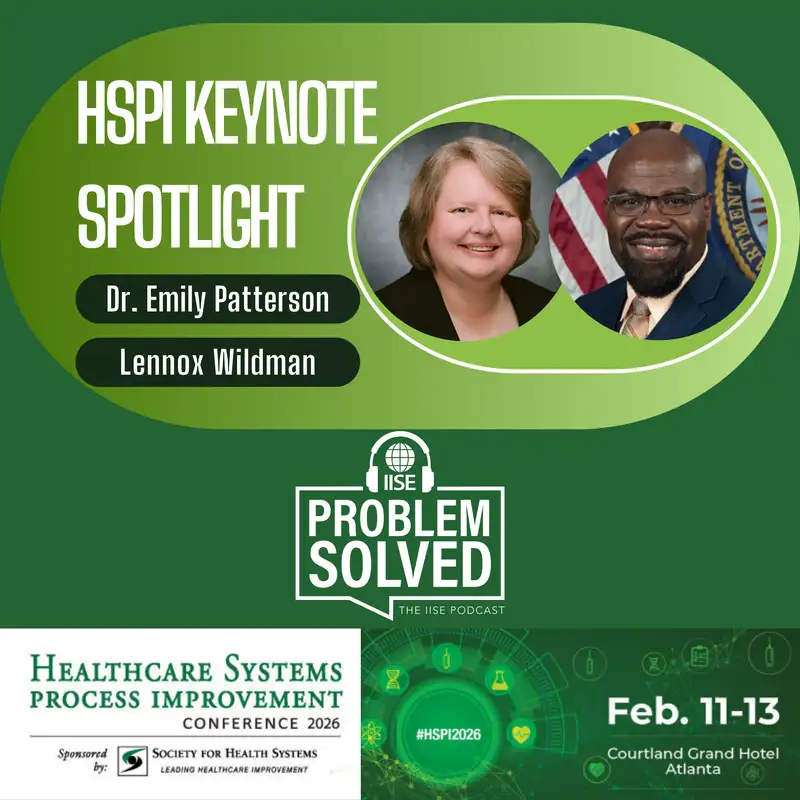
HSPI Keynote Spotlight: Inside Conversations with Dr. Patterson and Lennox Wildman
Download MP3Here's the problem.
Healthcare is more complex than ever.
New technology is rolling out
faster than teams can adapt.
Staffing is stretched thin,
and information is scattered.
So what's the solution?
It's not just better tools, it's
better systems, better communication
and leadership that understands how
people, processes, and technology all
work together at the Healthcare Systems
Process Improvement Conference, these
conversations are happening in real time.
Welcome to a special
episode of Problem Solved.
We are bringing you inside conversations
from two keynote voices who approach
improvement from different angles,
but arrive at the same truth.
Better outcomes depend on better
systems and the people inside them.
First, we hear from Dr. Emily Patterson
from School of Health and Rehabilitation
Sciences at the Ohio State University.
Then from Lennox Wildman from
the VA in Augusta, Georgia.
Dr. Patterson, thanks for taking the time.
We are gonna be one of our keynote
speakers at the Healthcare Systems
Process Improvement Conference in Atlanta.
Let's talk a little bit about what
your plans are for the conference.
for instance, what topic do you plan
to talk about in your keynote, and what
are you hoping attendees gain from it?
Well, thanks so much for asking.
So I actually, I guess broke the
keynote speaker role and asked for
an extra day because I think I'm
gonna learn more from attending the
conference than what I have to share.
Mm-hmm.
So I, I plan on going to the whole
thing and just, getting a temperature
of what's happening, particularly
around, ambient AI listening and how
that relates to quality improvement
measures and how large language models are
being used and standardization efforts.
But what I'm going to share is, I
worked with many large healthcare
systems and I recently did a very large
project with a system that's about to
transition to hundreds of sites that
have a new electronic health record.
And so we have eight sites that have
implemented, the electronic health record.
I went to three and we were looking
for what we could learn, in primary
care for medication reconciliation,
standardization before implementing
the new electronic health record.
And so.
It was a big effort.
Lots of support from lots of people.
It took about three months to do.
I had a team of about six people.
And we basically took three thoughts.
One is standardization and how to
get the benefits of reducing multiple
ways of doing things and clarifying
roles, and, reducing double work
and making it clear where in the
system information is gonna be found.
And then we also took
a look on resilience.
So for me, work system resilience thinks
about how do we have backup people.
So if staffing is down today or if
staffing is down at a particular
site compared to other sites, how
can we have backup roles, delegation
roles, and people cross covering.
And this is something that has
really emerged in the military.
They've been getting very formal
about how to do ad hoc teams with,
with electronic support systems.
And I'd love to bring that
thinking into healthcare.
particularly with intake staff
doing medication reconciliation,
corks printing medication lists
for patients, that sort of thing.
And then the other look we're taking
is, workarounds has a bad name.
So people will say, oh, you know, people
are super creative in all the ways that
they don't do what we want them to do.
And so we take a different look.
So from a resilience perspective, we think
about what positive local innoVAtions
can we improve, share, and spread.
So we found educational
posters in, offices.
We found, lab people who were giving
printouts that said, Hey, patients,
you know, take your medication list
and improve it before you come in.
Bring your medications with you.
And so, which of those do
we wanna take and spread?
So what positive deviance.
Positive workarounds do we wanna share?
And then we also did identify
negative workarounds that we
view as a way to see unmet needs.
So just previewing a little bit of
our findings at every single step
in the workflow that we mapped.
Every single one, there was somebody who
printed a medication list for a patient.
Mm.
Okay.
And so there's essentially no, patient
facing medication list in this electronic
health record other than there was one
that was hidden that no one knew about.
For a registered nurse visit before
a patient goes to long-term care.
And so everyone's been sharing this
report for these purposes, and recently
the organization standardized the role.
So they said only nurses could print it.
All these other people were printing it.
And so our first recommendation
was to allow everyone to
print it and to improve it.
And so they're, they're, pursuing that.
Okay.
I was curious, you mentioned you're
pulling from sort of military,
background or military operations.
Yep.
Yep.
How do you determine where to research
or find different methods, whether
you're looking at the military
or you're looking at, business or
supply chains, anything like that?
Yep.
So I am a human factors and
ergonomic society fellow.
So human factors is traditionally
from aviation, nuclear power,
military, that's its home.
And so it does work in healthcare, but
it's more of an emerging field for us.
So we've had a long time of
having research in all these other
domains, and I personally in.
2000 to 2010.
Right after getting my PhD, I was
working on intelligence analysis,
nasa, Johnson, military, all,
all versions of the military.
and even though I focus on healthcare,
I still continue to keep my toe in on.
I've had DARPA funding and,
other funding in these areas.
So mostly it's from the human factors
literature, but it's also from personal
experience and all these other domains.
Well, speaking of human factors, give
us a snapshot of your current research
in human informatics and communication.
Well, it's a great time to ask because
the whole nation is doing their Wiley
Coyote moment, where we're like,
what are we gonna do with research?
a little, actually the hospitals
are a little bit safer space right
now, a little bit less, crazy.
although there's plenty
going on there too.
But research has just, you know,
undergone a real big shift and so.
I think that all of the investment
that's going into ai, which is
larger than the GDP of the United
States is a real opportunity because,
a lot of these electronic health
records have implemented AI based or
large language model based things.
And they sort of put them in there and
they don't know what the use cases are.
So I think I am particularly well
positioned to understand the unmet needs.
What are the things that
are not, being done?
There's too much foraging in the chart
for what's happening to a patient.
Sometimes they don't even know
that a patient had a heart attack
overnight in the emergency department.
It's just really hard to
even know what events are.
So what are event driven displays?
What are shared displays that we can take
adVAntage of these large language models?
And knowing the dangers.
So with large language models, people
will say it's summarizing the chart.
It's really not.
So it's taking, you know, these models
that are created from all these social
media sites and so it can embed that
somebody has diabetes who doesn't have it.
And so we have to think about,
Carefully checking ourselves.
And one of the ways that I, I
would like to pursue is having one
large language model check another.
So if you have one with the really vetted,
and a lot of people are doing this,
but people haven't systematized it yet.
so if you have, you know, a particularly
good language model that's particularly,
vetted sources, particularly from a
medical perspective, maybe tailored to
your hospital, it maybe can't do as good
of a job, but it can be more accurate.
So it can check what it is that comes out.
Yeah, I find that in my work a lot as
well, from a communication side where
it's, I'm checking against, like if I
use Claude for an output, but then I
check against with chat GPT or if I'm
certainly in the realm of research, I
look at a tool like Notebook, lm and I
try to determine am I really getting the
full output or enough context of what I'm
actually looking for, but also what is.
Accurate and what is fully factual.
Yeah, and I, I, a lot of people in the
Human Factors society have gone so far as
to say it's a self looking ice cream cone.
Don't ever use it.
It's too dangerous and a safety
system should never have it.
But it's being used every day
and it's being helpful every day.
While in my own personal experience
in the last week, I fell for a scam.
I asked for a customer service number
from Chat GPT called it and it was a scam.
So I think.
It, it called it up because there's a lot
of, you know, spam email that sent out.
So it created a large language model
that had this number, and then I
typed it into Google and I said,
yeah, that's a spam number, right?
So number one, I'm never
gonna do that again.
And number two, you know, if I checked it.
Check the phone number through Google,
then I would've been able to find it.
So how do we put that in
healthcare, basically?
Right.
And that's, I think that's
of utmost importance.
All things considered.
What are some of the ways that
industrial and systems engineering
principles can address human factors and
communication challenges in healthcare?
Wow.
That's a great question.
I mean, I, I am so happy to be able to
go to this conference because I feel
like we're, have a shared mission and
really trying to accomplish the same
things, and I wanna see what ideas
are out there at this conference.
For me, I always return to communication
through a technology to other people
is often messed up by structured
data fields, particularly if it.
Forces more certainty than
the data has to start with.
And so always allowing, natural text
fields, unstructured data fields, ambient
communication ways for people to talk
to each other that doesn't have to flow
through the database are important.
And then a really just fundamental thing
is workload and workflow bottlenecks.
So I used to just think about workload
bottlenecks, like where are people, busy
and then they're doing these shedding
strategies where they're doing it less
well, asking someone else to do it,
delaying it in time, doing documentation
later that's well established.
Research from Huey and weak
Wiccans from like, you know, the
eighties, but workflow bottlenecks.
I feel like people are just
starting to really understand those.
And so for example, and this is not in my
keynote speech, but it's another study.
if you have the clerks who have to
enter information in the emergency
department to vet that someone has
insurance before you can start, you
know, assigning providers and giving
medications and prepping the patient,
you're never gonna have the whiteboard up
to date because the clerks also do that.
and so that to me, that's a
workflow bottleneck, not a workload.
It's not that they're busy, it's.
What has to be prioritized first,
so you probably don't want the
person vetting the insurance.
Also updating this real-time
board, you want people who
are clinical, able to do that.
So, there's definitely some thoughts
like that that came out in this
medication reconciliation about where
the workflow bottlenecks are in a
primary care and emergency care setting.
Finally, for your own personal or
professional knowledge and career.
What are you hoping to gain by
interacting with a lot of the
healthcare process engineers who are
going to be attending this conference?
Well, I know I've known some
of them for a long time.
I won't name names, but there's
somebody at Ohio State that I'm
excited to see again, where I am now.
but yeah, no, I, I, I feel
like we have a shared mission.
I feel like, the human factors
community is a slightly different
take from what's happening.
In, in, in this conference.
But this conference to me is more exciting
in some ways because it's not about the
research and the papers and the academic,
you know, I, I went to a conference and
presented it's people who are really
trying to make a difference on the ground.
And it's not that I can't learn from
people who are researching, but I do
think the practical nature of just.
Trying to do work and how draining
that is, requires you to have some
successes just to keep going, you know?
Right.
and so, if nothing else, I'm looking
to just reenergize my own batteries.
I am 60% time now with the VA
working on a VAriety of projects in.
Pretty similar role to what I think a lot
of the people at the attendees are doing.
And so, you know, just for
my own practical work, I need
to learn what's happening.
Dr. Patterson, thank you so
much for taking the time.
Thank you.
And you know, if they need
any extra incentive, there's
a huge winter storm coming in.
So go to Atlanta.
Well, you never know how it's gonna go in
Atlanta in February, I promise you that.
Dr. Patterson,
thank you so much.
Thank you.
So that's one side of healthcare
improvement, how technology workflows
and communication either support
the work or quietly break it.
Now we shift to another
side, high reliability.
How leaders design systems that
anticipate human error, sustain
institutional knowledge and
protect patients in the real world.
Here are highlights from Lennox
Wildman, VA Healthcare Leader
and HSPI, keynote speaker.
We can't stop errors from happening.
What we wanna do is make sure
that they happen as far away from
the, our patients as possible.
So that can be resolved and really
and truly the patient don't even
know that those errors, took place.
Excellent.
what are the challenges that you face
at a VA hospital where you then apply
industrial and systems engineering
principles for problem solving?
So, you know, a lot of organizations,
go through this, but I think in the
VA we see it a lot, turnover rate.
so having systems in place that are
consistent, that individuals can fall
in on is very important because if
we rely totally on the ability of
someone's own knowledge to get the
tasks done, and then we go to the, you
know, we end up at that one tier level.
Of failure where soon as you know, the
person with all of the knowledge leaves,
then no one else knows what to do.
So this is a challenge at any, you know,
a lot of times at any big organization.
But the VA is unique in the sense that.
it's a huge enterprise and it
allows, inter transfers as well,
just like the military does.
You know, so I'm here in Augusta and
if I see a position that's in, let's
say, In California that I like, and
it's the same position, you know, I
could, somehow try to transfer into that
position or positions become aVAilable.
I'll apply for that position and if
I'm good enough, I'll make the cut.
And so you have a lot of transfer
that are taking place where you
may leave the organization, but
you have not left the enterprise.
Mm-hmm.
So we have to always be thinking
about that also, a lot of times our
me, our members are military spouses.
As well.
And so we are sometimes close to
other facilities and so as the
military, member is leaving, the
spouses will have to leave as well.
So we're always having that transition.
So again, we still must maintain a high
reliability organization and, and a
lot of times that becomes a challenge,
for us to make sure that we have
systems in place that are so strong
that it doesn't matter who leaves.
The system is in place to continue
on with the service that we provide.
There's a saying in the VA, if you've
been to one VA, you've been to one
VA. So even although it's within
an enterprise, you also have to
maintain what your organization does.
And so the institutional knowledge is
critical because it's not something,
it's not a one size fit all.
So even though though we're all
within the VA, what we do, here at
Charlie Norwood VA Medical Center
is not what you would do in Atlanta.
Just a, you know, an hour and a
half, two hours down the road.
So sustainability is a key factor for us.
Okay.
How have you applied your experience
then in the military and other
leadership roles you've had to
operational practices in healthcare?
Practice, practice, practice, practice.
so the military, my military
experience, I'm 22 years on active duty.
I retired in 2008 and I remember,
this thing in particular as far
as success when it comes to the
military, it's train as you fight.
And so.
Repetition, but perfect repetition
or, or near perfect repetition, right?
'cause you could practice something wrong.
Mm-hmm.
And now you're just really
good at doing it bad.
And so, you have to make sure that
you're touching all the bases.
make sure you include subject
matter experts into it.
And, I think one of the other things
that I learned from military leadership
is to understand that while I may
be the leader, I'm secured enough.
That I am also don't come
with all the answers.
And so I can include the team
dynamic again, which is what
the military is, is built on.
you know, it's the team concept.
So I use all of that in there.
But luckily enough in healthcare,
it's basically the same thing really,
because it is a team, concept.
You know, there's an old saying
that, you know, it takes a village.
so the patient.
Comes into our hospital and a lot it touch
ba basis is a lot of different places.
It's the same patient that
left the, or that went to the
pharmacy, that went to the lab.
It's the exact same patient and
we are all playing a role in doing
our part to make sure that the
patient gets a comprehensive care.
So, from the military standpoint,
I would say is that, Continue to
do it, be secured, in yourself.
Not being afraid to let others onto
the team, and also to make sure that,
you never forget the human factor.
A lot of times we think of,
practices and processes.
Mm-hmm.
And, we tend to forget that those
practices and processes are, are
literally done by individuals.
I, I will say that any hospital
leader, look at metrics, you know,
what are our outcomes and how.
How well are we doing
on this sliding scale?
And we compare our sense
ourselves against each other and
or against a national standard.
And sometimes it might be easy for you to,
to chase those things and then forget that
those numbers didn't magically appear.
Right.
They were the result of someone's work.
And so our employees are not robots,
you know, they have their own
challenges, their own fears, their
own, Their own day-to-day lives.
And so you cannot forget the human factor.
And by getting to know your people and
getting to understand and let them see
you as a human being, I think it goes a
lot further than just being the leader.
Someone that they can trust,
someone they can speak to.
Personally, I look at a win.
For me, when an employee comes to me
and says, Hey, do you have some time?
I just wanna talk to you about something.
To me, that is a win because there's a
level of trust, that has been developed.
So for, for me, those are the things,
you know, the military has taught
me about taking care of your people.
First and foremost, the
mission is important.
You must achieve the mission, but never
forget to take care of your people.
Excellent.
And that's always great advice,
I think, in any organization.
So for your own knowledge and career
benefit, what are you hoping to gain
as an attendee of the conference?
you'll be speaking, I believe,
on Thursday, February 12th.
who are you hoping to run into?
What are you hoping to learn
for your own edification?
Oh my goodness.
So this would be my second
time going to this conference.
And so there's just so
many smart people there.
Right?
So I'm looking to run into just about to
be honest with you, just about anyone,
and there's this old saying again, you
know, if you find yourself in a room
where you are the smartest person.
You need to find another room,
you know?
And I do believe that's the room.
That's the room.
this conference is that room where you
go there and there are just so many
smart people that you can learn from.
So yes, I hope to share some things that
I hope, I can, inbox some knowledge, but
I also hope in the same, atmosphere to
gain, some knowledge as well from so much
talent that is gonna be in that, space.
Excellent.
And we certainly think there'll be
plenty of rooms to walk into where
you won't be the smartest person.
It'll always be a room full of
people smarter than yourself.
And that's what I think every attendee's
looking for at this conference.
Absolutely.
Linux, thanks again for taking the time.
Thanks again sir.
We hope you enjoyed these bonus
conversations with HSPI, keynote speakers,
Dr. Patterson and Lennox Wildman.
If you're joining us in person at HSPI
make sure you stop by the Problem Solved
LIVE booth and share what you're learning.
Thanks for listening.
Every great solution is
a story worth telling.