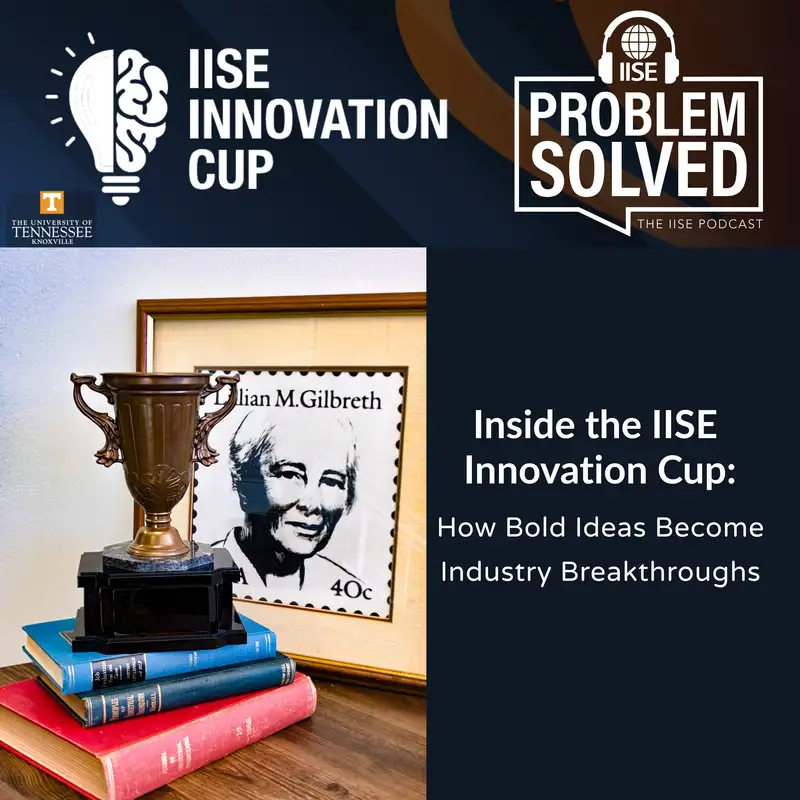
Inside the IISE Innovation Cup: How Bold Ideas Become Industry Breakthroughs
Download MP3Elizabeth Grimes: Here's the problem.
Across industries, teams are rethinking
how to tackle massive, complex challenges.
But when these breakthroughs happen
inside an organization, they often
stay inside the organization.
And the people doing this meaningful
problem solving rarely get a platform to
showcase their result and inspire others.
So what's the solution?
The IISE Innovation Cup, sponsored
by the University of Tennessee
Knoxville, a global competition where
teams showcase real results, real
impact, and the power of industrial
and systems engineering in action.
It's where bold ideas become measurable
breakthroughs and where incredible work
in ISE is seen, celebrated, and shared.
In this episode of Problem Solved,
we go inside the Innovation Cup with
committee leaders gold and award.
Uncover what great innovation
really looks like and what it takes
to stand out on the world stage.
The IISE Innovation Cup
was launched in 2020.
Teams from all over the
world submit their entries.
And the top three teams are recognized
each year at the IISE Annual Conference
in Expo in May to understand why the
Innovation Cup exists and why teams across
healthcare, manufacturing, supply chain,
aerospace, and more compete each year.
We spoke with committee
member Tom Mazzone.
Tom Mazzone: Thank you
for inviting me to this.
I'm very excited.
Yes.
I'm the program director for industrial
engineering at NYU and I'm an industry
professor there, as a committee member.
we have overall responsibility for
administering, the challenge, but
also, in many respects, not only just
thinking about what it could be, but
also promoting what we believe to be
is the excitement of this challenge
and the benefit to organizations.
And that's why I'm, I'm happy
to be here to talk about that.
Elizabeth Grimes: So to start, why do
you think this competition is different
than others and what makes it stand out?
Tom Mazzone: Well, I think
the world is changing.
Okay.
Especially for industrial engineers.
We have, I think, the premier skillset,
I think, to deal with those changes.
And the Innovation Cup is really an
opportunity for both the ISE, but more
importantly, I think for the organizations
that, or the teams that apply for this
to demonstrate that we know how to
use these skills to not only, yeah,
improve the organization, make it more
efficient, make it more effective, but
really build a, a capability to, to, to
be more agile, innovative, to help the
organization, to adapt to a world that is.
Really just being fundamentally
impacted by changes in technology.
So it's, it's a great opportunity
both to showcase I think what the
IAC has to offer, but a great chance
for teams to really, demonstrate
that they, that they understand what
organizations need and they can help
organizations, better adapt to the
changing environments that we're in.
Elizabeth Grimes: So what are some
of the real world outcomes that
you hope teams walk away with?
Like, aside from the award itself?
Tom Mazzone: Yeah, I
think, two things really.
So the first is they get a chance
to show that they understand that.
Implementing change is much more
than documenting a process and
recommending an improved set of steps.
That it really is a, a system
wide effort to engage all impacted
stakeholders, built in what the change
is, but also how do they work together
to implement that change, sustain
it, change that, that is impactful,
requires an organizational engagement.
I think that pulling that together
and presenting it to the, the Cup
Committee is also helpful because
they get the benefit of a panel
of experts basically in this area.
And what I found in participating
in previous Cup challenges is that
the, the team gets a lot of really
good input and advice on, not only,
what they did right, but also were
there opportunities for improvement.
Elizabeth Grimes: For any
organizations that are thinking about
entering the competition, do you
have any advice or encouragement?
Tom Mazzone: Yeah, start
with encouragement.
I would say embrace the challenge.
this is an opportunity to, showcase
what you're able to do and it doesn't
do you much good to have a really good
idea, without the ability to implement.
And I think industrial engineers in
particular are best positioned to help
organizations implement these new ideas.
Elizabeth Grimes: Can you share,
an inspiring moment from, a past
team, something that moved you in
some way that you can share with us?
Tom Mazzone: Yeah, I think the last
year's winner is a good example.
You know, they implemented,
a great innovation, digital
signs in a hospital setting.
And, you know, the, the reason why
I found that so interesting and, and
especially inspirational is that, I
think it's emblematic of the types
of seemingly small changes that.
Require a lot of organizational
involvement and can really make an impact.
Elizabeth Grimes: What Tom describes, a
small change with a big ripple effect,
is exactly what last year's innovation
cup judges saw in the Mayo Clinic's
winning project, "Revolutionizing
patient care with digital door
signs: enhancing efficiency and
communication." I spoke to a member of
that gold winning team, Aniket Ramekar.
Aniket Ramekar: Thank
you for having me here.
I'm Aniket Ramekar, a senior
business analyst at Mayo Clinic.
I currently lead cross departmental
activities and initiatives
within practice innovation and
excellent team at Mayo Clinic.
my role basically focuses on
advancing enterprise goals through
scalable best practice solutions.
I've been working at Mayo Clinic for
the past six years, so absolutely
love working in this industry.
Again, it's complex, it's convoluted,
but that's why we are here, right?
We are trying to offer the
tools to simplify, optimize, and
innovate across different systems.
Elizabeth Grimes: Yeah.
So could you just walk us
through the problem that your
team was there to, to solve?
Aniket Ramekar: Absolutely.
This is a project which is very close
to my heart, so I always love sharing
about, my project with everyone.
so basically, what we presented
was we're on digital door signs.
so if you are ever in the hospital,
if ever inpatient, I hope you
never are, but if you were.
You'll always see a door
sign right outside your door.
These door signs play a very critical
role for every patient because
they communicate patient isolation,
precautions and care concentrations.
now before this project,
we used paper door signs.
again, these needed to be updated
manually, sometimes every shift.
so what we did with this project, our
objective was to replace the static
door signs with dynamic digital door
signs to improve realtime communication
and reduce all the manual steps.
Elizabeth Grimes: Wow,
that's a great idea.
It's kind of like simple but brilliant.
Could you just take a minute
and talk about why the static
signs were so problematic and
why this needed to be solved?
Aniket Ramekar: Absolutely.
I'll give you some numbers and this will
probably provide a little bit more context
on how complex the system is right now.
Providers can select up to 256 possible
isolations and precaution combination.
Remember this number now, this
has to be updated every time there
is change in the patient care.
anytime they undergo surgery.
There's a change in the diet plan.
Again, these can happen overnight or
in between shifts, creating additional
communication challenges in between the
providers, the care teams, and all the
health unit staff available on the unit.
Now, staff members need to select
approximately eight different paper door
signs that encompasses these precautions
for every patient on the floor.
Now, staff need to prioritize
other clinical tasks as well.
Now if you're a member of a
staff or care team, it's not
the only thing you're doing.
You have to do more than 15
different tasks throughout your day.
So updating these digital dose
signs sometimes can get missed.
You know, there are multiple different
challenges that increase this cognitive
burden under clinical staff members.
Again, this creates a huge opportunity
for communication errors and issues.
again, it also leads, and this
is very hard for me to say, but
it also leads to decreased staff
satisfaction and negatively impacts
patient care and experience as well.
Elizabeth Grimes: With 256 possible
isolation / precaution combinations and
paper signs that had to be updated every
time a patient's status changed, clinical
staff were juggling an unsustainable
amount of manual communication.
The result was cognitive overload,
missed updates and communication risks.
Exactly the kind of problem a digital,
real-time solution could solve.
I asked Aniket to break down the
complex and detailed process his team
followed to tackle this challenge.
Aniket Ramekar: Yeah, it was, it
was a very comprehensive process.
So our team basically adopted
the DMAIC framework, so define,
measure, analyze, improve, control.
We went through a core current state
analysis, I worked with the team
to observe the different care teams
across a different spectrum of care.
We did value stream analysis.
I also went in and worked with the team.
I observed them in different
shifts to understand the
level of tasks that they did.
I reviewed their workflows.
We also did multiple time and
distance analysis with them.
So I actually followed them with
a measuring tape, and like I went
around behind them measuring each
and every scenarios that happened.
After that we created a
comprehensive implementation plan
with stakeholders, clinical teams.
Everyone was involved in selecting
the final digital door sign product.
Again, we did a risk analysis as well.
We worked with, again, each and
every unit and every clinical team.
And finally we implemented the real time,
digital door signs, which was integrated
with the scheduling systems, ensuring
automatic updates and clear visibility.
Elizabeth Grimes: And when you were
going through the testing process, was
there a moment that your team kind of
realized, wow, this is going really well?
Like, I think this is working?
Aniket Ramekar: Yeah, I, it's such
a wonderful question, to answer.
I think the first time when
everything came in seamlessly and they
realized that they no longer have to
manually go and update these signs.
I think that's when they realized
the huge potential of this.
Mm-hmm.
And now we are trying to scale this,
not just from the initial departments.
Looking at the numbers, looking at the
impact, there's more and more departments
that are interested in having digital
door signs rather than paper door signs.
Elizabeth Grimes: And so for the
Innovation Cup, your team presents
this, and a big part of the challenge
is to show measurable results.
And so what are some of the
measurable results that you present?
Aniket Ramekar: Absolutely.
Again, I love sharing some of the
things that we were able to achieve.
One of the first and biggest things is
improved accuracy of these room status.
Again, 40 to 50% of these reduction.
There was a reduction in issues,
due to missed signage placement.
Mm-hmm.
Now again, as I mentioned before,
it's not on our staff members.
Our staff members are doing phenomenally
well, in taking care of the patients.
It's because of the process.
It's because of those manual
updates and because of the number
of things that they have to do.
Again, reduction in walking distance.
As I said, I measured how much they, on
average they walk throughout the unit.
Can you imagine this?
500 feet in Rochester every shift.
A thousand feet in Arizona every
day, just traveling around,
updating manually these door signs.
And again, this can change at any time.
It can change in a four hour shift.
It can change in a six hour shift.
Every time you go for surgery again,
you have to look at it manually.
You have to go and then update this.
So the amount of walking that they
used to do completely went away.
Now I always tell it to all of our
members, and I want you to work
out at the gym, not where you work.
Then time, I think up to 14 minutes
saved per unit in Rochester and up
to 15 minutes per patient in Arizona.
Again, staff efficiency and satisfaction
along with patients are the most
critical and important things for us.
So giving time back to our staff
members to take care of the patients,
that's the most critical thing for us.
Elizabeth Grimes: And so I can tell
you're really passionate about this.
So why do you feel personally that it's
important to share this with the public?
Aniket Ramekar: Oh my gosh.
That's, it's, it's, it's one
of my most favorite projects.
what it does, this demonstrates that
how simple innovations can transform
healthcare organizations and inspire
others to adopt scalable solutions.
Elizabeth Grimes: So somebody listening
who might be interested in entering the
innovation cup, what would be your advice?
Aniket Ramekar: Do it.
I would absolutely go for
have doing it once more.
I went in twice.
I actually went in 2024
and I came back in 2025.
I absolutely love it.
This is a wonderful opportunity to
showcase a project and highlight
the critical work that we do.
I personally also went there because
I wanted to listen to others.
But listening to others, I think I
learned more, especially last year
when I was, listening to Smurfit and
their manufacturing, products and
how they improve their processes.
That gave me a lot of different ideas,
than listening to others are, for me
personally, that's even more betterthan
constantly listening to myself.
Sometimes I listen to myself and I'm like,
I think I can do better than what I'm
doing right now by learning from different
industries, not just from where I work.
Elizabeth Grimes: As Aniket points
out, the Innovation Cup brings together
teams from all kinds of industries.
So next we turn to Rishabh Bhandawat
from Smurfit WestRock, whose team earned
the 2025 Silver Award for their project,
"Optimizing spare parts inventory
for package machinery business."
Rishabh Bhandawat:
Thank you for having me.
I'm Rishabh Bhandawat
and I'm a data
scientist at Smur WestRock.
Elizabeth Grimes: And your team wants
silver in the Innovation Cup in 2025.
Congratulations.
And can you talk about that challenge
that your team set out to solve?
Rishabh Bhandawat: So for people
that don't know what Smurfit WestRock
are that are listening to the
podcast, we are a packaging company.
So if you think, your.
The Coca-Cola cans, red Bull cans,
they all come in a cardboard box.
so we make that, and these were all
examples of, mostly consumer side
of things that a consumer would see.
But we also build a lot of,
or we also produce a lot of
corrugated packaging as well.
To package things you need a machine.
so let's say you have a canning
facility and you want to
package, 12 cans into a box.
So this packaging division, the
packaging machinery division
builds machines that can package
boxes, package cans into the boxes.
so it's a very, niche, division,
but very, very innovative.
We built a very lot of
innovative tools with, within,
that section of the business.
Since we're building these machines,
these machines need a lot of spare parts.
And these spare parts could be to build
the actual machine or to, Provide service.
We have service contracts
to, our customers that we
have already sold machines.
So these could be replacement parts.
so, what our team, worked on is making
sure that the packaging, machinery, plan
at Smyrna always has the right equipment,
the right quantities of these spare
parts available to them so that they
are able to meet their customer's needs,
that need a replacement, or they're able
to build the machinery that they want.
Elizabeth Grimes: So essentially Rishabh's
team set out to solve a classic industrial
engineering challenge, balancing inventory
levels for thousands of spare parts.
Too much inventory ties up capital
that could be used elsewhere.
Too little inventory leads to
shortages, downtime, production
delays, and unhappy customers waiting
for weeks for a critical part.
Their goal was simple but impactful.
Make sure the right part is available
at the right time without the waste
cost and operational friction that
comes from poorly managed stock.
Rishabh then walks us through how
his team approached the problem and
the methods they used to turn this
into an award-winning innovation.
Rishabh Bhandawat: We first took
a deep dive into their data.
We looked at the historical consumption
patterns, looked at lead times for, where
we are getting these spare parts from.
so with that, we built an optimization
framework that balanced your service
level and your inventory that you
would tie up in working capital.
so we develop a tool in-house, and
we call it SPIN, which is, spare
parts inventory optimization tool,
which uses your historic demand,
and then makes predictions on what
your forecast could look like.
and then calculates lead time, and takes
a calculated risk, on saying, okay, based
on what we see and what the lead time has
looked like we should stock this quantity
and we should keep buying at this rate.
and if we do that, we will be able to
meet a service level of XY percentage.
Elizabeth Grimes: And so after you've
run the model and you've tested it
for a certain length of time, what
kinds of things do you measure?
Rishabh Bhandawat: Yeah.
one of the things that is very obvious
that can be measured is cost, right?
We were able to identify, a
million dollars in stale inventory
and even with, business growth.
so over the course of the project, we did
see significant, growth in the business.
we were able to see.
$200,000 in inventory reduction costs.
So this is, purely savings from, changing
your reorder point and reorder quantity.
And the last measurable outcome
that we saw was there was
90% reduction in shortages.
Elizabeth Grimes: That's amazing.
So, let's talk beyond numbers now.
On a personal level, you've said that it
feels meaningful for you to share your
work with others beyond your company.
So can you tell me why that
feels important to you?
Rishabh Bhandawat: Yes.
So, after grad school, right?
In grad school, we
always discuss everyone.
Like we, we'll all discuss what we are
working on, we'll discuss, what our
dissertations are about, but that sort
of changes when your in corporate, right?
We don't discuss ideas as often we'll
read about things that people are doing,
but it's, it's interesting to see them
implemented and having a good success rate
and what the story behind everything was.
So that's why I think sharing ideas
can, you can replicate or tackle similar
challenges that you are facing, in your
organization when you discuss ideas.
Elizabeth Grimes: And what advice
can you leave for people who
are thinking about submitting?
Rishabh Bhandawat: I would say innovation
does, doesn't always mean big tech,
fancy models or technology, ai, it
can be just re-imagining, rethinking
existing problems and implementing
them, in your scope to improve
operations and just having a data-driven
approach to make these decisions.
Elizabeth Grimes: And now we
hear from Bill Harrington.
Innovation Cup committee member who
offers vital insight into how the judging
process works and what separates a
good project from a great one before.
We begin - a quick note for anyone
planning to submit this year.
Bill's full unedited interview
is available on YouTube.
He goes into far more detail
than we could fit here, and it's
genuinely useful guidance straight
from a judge's perspective.
You'll find the link in the show notes,
so if you are submitting an entry,
don't leave his advice on the table.
Bill Harrington: Yeah.
Hi, I am Bill Harrington.
I, work for.
St. Elizabeth Healthcare.
Currently I'm a director
of quality improvement.
I also teach at University of
Louisville and University of Cincinnati.
I've worked in manufacturing for the first
10 years of my career and for the last.
14 years I've been in healthcare,
pretty much in a role doing,
continuous improvement kind of work
and advising teams, through that work.
Elizabeth Grimes: Well, thank you for
talking to us and let's just start
by talking about the judging criteria
and maybe you can help us understand,
for those who are thinking about
submitting, what is the criteria
and what makes a strong submission?
Bill Harrington: Right.
So there's four, a high level criteria.
That a submission is evaluated, with,
first is challenge, that really kind of
gets at the, the purpose of the project.
Why was the project, or
why was the initiative, so
important to the organization?
to do that needs to be supported by.
Evidence, you know, so what
was the performance gap?
What was the impact to the organization?
was there any kind of
societal relevance to it?
that helps as well?
And what uniqueness was there?
So that's challenge.
Then there's solution.
The solution has, Three criteria
of relevance, novelty, and
how well it's quantified.
Implementation is now the third category.
So we've covered challenge and solution
implementation, and that's gonna be,
one, has it been implemented and how
long has it been implemented for?
We look for at least one year.
Mm. Okay.
Now, we don't want a, a submission
that's, you know, 20 years old, right?
Because it's.
That's so far in the past, but we also
don't wanna have it be something that we
just did last month, and it hasn't been
tested in terms of its sustainability.
And then finally is communication.
And communication involves,
components of a, a video.
So submitters will put in a video that
shows or demonstrates what the, what the
project or what the, what the improvement.
Initiative was, there's then a
presentation, and then there's
a qual, a q and a session.
The ability in that space, you
know, I like to say, a picture's
worth a thousand words, right?
So when you're doing your video.
You may be dealing with
something that's a bit abstract.
Okay.
Well, can you show a process map?
Are there, interviews that you could
do with, with stakeholders that could
articulate the benefits that they've had?
in my past when I worked in manufacturing,
I was advised to take a picture or a
video clip of the process from before.
before the change and then
to do it after the change.
So if you can get up at a high point
of the factory, you know, where you
can be observing above, you know,
if there's a mezzanine or something.
Those are great video clips to show
how do things flow before and after.
Do we see a change there?
Can we see better organization,
better just flow of the process?
Those kinds of things.
That's really how things are
evaluated and it's kind of some tips
and tricks along the way, but four
basic, criteria of the challenge.
The solution implementation
and the communication.
So challenge, solution, implementation,
communication are those four components.
Elizabeth Grimes: Okay.
And now this is a team challenge.
So can you talk a little bit
about what makes a great team?
Bill Harrington: So first thing
would be what makes a great
team is one where all the core
stakeholders are represented and then.
How did that team work together
to really solve the problem once
you get in the work to help?
What I find really helps with the, the
storming, norming, and performing is to
get off on the right foot, and I, you
know, clearly stating what the problem is.
And you know how you're gonna measure
it and what, what solu, you know,
before you get into any solutions or
anything like that, make sure you have
the problem well-defined coming in.
But the next thing I would say is
once you have that problem defined
and what the goal or the objective
is, is to ask the stakeholders in the
team, the team members, what are you
hopeful this project would resolve?
What are you fearful could go wrong?
Before we start going any deeper in the
problem, and well, before we're talking
about solutions, we're getting out on the
table, what are the things that are most
important to people in, in this journey?
I'll give a great example.
In healthcare, we might be working
on, reducing turnaround time
in the op in an operating room.
So between surgeries, between
surgical cases, we wanna reduce
the time from the close of one case
to the open or cut of the other.
Alright, well in going from close or
final stitch of, or starting stitches or
starting close of case one and going to
in first step in incision of case two.
That time is time where we're
not doing surgery, right?
No surgery is happening during that
time, but there's a lot of really
important work that has to happen, right?
So if value add is the surgery and
non-value add is all the other stuff, some
of that stuff though is very important
from a patient safety standpoint.
So if we were trying to
reduce the time between cases.
That might be a goal or something
that we're hopeful for is that
we would reduce that time.
Maybe we don't run over, staff
doesn't have to stay around and
work too much overtime, that
those could be all the hopes.
But then the fears could be
is, well, what if we rush and
we jeopardize patient safety?
Right?
So getting those things identified
on the front end, and what I
find that does is that helps too.
Avoid unintended consequences.
Elizabeth Grimes: Well, I know
that potential submitters are
going to find all of that advice.
Extremely helpful.
What do you think that participants
will gain out of this experience?
Bill Harrington: You'll gain some maturity
for, for certain in this in terms of
your walk in the industrial and systems
engineering journey that you're on.
And that will alone
benefit an organizations.
You can do it for the award, that's
fine, but I think the lessons
really are learned in the journey.
Elizabeth Grimes: I wanna thank all of
our guests again Tom Mazzone, Aniket
Ramekar, Rishabh Bhandawat, and Bill
Harrington for sharing their insights
and for reminding us what makes
the IISE Innovation Cup so unique.
This competition isn't about having the
newest technology or the biggest budget.
It's about thinking like an
industrial and systems engineer.
Seeing systems clearly, reducing
complexity, solving the real problem
and creating a measurable impact.
Whether it's re-imagining workflows
in healthcare, transforming systems
in manufacturing, or simply looking at
an everyday process with fresh eyes,
these teams prove that innovation
comes from intention, not spectacle.
And presenting at the Innovation
Cup pushes you forward.
As our guests said, you mature as a
professional, you gain perspective you
can't get inside your own organization,
and you benefit from thoughtful
feedback, both from judges and from
the other presenters in the room.
So if you've solved a meaningful
challenge in your organization,
large or small, this is your moment.
Submissions for the IISE Innovation
Cup, sponsored by the University of
Tennessee Knoxville, are now open.
Visit iise.org and see our
show notes to learn more.
Take the first step towards sharing
your breakthrough on a global stage.
Thanks for listening to Problem
Solve and remember, every great
solution is a story worth telling.