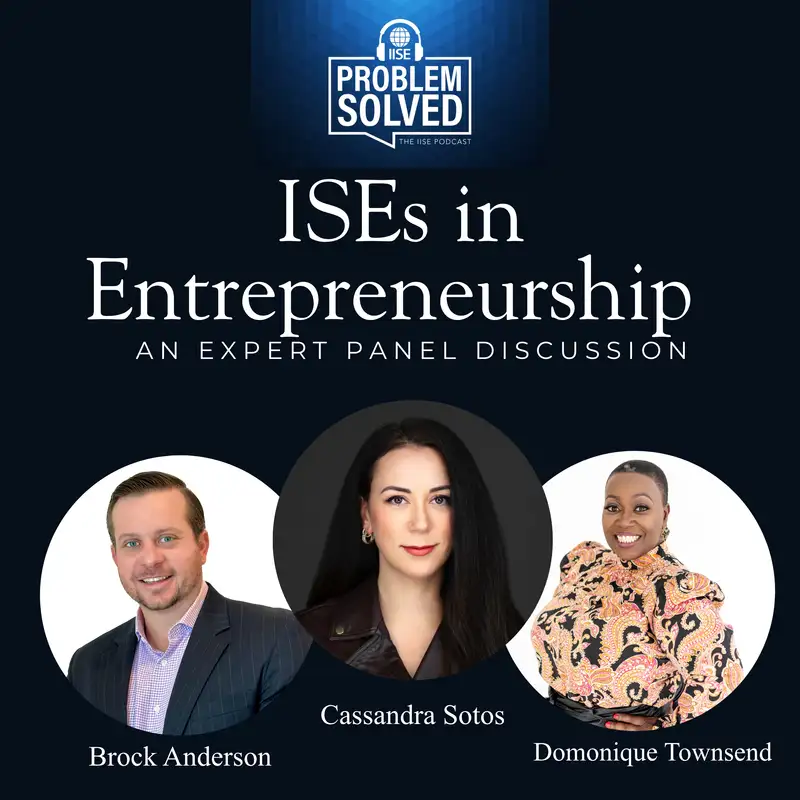
ISEs in Entrepreneurship: An Expert Panel Discussion
Download MP3Welcome to Problem Solved.
On this episode,
we're exploring the intersection
of industrial engineering
and entrepreneurship.
Before we begin,
I'd like to introduce
today's host and panelists.
Taking over the mic is Cassandra Sotos,
an industrial engineer,
internationally
touring violinist, and CEO of AmpRX
a music products company.
And joining Cassandra
are Domonique Townsend,
CEO and managing partner
of We Optimize Work.
She's an industrial engineer
and Lean Six Sigma
Master Blackbelt
with two decades of experience
helping organizations
solve complex business challenges.
And Brock Anderson, founder and principal
ergonomist of Ergo-ology,
who combines ergonomics
engineering and Lean Six Sigma
to help organizations
improve workplace safety and performance.
Together,
they'll explore
how their engineering backgrounds
have shaped
their entrepreneurial journeys,
the risks
they've taken and the lessons
they've learned along the way.
Here's Cassandra.
Hello, my name is Cassandra Sotos,
and I am honored
to be the guest host of Problem
Solved today.
We're going to have
a great conversation today
about industrial engineers
and entrepreneurship.
And I am joined
with, Domonique and Brock here.
Could you guys tell us a little bit
about yourself, your company,
how you ended up in entrepreneurship,
the wild world of entrepreneurship, and,
your background?
Okay. I'm Domonique Townsend.
I am the managing partner and CEO of We
Optimize Work.
And our motto is to make work feel good.
I have two decades of experience
as an industrial engineer
and lean Six Sigma master black belt.
The journey to entrepreneurship.
I've always wanted to be a consultant
to help
people solve problems on a larger scale.
So, with the journey to entrepreneurship,
just being able to see common gaps
throughout my career led me to entrepreneurship
so that I can have a bigger impact
and how people were able
to solve problems,
particularly frontline employees,
all the way to the leadership levels
and getting them together
to solve problems cross-functionally
and helping people improve
how they can see themselves relevant
to a change in the workplace.
So that's what
led me and inspired my journey
to entrepreneurship today.
So Brock Anderson,
I'm the founder of Ergo-ology.
So we are,
lean and
engineering and ergonomics
based consulting firm.
Been around since, 2015.
Really
The moment that I realized
I was going to do
this, my, my corporate job at Coca-Cola,
was dissolving the
the whole global department was being,
kind of let go.
So we were sitting there or,
you know, talking at the dinner
table, and I was like,
all right, well, I'm
going to start throwing
my name out there to some big companies,
I guess, and, and get back on board.
And my wife's like,
this is the prime time to do
what you've always been talking about.
And I was like, well right, now? Like,
we got a little kids and,
you know, brand new family.
Like, are you sure
we're going to dive into
to start a whole, you know,
a whole business
and the whole platform and she goes,
you know,
what do you love to do more than,
anything else?
And I was like, well, create, innovate.
Like figure out
where mega problems are
and how do we solve those,
you know, worldly problems
or company based problem.
And she's like, all right,
there you go right there.
You're not going to go introduce
you on the other jobs. You’re gonna create it.
So and I was like, wow,
this is we're going to do this, I guess.
The following day on the back deck,
the big windows,
I had a dry erase marker
and started scribbling.
How are we going to do this? Right.
So one thing led to another.
You know, 12 years later,
we're rocking and rolling.
Wow, that's really fantastic.
I love I love that story of that moment
when you the dinner table moment
when you realized to make the pivot
and both of you were
like traditional eyes
before traditional eyes.
Yes.
And it's the same saying similar.
Entrepreneurship was always the goal.
Now when it was supposed to
happen was by divine innovation.
But I was also a part of a relief.
And the
the restructuring of the organization
led to the layoff of my role.
And it was
it was one of those it makes sense,
but it doesn't make sense
because we were a family of six.
My children were four children,
nine and under
and health insurance,
all of the things that,
you stay in a role to keep your,
your safety and security,
all of those things were
were on the table, as Brock was saying,
leading into entrepreneurship.
It was the the ability
to solve the very problem
that I was laid off for.
And it was like people are not seeing
they're determining
what value is based off
of a surface level assumption,
versus really taking the time to engage
with people
seeing what their performance is
beyond what a manager
reports, beyond what
what they are able to see.
And, one of those gaps
was not seeing how people were relevant
for a change,
how they were communicating,
what was an improvement,
how they were driving solutions
that just wasn't visible.
I want to help solve this problem
so people can see
what they're letting go of.
I want to solve this problem,
on a bigger scale
because it's happened to me personally,
but it's also happening
in how people make decisions
is the gap in how they determine
what's value,
who's including
and shaping those decisions
and how they're solving problems.
And that,
definitely was one of those
for children out and under.
And it was one of those things
that I wanted them to see.
How can you
have this vision and make it come true?
It was one of those things
where it was like it made more sense to
to pursue this.
This journey
than it did
to go back into corporate America
because of the gaps that were
that were happening.
You know,
I really a lot of what you said
has resonated
with me already,
just five minutes
into this conversation,
feel that we're aligned on the idea that
wherever you put your energy,
your intentionality
can become a success, right?
You know, it's like,
not that there's anything,
quote unquote,
wrong with the corporate job
or the corporate career
or the traditionally
the nontraditional
I it's just, you know,
where your energetic efforts
can bring the most impact
actually at that time.
So, you know, I have
I have a question here
that I was going to ask,
and I should have known not to word it
this way,
because this is not the case for me.
The question is, actually
looking back, was entrepreneurship
always the goal
or did it happen by accident?
What it sounds like to me is
and what my
my answer to that question is,
is that it was always the goal
and it happened by accident.
I can't even say that I had an interest
in being an entrepreneur
like as a kid, college
kid, high school kid,
because I was just doing things
entrepreneurial.
I went to Penn State,
I'm a Penn State I
and then I became
I went into the corporate world
for a couple of years,
but I left totally,
and I was a touring musician
for over ten years.
So I, you know, I'm a violinist.
I toured,
I toured for
internationally for,
12 years and then by accident
got back into business.
I'm in the music products business
and my,
my partner and I, who's
also a musician after the after,
the touring world shut down,
we went through a bunch of
different changes in business,
and then we found out
about an opportunity to buy a business.
And here we are
in manufacturing
power supplies for guitar amplifiers.
It's a longer story than that, of course,
but I think one of the things
that made me successful as a musician,
as a touring musician,
is looking at my work
from an entrepreneurial standpoint.
I had never felt like I was just quote
unquote, just a violinist or just,
a band member or whatever it was.
I was running my own business.
I happened to be the product.
My services happened to be the product,
but it made me really successful in the.
I live in Nashville
in the Nashville market.
So that cumulative skill
set, I think, especially as,
people with IE
backgrounds, is really valuable
in entrepreneurship
and in the world in general.
Leadership.
And that leads me to my next question
that I want to ask about the IE
advantage, which I think we all have.
I know we all have.
I believe greatly,
strongly in what we learn
and bring to the table as I use.
But the question is,
has your engineering
background made you more willing
or less willing to take risks?
So, you know,
I've built my my career off of,
stepping off the ledge
into the great unknown
saying, yes, people always like to say,
there's power and no.
And I've always said that
there's power and.
Yes. So,
what do you
what are your thoughts on that?
The risk taking, the risk
taking aspect of it.
Because I know you can
calculate the risks.
Yeah, I know what I think of that.
I love the power of yes,
I want to take a pause.
But that that was that's really good.
It is a power of yes.
I mean, as an engineer,
I think we are naturally solution is
and there's always a possibility
for something to work.
It's
it's in our ability
to figure out what that problem is.
And for me
it's made me more willing to take risks
because I can easily identify
or reiterate.
So it's the caveat to that.
It's good that we can reiterate
so quickly, but it's also it leaves us,
you think continue to reiterate,
before we're bringing out
a solution to the market.
But that's neither here nor there.
So with engineering, like,
for me, my background
and just knowing that
I will always be able
to identify the problem
and connect the dots
and apply systems
thinking to it
allows me to be more confident
in taking risks,
because how to solve a problem
follows the same set of principles
that are proven to
be effective in
whatever problem
we're seeking to solve as engineers.
Traditionally.
And for me,
that background has led me
to be more willing to take risks.
Brock, what do you think?
It's a great question.
I have a seesaw answer.
I think that, as engineers,
you're trying to eliminate risk.
But as leaders, where we learn
which risk or we're taking.
So kind of looking at it from a problem
solving standpoint,
I think that's what the engineering
type background and mentality,
allow you to do,
systems thinking, meaning thinking.
But I think that it has to be met
like that.
Technical background has to be met
with some soft skills.
A lot of soft skills,
around the leadership space
so that so that you can decipher again,
what problems
are you willing to kind of step into
without knowing all the answers?
But it would be very calculated.
And over time, you
you see that success,
you see that growth.
The technical engineer, the the the the,
the non-autistic who might go,
hey, man, we got this.
Let's, let's move forward.
Because, you know,
you're a leader in this space
and there's no reason
not to create some
kind of a seesaw answer for me on that.
I answer this by saying
it makes me more willing,
because of that
systematic, I
call it systematic
dismantling of of problems.
You know, like, I feel like,
I can look at anything,
figure out what the worst case scenario
is, understand that it's not as bad as,
you might emotionally think.
And then
systematically dismantle
it and figure out how to solve it.
I think for me, entrepreneurship
as a whole
has taught me that
the biggest risk is not taking one.
We have to be calculated,
we get better with that,
with experience and age
and all of our tools and resources.
But I think the big difference
what I see
with some of my employees
or some of my peers in the world is,
is you get two facts, all right?
You get two to into the weeds of
I have to make the perfect decision.
That has to be so calculated
that I never actually make the decision.
And a lot of times, those
are the guys that are saying,
you're so talented,
you should just still
run your own business or like, heck
no, there's no way
I'm not going to take that risk.
And I'm like,
you know, believe in yourself.
Like I believe in you.
And they're like, I believe in myself.
But, no, now that's not me.
I'm good. Right.
So there's there's a balance
that constantly is going on. You know.
This is taking an interesting turn.
Now, this is this is not on script.
So I just want to take a quick detour
to ask you guys both this.
And then we'll get back to the script.
But I,
I didn't know what IE was
when I went to school.
I didn't start in that.
Did you know about it? What?
How did you end up in the IE program?
I had my initial interest
I did for years and,
in architectural engineering,
concentration at Tennessee
State University.
One of my first internships was in a role
that was under
someone who was an industrial engineer.
And so the assignments
that I was given
required to go out to the floor, engage
with the people.
And so for me, it was like,
well, what is this? I really like this.
I get to engage with people
and I love engaging with people.
I love helping them solve problems.
And for me,
I asked the
the my mentor at the time
who I was under,
what is what type of engineering is this?
And and they mentioned
industrial engineering
and I went back to school.
I still did another year
of architectural engineering.
And I met someone
and his name was the Wayne Allen,
and he is an industrial engineer.
He graduated from Tennessee
Tech University.
When he spoke about his career
and he shared what he did,
it really inspired me
to take it more seriously in transferring
and really completing that.
The matriculation
and I e
but again,
I did not hear about
industrial engineering and
and so I was deep into college already.
Right. Very interesting.
So mine I'm
completely opposite side of, of the,
the earth.
Okay.
So,
I didn't study any engineering undergrad,
studying physics and geology.
Like I mentioned earlier,
I was all wrapped up in the baseball
playing in college.
All about human fitness.
You know, you name. Right.
So this undergrad went
and played
a little bit of professional ball,
got caught and said,
what am I going to do with my life?
I'm no longer a baseball player.
I found myself going back to Auburn.
Like nobody saw me like, hey,
you gotta let me in.
I know that look like whatever it is.
Like I'm sleeping in my truck
until you let me in.
In the program, in the parking lot.
Like this is what's going to happen.
Two weeks
later is still sleeping in my truck.
She finally was like,
all right, well,
let's see in the fall semester, like,
that's fine.
Like, come on.
So I was still studying
what we call biomechanics, right.
That's the path
that I thought I was going to head.
Had you still touched
in the engineering space
at all of my masters
in body mechanics, biomechanics,
mostly dealing with sports. Right.
I'm still working with the baseball team
and over an internship as a strength
and conditioning coach
for the Auburn football team.
So I'm in there at like 3:30 a.m.
trying to work these athletes out.
They got attitudes.
They don't care that I'm determined.
Like, I'm all ticked off.
I'm like, look,
I got no sleep last night.
I'm here for you.
I know, I know, you're an athlete.
I used to be one, but you're a punk. I'm.
I'm there with athletics.
I'm never. I'm done.
So I remember
I went straight into my professors
office and look,
what can I do with all of my background?
That has nothing to do
with athletics ever again.
She's like, what do you know?
That's not me.
You're still going to dabble?
I said, okay,
80, 20,
80%, something
else, 20%, maybe Athletics.
She goes,
well, the,
the engineering department
had something called ergonomics going on.
You should go check it out.
And I literally heard her say, aura.
And I was like,
sorry.
I was like, paper birds.
She's like, no, no. No, man.
Like ergonomics.
It's an engineering discipline.
And, literally within like two to,
credit hours, I was obsessed.
I was like,
this is still body
mechanics and ergonomics,
but it's totally my mentality
of picking apart things and being like,
how do we get systems better?
It started to get the wheels flow,
and I was free from sports
all of a sudden.
And it was a it was a good space to be a
wow.
Now that's a story I love that
I really love. You know what?
I think we need better marketing.
I had never heard of
industrial engineering
before, before I got surgery to,
to Penn State as well.
I, you know, I was
truth be told, I wanted
to I wanted to be a musician, and I had
I knew that I wanted
to, like, be in business.
I wanted to be a musician.
I didn't
I didn't see a path for me
in the music program.
But I,
I got a scholarship
to the engineering school,
so I had to be in the engineering school.
Yeah.
And so I was like, well,
I started out in bioengineering
because just
I just freshman year,
you pick something
that I got paired with a senior
as just part of,
like a orientation program.
And I was like, what?
You know, she's telling me what she does.
And I'm like,
well, I'm really interested in business,
but I don't want to go
to the business school.
I don't know, like, what should I
what should I really be doing here?
And she told me what she did.
She was an industrial engineer.
And I was like,
so you're telling me
that, like, I could work
in the environmental industry with that?
And she's like, yes,
and I can design
new products with that, just like, yeah,
you can
and I can work
in music products.
She's like, yeah, you
anything where something's made
the answer is yes.
Whatever you're about to ask me,
pretty much the answer is yes.
And I was like,
this is awesome.
She and the way that she that
she described it to me
was the liaison
between the business world
and the technical world.
And that was
like, that was it for me.
I was like,
I like to see things happen in real life.
I like to see the idea.
I like to then make it happen,
and then I like to make it better.
But yeah, like I said,
I think we need some better marketing.
And you know,
everybody knows
about mechanical engineers Aero.
And you know, I. Mean like we design.
And then you find out
that there's more CEOs
that are industrial engineers
than any other background.
And you're like, how are we nice.
Why is the flag not being flown?
So on that topic, what do you think
in your in your experience as, business
owners, entrepreneurs or even, you know,
in the corporate world?
Like,
what part of your education or background
do you use almost every day
that you didn't fully appreciate
while you were in school
or in the corporate world,
or has been the most surprising
facet to your current day business?
We're going to get
the marketing soundbite right now.
Yeah, right. Right.
The calls for station identification.
So I think for me it had to
do with this
evolution of IE leading me to lean.
So I also got a lean Six Sigma
black belt through the,
the Institute
of Industrial Systems Engineer.
IISE
that in and of itself
really transform
not just work life, but personal life.
I mean, I've always kind of
put my time under a microscope.
I've always been very careful with
what does my daily routine look like,
so I can maximize
efficiencies and get rid of waste.
Maybe at the household
that that tool or that skill set
is not like this.
Much like when I go into the pantry
and start going,
hey, first and foremost, now, like,
none of this isn't going to work.
Well, you know.
My wife’s like no...I'm just picturing it.
I am picturing it right now.
No wife's like, no, no, no,
that's Thursday's dinner.
I'm like, okay, well I'm just saying
I apply a lot of that same stuff
to work, too.
I, you know, talking with,
with the team and saying,
you know, where do we feel like
we're, we're missing
as far as wasted time or wasted energy or
or wasted customers?
Like, who are we spending time on that
we really don't get a return on,
that we have to let go and
and feeling
confident in the ability to let go of
what is a paycheck in order to go
maximize a paycheck somewhere else.
Right.
We're all we did in that time.
I fired energy back
every week, every day.
So, you know,
I even have those conversations of,
you know, where's where's the,
the juice and the squeeze, right.
How hard are we having to work
for that dollar versus,
you know, can we go over here,
show our skill sets, maximize our value,
and it's a better partnership
all the way around.
So,
I would have to say my short
answer would be lean.
I think just the tools that come in
the lean space
is something that's
surprising to me,
that I never really
found myself gravitating on a continuous,
cerebral forefront of those types of,
concepts.
That great perspective.
I love that.
And, I do agree like you do.
Take it home.
I know
when I go into stores,
I cannot go into any store right now
without thinking of how could this
be more efficient,
this, the merchandise
and all of those things.
For me, the most surprising advantage,
with industrial engineering
is being able to easily
see how one part of an ecosystem impacts
the other.
I did not realize how many people do
not think cross-functionally that,
we do as industrial
engineers because we're trained that way.
And, you can go as far as saying
that people who consider
industrial engineering,
are wired
that way
and thinking
cross-functionally,
how does one impact the other?
So I would say that
that would be the biggest,
advantage, especially now
with the pace of change
and transformation,
job roles are becoming obsolete,
but the skill sets or not.
And so when people
are thinking in job roles,
they're thinking in silos of,
of this department
versus this department.
But as transformation is
the pace of it is rapidly changing,
you can see how those skills
can be transferable.
And being able to see,
well, if you're making this solution,
this impacts these other functions.
That's an advantage that we have
that not there's not a lot of people who,
like approach work
in that sense
of cross-functionally versus silo,
especially in the space
of corporate America.
So for me,
I will say this, the surprising advantage
that I thought that even went, thought,
like I said, that when,
when they approach solving problems.
That's really interesting.
One of the things that
I wanted to talk to you both about
is when it comes to leadership,
I look at it as there
are
Visionary,
there's like visionary leadership
and operational leadership.
And how do you lead?
Tell me what your thoughts are on that.
I found myself,
even with an IE background,
excelling more in the visionary aspect
and the strategic overall
aspect of our business.
Not as operational as my professors
would have liked me to have become.
And,
it's interesting because my partner,
we we run the business,
we're co-founders,
we run the business together.
He is he's not the IE, but he's the IE.
So he's kind of in the CEO role.
He's really like
things much more operationally.
And I find myself being more visionary.
I think that my visions are informed
by the operational side of me.
But I'm curious to hear from you.
If you identify
more as a visionary leader
or an operational leader.
I hear a lot of operations
from both of you.
I'm a visionary,
but I like to stay in the lab.
So, which I didn't realize
I like to create and so.
Well, in the creation of it is
how can we make this,
this problem better?
How can we have new ideas?
How can I create it
so I can introduce it into the world?
But it's all a part of this big vision.
But I
definitely look at myself
being more operational
in how I approach things,
the iterations of it,
and to refine it
being in this,
this lab creating
and then bringing it out,
to meet the bigger vision.
So I lean towards
more towards
being operational in my habits.
But my
I'm definitely visionary
in my mindset approach.
So it's this big vision.
I have all these things,
but then I go right back into
looking at the the,
you know, being in the lab
versus staying in the visionary, realm.
When it gets to how I look at,
how I even apply industries
to engineering and even entrepreneurship.
Brock, what are your thoughts?
It's a good question.
It's a great question.
I think the the the sweet sauce,
is living in the,
like, the intersection of both vision
and execution.
So if you're only visionary,
nothing gets done.
If you're only operational,
nothing changes.
So if you think about that,
it has to be this balance, this balancing
act to my mind of when to be visionary,
either forced, forced visionary, like,
I'm going to go have quiet time
and I'm to, I'm going to whiteboard
or write on windows like,
how are we going,
what where we want to go
and how are we going to get there. Right.
And what is it
going to take to get us there?
And then what is it
going to take to get us there?
A lot of times
drops back into more of the operational,
the operational side.
So there's a there's a time, resources
and what
type of funding are we going to need
to do that.
So again
know like if if you're only visionary
nothing gets done.
So we have to have
some boots on the ground.
But if you're only operational
I think the bigger risk is
if you're only operational,
nothing changes.
And we live in this world of
ever evolving
and dealing with it right now
with, with, our tools in an AI world.
Right.
So I think it's no surprise
a lot of people, companies are or,
trying to reduce headcount
and go to more AI driven
platforms and
coaching customers, educating
customers, deciding
if we're going to go
in a different route, is both visionary,
because I don't want to
just stay in operations
mode on a hamster wheel,
and all of a sudden,
you know, we get left in the dust.
So,
you know,
I think you got to have the windshield
and the engine, right?
The windshield is our vision.
We are the engine.
That's how we're going to get it.
It's good.
To have you.
Either of you felt
that you've
become unbalanced
between those two aspects of yourself?
And what did you do to rebalance
or create space for
one side or the other?
I found myself being unbalanced
in the beginning of the entrepreneurship
journey and,
being more operational,
just having that one vision
and going back and operational
and how to work with clients
in particular.
Over time, as was being more intentional
in providing that space.
So now I have developed habits.
I have an approach of how what like what
I was saying
and having the operational side
of things of
we need to space, look at time,
study and trends.
We need to look at the data.
What is the feedback
telling us to make informed decisions?
If the vision that we have
or are we in alignment?
So for me was unbalanced at first,
and then it got into being balanced
when I started to see like this
vision cannot be executed
if you don't have the
the operational
habits are the way the systems
in place for people
to be successful in doing it,
and then also is making
sure you're reminding people
this is the vision that you're
working towards,
so they won't be so into trying
to make this work without assessing.
Is it the right direction to take?
When do you flip a switch
so you can reassess?
The vision to reassess
how, your,
your systems drive,
the way that you reach the vision?
I have a lot of
commonalities with my answer.
I would
say at one point, to,
to kind of go
right back to your question at one point,
got a little,
too operational, heavy,
not so visionary heavy.
And really, my soul for that is,
I went home and I said, honey,
I think I need to go to Hawaii
for a month
to get very visionary on things again.
That she didn't go for it.
So out of fear of.
And I. Anticipated it.
I'm listening like something, and.
I'm like, I need to meet this lady.
You know?
No, I,
you know, honestly,
again, it's being able.
I feel like to have the ability
to see a clear forecast.
So, like,
what is coming for your business
and how do I prepare myself
either operationally or shifting,
you know, our mindset or our vision
based on what's coming?
I think
really good
entrepreneurs have a pulse
on two steps forward versus
like waiting for that to happen
and then reacting.
So I think the real challenge
is for a leaders
balancing the two worlds.
Right?
Vision without execution really
just becomes
a collection of great ideas
that never create value. Right.
And that's what
I was pitching for Hawaii.
But, you know,
probably a good thing that of
and then I think the execution
without vision can lead to this
incremental improvements,
but not really have meaningful growth.
Right.
So I can stay in operational mode
and go
day to day to day to day
to day, an invoice, English
invoice, invoice, invoice.
But ultimately,
if I'm not developing a new program
or a new type of training or a new tool,
the current customers are
eventually going to get tired of of,
number seven on the dinner menu.
They're going to say, hey, tonight
I want to try a little something
different, right.
And that's
where that growth
and innovation comes into play.
And I'll expand on this
when I think a little bit,
because I sit in this space a lot,
early on,
deeply involved in the building process,
delivering programs, developing
programs, the content
within the solving day to day problems.
How do we market this company?
Some sidebar story, like how do I so
how do I sell myself?
How am I so much services
like I'm a technical resident,
you know,
at every corporation
that I was a technical resident.
So if I said jump, let go. Okay. Cool.
So, now all of a sudden, I'm telling
I remember it was Clorox.
I was like, hey, you need me?
Because I've done some data digging.
And the lady literally was like, no, no.
No. It's like.
All right, have a good day.
But, you know, like,
look at what a terrible salesman like.
Those are terrible.
So, so,
but those are operational growing pains
that had to take place. Right.
And, you know,
I think
now my role is, is helping
my team understand
where we are, where we're headed,
why it matters.
What's a bigger impact
for the for the client.
So I don't think the best leaders
are purely visionary, purely operators.
I think you have to maintain
that balance.
Everything that you said
really resonates with me.
And I think that part of
being the entrepreneur,
especially in the early stages,
until you are able to grow a staff
and I'm not sure how many employees
either of you guys have,
but it is wearing all of those hats.
I mean,
you know, every hat,
like literally every hat
sales, marketing,
making the website, the janitor, the,
you know.
Staff psychologist, psychologist,
accounting.
Okay, I'm the I'm QuickBooks clean.
Now, I finally got rid of
somebody else on the QuickBooks.
How many screams
have come out of my office
because of QuickBooks?
Anyways?
I just
I think that one of the advantages
that I've had throughout
this is, is being able to manage
all of those things at once, you know, I
which I've been able to do at varying,
you know, levels of success.
It's obviously
like I mean,
it's it's been very, very challenging
at times, but,
you know,
identifying where to spend my time,
how to spend my time, how to view it
all as a system,
how to view your entire business
as a system.
I think that's why we end up
so many people in the CEO chair,
because you can see that
cross functionality.
You can see,
that you have maybe
an operational weakness
in sales, for example,
which is something that that
we struggle with as well.
I want to
ask some questions,
some specific questions
about lessons and advice.
What is one lesson
that entrepreneurship has taught you?
That engineering school did not
I’d say
Engineering school
it taught me how to solve problems.
Entrepreneurship propelled me
to solve the right problems. So
There are several ways
that we as industrial
engineers can solve problems
because we're trained that way.
So just
being able to narrow it in
on solving the right problem
and then identifying
what companies algin with
that would market aligns with that
and being
okay with it,
even though that urgency is
you want to save the world is like,
what is that one thing?
And then how can you establish
those relationships?
But we do know how to solve a problem.
We do know how to follow the methodology
that we are taught and how to apply it.
But it's all about narrowly,
narrowing in the end,
when you get into the entrepreneurship
so you won't have to,
you won't feel the need to be the problem
solver of the world.
But you're the problem solver.
That one thing that you like, the,
that that really compels
you to want to keep solving
and learn more about and expand upon.
I'm going to
you gave me a second to think about this one.
So I'm going to answer
from both a operational response
and then a visionary response. Right. So,
operational,
I think that,
just engineering tools in general
or going through those, those classes
teach you how to seek certainty.
Then I'll expand on that.
But entrepreneurship taught me
how to lead through uncertainty.
All right.
So I think
most problems have constraints.
They have data.
We have a logical path to a solution.
Right.
So engineering class mentality
if you work hard enough
you most of the time
to bergdoll yourself to the right answer
versus entrepreneurship
or outside of those engineering
type classes,
you're having to make decisions
with incomplete information,
with limited resources,
and then really no guarantee
that your assumptions are correct, right?
So,
what I mean by that is, I guess, on the,
on the outside of engineering
classes side,
well,
how do you navigate
through the uncertainty,
when you don't have data
or you don't have forecasts
and sales leads or you don't have,
line of sight
to really what that customer
is asking you to quote,
you're like,
going back for the 12th time on the email
or the phone call and you're like,
so great answer.
I need you to expand
a little bit, please.
Like a little bit of details,
maybe some bullet points, you know,
what are your goals?
Maybe you have one of those in there
because you know, the one sentence,
I just need something that works here
that doesn't really give
me a lot to go off of. Right?
So that's that's my operational answer.
The visionary answer.
All the soft skills stuff
you just talked about, we spend,
three hours a month.
That's a given day that we all pick.
It's almost a half day
where the whole team gets together.
We go through a leadership topic.
It can be some type of,
leadership philosophy,
like the Three M's to motivation or
any anything that's grooming or polishing
the team around
soft skills and leadership.
Active listening,
no military body language,
knowing when to not push, knowing
when to push.
It's the grit and the grind.
I think that even though,
you know, engineering
classes were tough
and you have to study
what McGinty by any means,
you know, when you start
for the 120 hour weeks
trying to get a business off the ground,
I don't know if if school
in and of itself taught me enough
to actually be able to do that.
Does that make sense?
Yeah, definitely.
It's interesting
because it's probably one of the best
backgrounds that you can have,
but it's still
it still doesn't show
you everything that you need to know.
You know there's still just some mystery,
of challenges
of side quests, of learning that
that happen after the fact.
But I still I still believe that we have
one of the best foundations
to start the journey with.
For sure. Yeah, absolutely.
What is something that you believed
about entrepreneurship
that turned out to be completely wrong?
Oh.
I can start on that one.
Yeah.
I think one of the things
about entrepreneurship that I,
they turn out
to be completely wrong
is that
everyone is not your target market,
and it goes right back to the background.
We know how to solve problems.
You give us a problem,
we can help solve it, or we can tell you
if you're solving the wrong problem.
The caveat with
that is you can solve problems
but at a broader scale.
And what,
the thing that I had completely wrong
about entrepreneurship
is that everyone was the target market.
So just finding companies
and just identifying the problem
and saying,
I know that
this is what you're experiencing
because based on my experience
with this industry,
this is what's happening.
And then I go to another company
and do the same thing.
And I had it completely wrong,
because it disqualified
how I was able to make sure
that my values were at the top.
So my values were people.
Is this company people centered?
Are they aspiring to be people centered?
Do they intentionally engage,
cross-functionally in
how they are using frontline employees
all the way
up to the executive level
in solving business challenges?
And for that, it limited it.
It started to narrow down
which companies aligned
with my target market.
And so completely wrong was thinking
I can solve every company's problem
and convincing them of the value
it is in having
cross-functional collaboration.
So not all companies are ready to
understand how to be collaborative,
and how they’re reaching business challenges,
how they address and business challenges.
Rather, it
let me know
if I have to convince them
of the value of this, the sustainability
after even if if, I'm done
consulting with them
or we completed a project with them
that it won't sustain,
that was the one thing
I had completely wrong.
Is still feeling
the need to convince people
of the value of,
solving problems,
cross-functionally of value,
and of letting the data tell a story
and and engaging people
to see how they're relevant to the role.
And, and if you have to convince them,
then the likelihood of them
sustaining that improvement is very low.
Those are great I'll tell you the story
that I really,
I really thought would make it
successful
early on with it
you know, revenue in the company.
So, I remember like, we were
we were at a point now
where like the web pages rolling,
you know,
a few clients are starting to trickle.
And I think
I just put on my old school, like,
I don't know if it's the the athlete
mentality or what,
but push harder, push harder,
push harder.
You know, more more is better.
And I just remember this one time I,
just got off the phone with this guy.
I thought
we were going to close the business.
He said, I need to think about it
a little bit longer.
So I said, okay, yeah, no problem.
In about 95 minutes
later, I call you back and asked you
if you had time to think about it.
Well, you're.
And he's like, I remember
like quote unquote,
bruh, I'll reach out to you
when I'm ready.
And I was like, okay, sounds good.
So tomorrow I'll call you again.
Like, no, maybe,
I kid you not, just
that was my mentality going into
it is run
hard, cover some ground persistence.
Like maybe they'll say yes
just because they're tired of me
being a woodpecker.
I don't know, but, literally
that whole mentality
of, of pushing harder,
was not
that's not
that's not what leads to success. Right?
When you push harder at the wrong things,
it really comes from being able
to push harder,
use that passion and use that fuel,
use that energy, that grit,
whatever you want to call it.
But don't let it out of its cage
until you find the right vector
for it to go right and push for it.
The right things
more is not always better.
We've heard that quote, right.
I think the more is better,
as long as it's,
channeled in the right direction.
Right.
So,
effort and effectiveness,
they're they're totally different.
And when I do a lot of my,
my entrepreneurship talks or,
you know, talking
with, with young adults or whatever
it might be,
I use a term called compounding effort.
All right.
So very similar to compounding interest.
The sooner you put the money
in, the longer
it sits there,
the more you have it in the
the same with same with effort.
But you also have to have
the wins of effectiveness.
So the earlier in your career
you can find that that grit and grind.
Second gear,
be a visionary,
be operational, start
putting all those pieces together.
I think
compounding way over
the course of your career,
your efficiency and your
your yield will always be exponential.
Right?
But you can't just go at it
from an effort standpoint.
You also have to bring
in that effectiveness.
Long hours
doesn't automatically create
better results.
That has been a challenge
for me over the course
of owning our business too,
is that it's it's
looking back and saying,
I put a lot of energy into that and.
Yes man lessons.
So yeah.
And it's like,
not, it's never for not, it's like just
you've always learned something from it,
even if it's just that you shouldn't
be putting so much effort into that.
You might not have
needed to put effort into that vector.
You know, as you put it,
you know, being the person who is
in charge of deciding
also brings a lot of weight
to the equation,
a lot of that responsibility and the,
you know, corporate world or whatever's
people complain
about how there's 18
layers of red tape, but,
you know,
there's 18 people
that are weighing in on that decision,
and then it's annoying.
But then whenever you have to be
the one person who decides
to pull the trigger or not,
it's it's freeing
and also crushing at times.
And,
it can be a lot,
but there's always a lot to learn.
If an industrial engineering student
listening today
is considering entrepreneurship,
what's one piece of advice
you hope they remember
from this conversation
five years from now?
Oh.
I would say don't let timeline
be your strategy.
So I know I've always
expressed an interest
in being a consultant
and owning a consulting firm.
And people tell you
work for 15 to 20 years
and then you'll have
the expertise to do it.
And when I look back, it wasn't
like the
time that I started in a consulting firm,
even though it’s divine intervention
it was really understanding
what is that
problem that I want to solve?
And then looking at
what are the frustrations,
what are the experiences
that I personally have experienced?
What are the experiences
that that others
that their peers are experiencing
and then seeing?
What is that common now with you?
And how does this support
that problem and strength
and how you,
study to solve that problem
is, is my biggest thing.
So if you're considering
entrepreneurship, identify
the specific problem and hone in on that.
Brings a greater value
than focusing on
just gaining experience
in a broader spectrum.
You're actually like assessing
as you are experiencing
different challenges.
If you're going to internships or co-ops,
if you go into corporate America,
just start paying attention to how
what frustrations there are
and then narrowing it down
to that
one specific problem,
like if
if you feel like this is the one problem,
if we solve this,
this can help change A, B, and C.
Like all of these experiences,
it seemed like I was going
through the same challenges and gaps
in each company that I worked with,
as if it was.
It was like, you got to be kidding me.
Same exact gaps.
So it was like,
this is the type of problem
I need to solve.
The gap is in
how people are being engaged
and who's involved to shape
these decisions.
And so that's
yeah, that'll be the, the, the one slash.
Two things
that I encourage people
to consider
if they're looking
at considering
entrepreneurship as an idea.
So don't let timeline be your strategy.
Yes. Yes.
Get clear on your values.
Your values are Sara.
Let's say me.
Should I tell a love story?
No. Oh.
You have good.
Stories.
Maybe my advice.
The answer.
Students will be
become a good storyteller
because people remember stories, right?
People like doing business with people
they like. Yes.
All right.
I don't want to underplay my
technical skills.
I don't want to underplay,
any of my team's technical skills.
But I can tell you right now,
even if we're overpriced by 50% to the
next competitor,
if it's a customer
that likes doing business with us,
we will get to the right,
kind of goes hand in hand
with this philosophy, right?
Like,
don't let your job become your identity.
Right.
I remember sitting in that seat as a,
as a, a grad student.
And in fact,
the whole reason I didn't finish
my PhD is
I got a job offer, and I took it.
I took an internship job
offer at Gulfstream Aerospace.
Was on my path.
I think I had another year or so
to go to to finish all the doctorate.
And I was like, heck no, man,
I got a job.
Let's go. I'm going to McVay.
This is going to be amazing.
Meanwhile driving you know a
little little bitty car and like
oh man's got an old saying that's needed.
This is not good.
You know you should stay in school.
But don't let's don't focus on the job,
okay?
Don't focus on doing all this stuff
so that you get that job,
build your skills,
build your character,
build relationships.
Those are going to outlast,
outlast any title
that you're going to ever have, right?
People like doing business with people
they like,
whether you know,
whether you do take that
corporate America
job is still the same thing.
Like you're going to get promoted
based on two things technical
technical ability and likeness.
And I would say more times
than not, it's the like
and also the technical ability
and especially
a lot of different sectors.
So but I think over time
you realize that,
careers change much
faster than character does.
Like this.
That's the supreme bull, right?
Careers change much faster
than your character does.
So as a student, focus on you.
Focus on yourself as an asset.
And if you do become an entrepreneur,
you will actually
have all the preparation built upon
you were in you to handle
what your title is.
When the time comes.
I like.
That, yeah.
If they say hey I, he ain't got the hang.
I mean seriously because you're spending
whenever you're touring.
This is just to illustrate
how applicable this is in the world,
not just in owning a business,
being an IE or whatever.
You're a touring musician,
you play guitar for so and so.
You spend
when you're on the road 24 hours a day
with these people for weeks on end.
If you don't have the hang, forget it.
You're done.
There's somebody else that can do it
that has the hang.
Now, of course,
you have to be able to perform
at some level,
but the hang is a lot of times
more important
than the actual performance.
As long as you're
performing at a base level.
So that's just such a great point
at our company, up our,
we sell a product called the Brown Box.
We deal with voltage.
I, I make a joke,
sometimes I say that I'm going
to get an honorary MBA from Harvard
in marketing for making voltage funny.
And but what people say, they say,
what do you like about AmpRX?
And they say,
oh, they make great products,
but those are they're just great people.
They're just great people to work with.
Cool.
You know,
and so I just really echo
your point, Brock.
We've just covered so many great topics.
Are there any other things
that you'd like to add
that you think
that we missed, that we didn't cover,
that would be important to our listeners?
I would say if you see yourself
providing a solution
that solves a problem,
you are fully capable
of bringing it to fruition.
Many times
people try
to qualify us through the lenses
that they
determine as ready or as capable
or as fit,
meaning, fitting in a box or whatnot.
And
I encourage people who are listening
to be okay, owning
what they believe about themselves
and how they see themselves
solving a problem,
how they see themselves
bringing a solution. It's not easy.
And sometimes you have to remind yourself
of who's you are.
I even have to do the same thing.
But oftentimes
we forget that we can remind ourselves
of who we are,
but we can define who we are,
in the process.
And that can be enough,
to move forward in what we need to do
and just be anchored
in what you believe about you,
being that person solving that problem.
Not not anything.
While for me, I think in closing,
it's important to remember that success
really kind of comes from a single
great idea
or a single breakthrough moment.
It kind of comes from having this vision
to see what other people can't see.
Discipline
to execute consistently.
I think you have to have some resilience
to keep moving forward
when results are not immediate.
I think as a leader, you kind of have to
polish those soft skills
to inspire people.
Ultimately,
not being liked or being able to hang,
not the hand.
I was actually in Nashville last weekend,
so I totally get what the hand means.
And I was a dangerous.
That was a dude.
It was. Hey. All right. Also.
All right.
Well,
we're we're
we're going to talk about that
after we stop right
off the record button. Yes.
Please do.
It.
We're hanging, very systematically.
Hanging. Very.
Oh, I know, I know how to do that.
Well,
if you can balance
the vision with the execution.
Grit with.
Oh, man, I'm
getting to philosophical here.
But, like,
grit with the ability to adapt.
Adaptability doesn't have to mean soft,
right?
You've got to give yourself
the opportunity to build something
meaningful. Right.
Like that was my whole
thing is
I don't want to look back over a career
and see myself on a hamster wheel,
see myself
going back to the same office,
seeing myself
doing
relatively the same things
over and over year over year.
Still getting paid
with three 5% payments.
But ultimately my value,
stays on a flat line versus
an exponential curve. Right?
So I think when you think in those terms,
the long term,
even if the results aren't
there, all the grit growing, humility,
that's kind of what I would leave
you guys with.
That's what it's going to take on the,
on the entrepreneur side.
What I would like to say in response
to all of that, to our listeners,
is that everything that you all have
said, everything that we've said,
this applies to anyone.
This is not excluding anyone.
All of these things
that we've discussed as what you need
to bring to the table or what
you should try to bring
to the table as an entrepreneur.
These things are available to you.
This is we're not like nobody's
superhuman here.
There's not any unique positioning
about who we are, where we've come from
that has made us more or less able
to accomplish
the things that we've accomplished.
Many people might look at my story
and say, I had no business
taking over the business
that I took over.
I had no business
becoming a full time musician
like you could make a lot of excuses
as to
why or why not,
but I don't think any of
them are applicable.
And all of these things are within reach,
especially to a person
who probably came across this podcast.
If you have
a industrial
or an industrial engineering background,
which, you know, we
I'm sure we have some listeners
who are maybe considering
this path educationally,
maybe they're not there yet.
You have already a great foundation
to start,
to start from,
if you want to go on
the entrepreneurial path.
Something that I learned every day
is that I don't
I don't know what I'm doing,
and neither does anybody else.
And that can be a great advantage.
I always just try to figure out the next
best thing to do.
It's not because I have some superhuman
divine intervention of what
how to do things.
It's just us figuring out what to do.
And sometimes it's right
and sometimes it's wrong.
And if it's wrong, you don't do it again
or you try not to.
One of my missions is to help people
stop saying, I could never do that again.
I don't I don't want to hear that from,
you know, from anybody,
especially people
who I know who I believe
are more than qualified to
start this past, start
this journey, and everyone
is qualified to
design and live a life they love.
That's what I would like to
to leave everyone with.
Thank you so much
for sharing your stories and your advice
is there a way that,
that we can reach you,
that listeners can reach you guys
afterwards if they want to?
I'm mainly on, LinkedIn.
So, Domonique,
D o m o n i q u e
last name is Townsend, and you can type
in L s s m b b for lean six sigma
master black
belt is the acronym for Visit Me on
We Optimize Work .com
We're definitely on LinkedIn.
I love to connect with you.
Yeah.
Likewise, LinkedIn.
Brock Anderson,
you'll be able to find us.
You can see
Ergo-ology on LinkedIn as well.
That'll have
all of our contact information.
Ergo dash ology .com
And that's the web page.
Thank you guys
so much for joining us again.
My name is Cassandra Sotos.
It's an honor
to be a
guest host for Problem Solved with IISE
I'm also on LinkedIn.
That's a great place to find me.
I'm on Instagram.
Anywhere you find guitar players,
you probably find me.
I'm a violinist.
I banished myself to the world
of talking to guitar players every day.
My partner's a bass player.
I'm a violinist.
I'm like,
sometimes we look at each other
and we say, what have we done to do it?
We're talking to guitar players
all day long and baroque.
You know what I'm talking about?
Because you're just
in Nashville, Domonique.
You know, because you're in Nashville.
Yes. Born and raised.
So, thank you guys again for joining us.
And,
I hope we all stay in touch.
Thank you.
Because yes, I.
Thank you guys. Take care.
Thank you.
A big thank.
You to Cassandra Sotos, Domonique Townsend
and Brock Anderson
for sharing their experiences
and insights.
And thank you for listening
to Problem Solved.