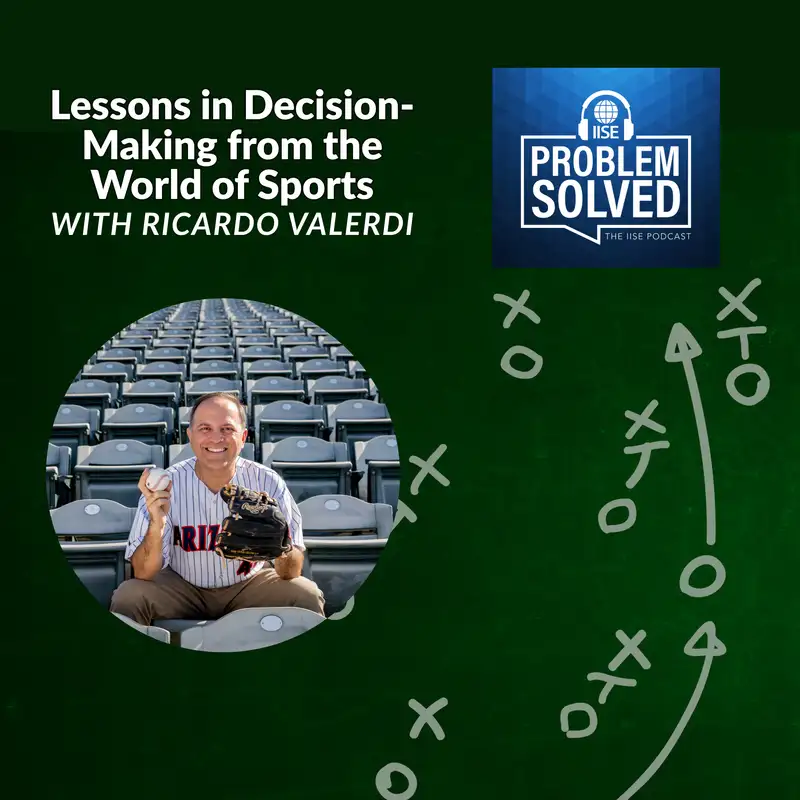
Lessons in Decsion-Making from the World of Sports with Ricardo Valerdi
Download MP3===
Elizabeth: [00:00:00] Welcome to Problem Solved, the IISE podcast. What do Major League Baseball, the US military, and industrial engineering have in common? They all depend on making good decisions, often under pressure. Today's guest is Dr. Ricardo Valerdi, department head and distinguished outreach professor at the University of Arizona.
He's also involved with CIEDAH, the Council of Industrial Engineering Academic Department Heads. Ricardo has worked with organizations ranging from SpaceX and the US Army to Major League Baseball. He's also the founder of Science of Sport, a nonprofit that has introduced more than 700,000 students to STEM concepts through sports.
In his new book, The Five-Tool Team, Ricardo draws on those experiences to explore how individuals, teams, and organizations of all kinds can make better decisions. Ricardo joins IISE's Keith Albertson to discuss the [00:01:00] book, the role of AI in decision-making, and what industrial engineers can learn from the world of sports.
Keith: Ricardo, welcome back to the podcast. Great to have you. It's been a while.
Ricardo: It's been a while. Thanks for having me, Keith.
Keith: Yeah, sure. It was great to see you at annual conference, and glad you got a chance to catch up with us there, as well. last time we actually talked on our first podcast is about six years ago now.
since then you've become the department head of, systems, and industrial engineering in Arizona. been involved with CIEADH, the, ISE group of, academic department heads. Tell us a little how that's going. Some of the things... I know you were involved in the meeting there at annual. What are some of the challenges, department heads are going through right now that you're kind of working to get through?
Ricardo: Well, what's interesting is that we all face very similar challenges. One, I'd say is, promoting our profession and, making sure that [00:02:00] people realize that even with all this, changes in technology and, and modernization and the economy, i- industrial and systems engineering is still at the heart of, making things better.
so we talk about ideas for how to promote that message, not just amongst the college students, but also amongst high school and even younger. and, a lot of the conversations at the CIEADH meetings also are around how artificial intelligence is changing our field. not just in the classroom, how can we use AI to, help educate and, help accelerate, learning, but also the industrial solutions, that our students are facing.
So how do we prepare our students to be competitive for those jobs that are utilizing AI? I, I'm not concerned with AI replacing industrial engineers. I'm more concerned with our graduates being replaced by other people [00:03:00] who know how to use AI better than them. So, so there's a lot of discussions about that, and we have some, some good solutions, but it's not an overnight project.
This is a, a, a long, multi-year, vision that we have to implement.
Keith: Well, in one way, you've reached out to, young people and grow the profession is through your Science of Sport organization, which we discussed, on our first podcast, that exposes young people to, STEM topics through sports.
And you've partnered with a lot of sports organizations over the years. T- give us an update on where that is. It looks like it's still really growing and been very successful. What's, what's the latest, that's going on with your organization?
Ricardo: It's been a ton of fun. Science of Sport, is now, about 13 years old, and we started, with the Arizona Diamondbacks creating a program that used, baseball to teach kids [00:04:00] math and science.
So all the geometry, all the statistics, and even physics. And, and then that, expanded, all the way to, the Atlanta Braves, you know, in your backyard.
Keith: Mm-hmm.
Ricardo: and what's also, happened, since we last spoke is we've expanded into other sports. So we've really hit, the NBA heavily, the NFL, Major League Soccer.
And, you know, with the, World Cup also, happening, recently, it's like there's an opportunity to get visibility through soccer. So we've been doing some work with FIFA as well. a- and the objective is the same, is how do we get, kids interested in STEM, through sports? And, boys and girls, altogether because it's not just about, baseball and it's not just about football necessarily.
I mean, basketball and, soccer are, very gender neutral [00:05:00] sports. everybody can play them and, they can start at a very young age. So, so we use that excitement, that momentum that people have, about sports and we say, "You know, you're actually doing math and physics, you just don't realize it.
let's, look at the sport through that lens." And it helps you both be a better athlete and a better student.
Keith: Mm-hmm. And that's something all kids can relate to, that like to, go out and throw a ball around.
Ricardo: That's right.
Keith: Well, and some of your sports contacts, I believe, have sort of played into the new book you have coming out as well, the, The Five-Tool Team.
tell us a little about how you were inspired for that title and what kind of message it presents. and when's the book coming out?
Ricardo: The, The Five-Tool Team is absolutely the, convergence of all of my worlds, I would say, with engineering a- and sports, but also a lot of work I've done with the military.
So, a- actually, the, the name comes from baseball. [00:06:00] So in baseball, the, scouts use a, rating system based on five tools. So they'll measure a player's, ability to hit for average, hit for power- Running, fielding, and throwing. So, so if you're a, a scout out there looking at a high school player or, a college prospect, or even a Major League Baseball prospect, that's your scorecard.
and, so what I wondered is in the world of decision-making, do we have something similar? Do we have five tools that makes a good decision-maker? And the answer is yes, obviously that's what the book is about, and we can go into the five tools, if you'd like. But the idea is beyond just the individual behaviors or traits of good decision-makers, the book really makes the point that good decision-making is really done by a team of people.
So that, that solves a couple of, of [00:07:00] complications with, this, puzzle of decision-making. The first one is, it takes the pressure off the individual to have to be an expert in everything, right? But it also builds, an environment where people can have dialogue, they can have disagreement even.
they can scrutinize things in a, level where at the end of the day, there's buy-in from the team, and they can move forward. They can say, "Hey, you know, we, did all the analysis, we had all the good conversations. Now we've made a decision. It's ready to go and execute." And, that's really why the book is called The 5 Tool Team, a- as opposed to, like, the five tool decision-maker or the five tool person.
it's been a fu- a lot of fun writing. It's been a ton of fun interviewing people for it, industry executives, military officers, and of course, Major League Baseball coaches.
Keith: Yeah. Well, and you've got some im- impressive folks who have, sort of [00:08:00] lent their voice to it. You had, an endorsement from Tony La Russa, the Hall of Fame manager that I saw.
Your forward is written by, John Harbaugh, NFL coach who won a Super Bowl, with the Ravens years ago. So those, those sports ties come back. And you use examples, of decision-making, from sports, from the military, and business, as you say. How do those parallel? They're very different fields, but, how does the decision-making process kinda tie those together, and as you do so in your book?
Ricardo: A lot of people think that the whole sports and business metaphor, falls apart, eventually, but I, disagree because there's, a lot more in common between, sports and business. and h- here's an example. Even though, in sports there's a definitive beginning and ending to a game or beginning or ending to a season, business, I mean, also is structured with, [00:09:00] objectives like quarterly objectives or annual reports, right?
So the, the cadence is there in both. and also the determining of what a winner and a loser is in sports is very clear. You just look at the scoreboard, right? In business, it's, a little harder, but all the metrics are still there. People are still measuring performance at the individual level, at the team level, and even at the industry level.
what I like about sports is that it's, to me, the ultimate laboratory for decision-making because you can really see whether your strategy is, gonna achieve the outcomes that you like or not. and you see right away. and in fact, what's even most valuable in sports is after the game you have the post-game press conference.
And this is something you don't have in industry, by the way. So i- in professional sports or college sports, the coach or, and sometimes even the players, [00:10:00] have to sit and answer questions from the media. And so the media will ask them, "Hey, coach," or, you know, quarterback or tennis player, "what was your thinking when you made this decision?"
And so all the analysis, post-game analysis takes place there. And then there's a, like a very important, feedback loop there that can be closed to m- make adjustments, before the next game. We don't see that in business because a lot of those decisions are made behind closed doors. it's considered, you know, proprietary and confidential to that company, so it's hard to even know, whether these decisions, were scrutinized, whether these decisions actually are gonna be influencing how, the next round of decision-making for that company.
but at the end of the day, I think everybody can learn from both. and there's been a lot of good interaction. There's always, y- you know, executives who come and talk to sports teams, and then there's, athletes and coaches who come [00:11:00] and talk to companies because they see the connection, they see the back and forth.
Sports is a business. and, you know, maybe a couple years ago you may have disagreed with me if I said college sports is a business, but, maybe today you might agree with me. Right. Definitely, yes. Now that it's... You know, it's all there. You know, these student athletes are getting paid, on this campus, on all campuses in Division I, they, can get paid.
And so, don't tell me it's not a business. It definitely is. a- and so as a result, you have to treat it, in the same way you would any other business. You have customers. They're called fans. You have competitors, right? You have objectives. you have external economic pressures. it, really is, the perfect laboratory for decision-making.
Keith: and one of the key points you make with that, and again, it applies to all, is that it's more about the process of decision-making than the outcome. You can't really control [00:12:00] the outcome, and as you say, tolerating bad outcomes is part of the process. One of the examples you use, that I think kinda shows that was, from basketball coach at Arizona who, was in a key tournament game, had to design a last play in the final seconds of the game, decided to put the ball in the hands of her star player to get the shot.
Shot didn't go in. The outcome was not what everybody wanted, but the process itself was made correctly. How to get people to sort of see that? There's so much second-guessing in sports, but probably also in business when the outcome is not what people want, even though the decision-making process was right.
How do you connect those two and get people to look at the big picture?
Ricardo: That's definitely the most fascinating to me in terms of decision-making because it's always important to remember that control what you can control. And that thing that you can control is the quality of the decision that you [00:13:00] make, but you don't control the outcome.
So sometimes, like you said in this example for the basketball coach, you feel like you're making the best decision possible to put your team in the best situation to win. If the ball didn't go in and you lost the game, in fact, in that scenario, they lost the national championship against Stanford, so it was like all or nothing with that shot.
'Cause if that shot would have gone in, we'd be having a different conversation. So the fact that the shot did not go in and the outcome was unfavorable, it might cause you to question the decision. But I had the opportunity to talk to, Coach Adia Barnes, who was the head coach at Arizona, who made that decision of we're gonna pass that ball, we're gonna put the ball in the hands of, the star player, and I asked her, "Would you...
Do you regret that decision? Would you make that decision again, putting the, ball in your... in the hands of your star player?" And she said, [00:14:00] "10 out of 10 times I would have done the same thing." So she had conviction. She knew that was the right decision. And, the fact that it didn't work out didn't bother her, because she knew she had made the right decision.
And I, love that. I mean, I love that conviction. I love knowing that you put your team in the best situation to suc- in the best, position to succeed. And, I also love that she recognizes that the process, as long as it's sound, over time you get the results that you're looking for. You're not gonna win every game, right?
And I mean, I think, like, the, the stat that I love the most about, like, Roger Federer, I think he said, like, he only wins, like, 55% of the points that he plays in tennis. But he's won, you know, all sorts of Grand Slam tournaments in his career. But when you think about 55%, you would have thought that number is much higher in terms of the, the individual points won.
But no, [00:15:00] that means he's lost 45% of the points, that he's played. That's a good reminder that you have to really be process-oriented, not just outcome-oriented. Mm-hmm. Mm-hmm. And I think most IEs can resonate with that.
Keith: Mm-hmm. and as part of that, too, it's taking that systems approach by using data, going over options, and figuring out the best, right?
Not just going through intuition. As you say, your gut isn't always right. you can't always trust intuition in that situation. And that's where ISE principles come in, right? It's, sort of removing the, sort of, the intuitive part from a human perspective and putting it in the hand of the system.
Ricardo: That's right. And I think the ideal blend for decision-making is taking into account the data, the objective evidence that's there, but also knowing that there's this in- intuition that's, that you have that is [00:16:00] a combination of experience, but it's also incomplete, right? So you essentially have two imperfect sources of information, and you have to decide what blending of those two insights are you going to use to make that decision.
And, you know, in, in the world of AI, for instance, we're never going to say or we're never going to do, "Hey, I'm gonna trust AI only because it tells me that I should do this." You shouldn't do that, right? Instead, you're gonna use AI to get you part of the way there, but at the end of the day, you have to use your experience, your knowledge, and you have to own that decision.
So as a human being, you have to say, "I made that decision. AI may have helped me get there, but I, took it the last mile, or I took it the last foot in order to make the final determination." So again, that's a good example of blending data with, intuition and, you know, in the decision-making world, they call that making decisions [00:17:00] with your head and with your heart.
Keith: Mm-hmm.
Ricardo: and I love that way of thinking because you use both, whether you know it or not.
Keith: Well, tell us what the five tools are that you mention. You have an acronym for that, FLASH, in the book. kinda give us an idea what those tools are and how someone should work through those when they're going through this process.
Ricardo: The FLASH acronym is focus, look, analyze, scrutinize, and humanize. So l- let me unpack that for you.
So the focus is to focus on the right questions, because a lot of times when we go into a decision-making scenario, we, haven't really asked the important questions like, "Who is the actual decision-maker here? When does the decision need to be made by? How are we gonna judge the quality of the decision?"
You know, so there's a list of, questions that are [00:18:00] really important to ask, investigate, so you actually know what you're in for here. the L in FLASH is to look at data from multiple perspectives, and this is really intended to, try to eliminate some of the decision-making biases, that are out there.
you know, confirmation bias is, a very common one where we, tend to only look at information that supports our opinion rather than looking at contradictory information. So, th- that's a bit of a mental exercise to, even acknowledge that exists, but that can also be done with the help of others who could maybe play devil's advocate or help you look at things or ask questions that you aren't asking, about that decision.
the A in FLASH is to analyze the consequences, and, this is critical for, you know, anybody who's a- approaching a situation with a systems thinking lens [00:19:00] because analyzing consequences means you have to think a step beyond the result. What is going to be the intended consequence of that decision, but also what is the unintended consequence of that decision?
So this is second order effects, maybe even third order effects. And, what I love about, interviewing people about that specific topic is that, most people, know that when you look at unintended consequences, the tendency is to only look for negative things. "Oh, I didn't plan this, and this bad thing happened that I didn't intend to."
Well, well, it turns out sometimes unintended consequences can be positive. It's like, "Oh, I, I did this and I didn't plan on this other thing happening. It turns out it worked out even better," right? Mm-hmm. So that's- Right ... that sometimes, can occur as well, but it requires like a mental leap beyond just the immediate surface, outcomes that you observe.
the S in [00:20:00] FLASH is to s- to scrutinize the options. And, Keith, you mentioned this earlier in terms of looking at data, looking at all the potential outcomes, doing the analysis, cranking the numbers, really understanding what are the, the potential, probabilities and what are the potential outcomes, of these, various decisions if we go one route or another.
but, you know, the, point about scrutiny as well is not just scrutinizing what the data say or what other people say, but also scrutinizing oneself. What am I not looking at? What am I not asking? What are potential blind spots that I might have? and that's, harder to do because we, almost always assume that we're right and we're just trying to, provide the evidence to support that.
And, last but not least, the H in FLASH is to humanize it. And, you know, the example I gave earlier about, [00:21:00] us- using AI to get to a decision or partly help guide, in that direction, the, that's important with the, humanize, aspect of this because at the end of the day it's human beings making decisions that impact other human beings.
And while AI might help you get part of the way there, the human being has to own the decision. You're not outsourcing the decision to the AI, the LLM or the algorithm. Maybe AI is helping you do the analysis. Maybe it's helping you crank out that analysis faster or be able to handle a lot more data.
That's fine. But at the end of the day, it's the human being making that decision and owning that decision as well. So, together, all those five tools, are what I feel a good decision-maker needs to possess, not just individually, but also on their team.
Keith: and back to that team element [00:22:00] too, the, y- you emphasize the importance of having a diverse, source of opinions, not just from, you know, one school of thought, one group of person.
You want, as you said, sometimes contradictory, opinions from people in order to get all the information you need. That's hard for some people though, isn't it?
Ricardo: That's right, and there's a difference between doing the analysis and actually executing the decision. Doing, during the analysis portion of the process, it's okay to have disagreement, it's okay to have conversation and ask the, run all the what if scenarios.
But at a certain point, when the decision has been made, whether it's by the group or by the individual leader, there's a very important, cutoff point there, that now we have to commit and execute. And a lot of people have a hard time, understanding that the decision has been made, we now have to go [00:23:00] forward.
Even if, you slightly disagree, it, like that point is over. Like, we have to go deliver, we have to go execute on this thing. We need supporters. We, don't need reluctant supporters who are gonna say, "I told you so," or, "I, didn't agree with this to begin with." Like, no, we don't need that. We need 100% all-in people who are gonna help execute the decision, because a lot of times the likelihood of success is in the execution itself, not just in did you make a good decision, but it's like, do we have alignment here?
Let's go deliver
Keith: Kinda back to the academic side too, this is a soft skill that, young students or students coming along, ISE students in particular, really do need to develop. How do you pass along to them, in, in addition to everything else they're learning, the idea of decision-making is an important part of what they do?
Certainly ISE's are all involved with, problem-solving and taking data, making decisions. How is that a skill you're trying to [00:24:00] pass along to students, as they go out looking for, careers, after they graduate?
Ricardo: Well, that's the, title of this podcast, right? Problem Solved. Mm-hmm. So there's a decision that was made there that this was a solution and it solved that problem.
And at the end of the day, I think that's what industrial engineering is. It's good decision-making. You happen to be using analytical tools to get there. Maybe you're running a, a discrete event simulation, maybe you're, doing a time motion study. whatever it is, you're trying to create a solution that's gonna solve somebody's problem.
But deciding which solution is best, th- that- that's where the really interesting, part occurs, is, what does best mean? Is it the most efficient? Is it the most... Is it the least expensive? Is it the quickest to market? and ultimately, that's what I love about industrial engineering. It's at that intersection of technology and [00:25:00] business.
If you only think about the technological side, you're probably not making a, great optimal decision. It's, balancing the two. Is this, gonna work, from a business perspective or is this gonna work from a economic feasibility perspective? So every industrial engineer should think about, not just the analytical tools, but how am I helping solve somebody's problem?
And to me, in my words, you're helping somebody make a good decision for their business or a good decision for their hospital or for their nonprofit or for their government. Ultimately, you're an advisor, to that person, and that's why they've hired you, because you're a good decision-maker. You're a good analyst.
That's why you bring value, to their organization.
Keith: Well, what else do you hope people take away from the book? just in, in scanning through it, you know, I'm already applying some of this to my fantasy baseball team . What, w- what are some of the ideals that you think, an ISE can just r- [00:26:00] really apply, and, as you said, sort of use AI as a tool but, continue to, keep the human side and the human decision-making as part of what they do?
Ricardo: Good decision-making is a blend of the subjective and the objective, and knowing how to combine those two, right? So when, both point in the same direction, it's easy. You have confirmation that the data and your intuition tell you this is the right decision. No controversy. Move forward. Great. But it's interesting when they disagree, when your intuition and the data actually point to different directions.
So what do you do in that case, right? So at, at the end of the day, it's, about knowing how the outcome is going to be judged, right? And knowing how much is at stake here, right? Are we making a decision about, you know, deploying troops to a, a certain location [00:27:00] around the world, or are we just trying to decide between vanilla and chocolate ice cream, right?
So those are ver- two different, you know, missions and two different levels of severity. and sort of knowing that context is important to, to be able to determine what you're gon- whether you're gonna favor the data or your intuition or a blending of both.
Keith: Well, it's very practical stuff, and stuff anyone can use to, apply to their work and their life, and, very, down to earth.
The examples are really helpful too. So I, found it very interesting. I'm sure everyone will. Good luck with it. I hope it's, very successful. What's, new for you down the road? another book? More on the science of sports? what's next in line on your calendar?
Ricardo: So I, do have an idea for another book, but, you know, I, I, my, my family told me, "Hey, slow down."
i- just enjoy, this one- Yeah ... for now. And, actually am looking forward to, the various opportunities that [00:28:00] the Five Tool Team, will bring, in terms of, seeing the concepts, the five tools play out in different scenarios. So I'll, give you, an example. I recently talked to, an accounting firm who, wants to adopt my book and train their accountants and their partners on the decision-making tools from that book.
And I'll tell you, an accounting firm was not on my radar, when I was thinking about, the prototypical audience, for the book. I think that's fascinating because then I get to learn more about how robust these concepts are, and even, learn about how they apply to industries that I had no idea, and, you know, not even, were, in the, context when I was thinking about, the development of those ideas.
So, so I'm looking forward to that. I, I'm also looking forward to, see how your fantasy team does, [00:29:00] after applying these-
Keith: Hanging, hanging in there for the moment, but yeah. There's a ways to go.
Ricardo: If, you win your fantasy league, then I have to take all the credit, you know, for
Keith: I, I will. I will definitely, yeah.
I'll send you a picture of the trophy.
Ricardo: Awesome.
Keith: Well, thanks so much, Ricardo. It's great stuff. It's great to talk to you again. hope to see you at a annual conference in the future, and we'll catch up again then.
Ricardo: Thank you, Keith. I appreciate your
Keith: time. All right. All right. Take care. Good luck.
Elizabeth: Ricardo Valerdi's new book, The Five Tool Team: Bringing Out the Best in People to Make Better Decisions, is available now wherever books are sold.
And you can learn more about his nonprofit, Science of Sport, at sciencesport.org. Thanks for listening to Problem Solved.