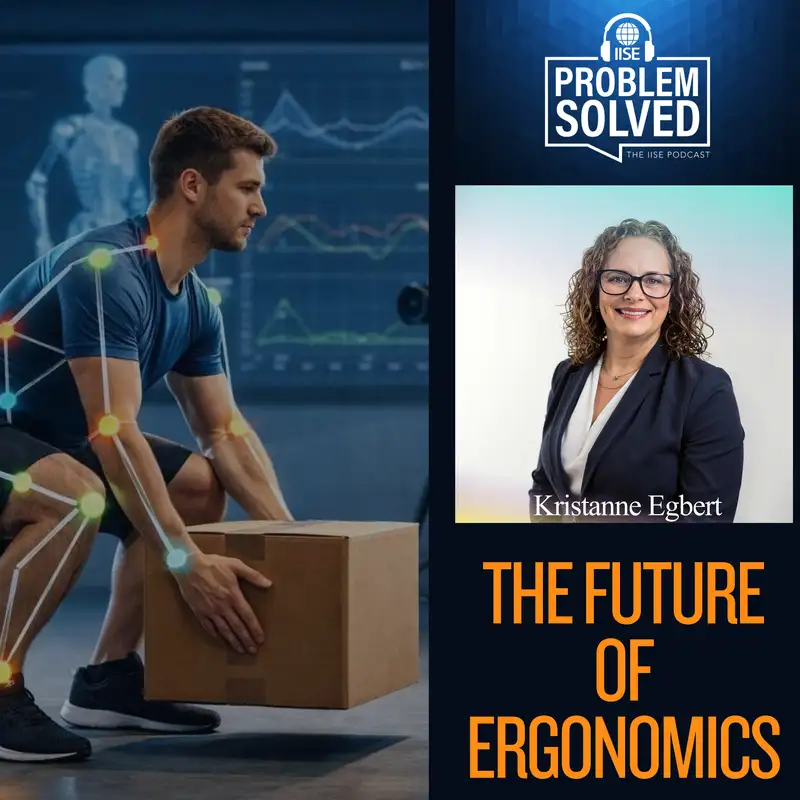
The Future of Ergonomics with Kristianne Egbert
Download MP3Welcome to Problem Solved.
October is National Ergonomics
Month, and today we're looking at
how technology
is changing
the way we understand
the human side of work.
Tools like motion
capture, computer vision
and artificial intelligence
can now help ergonomics
identify and quantify risks
in ways
that weren't possible
or practical not very long ago.
My guest today is Kristianne Egbert,
senior corporate economist
at Briotix Health
and a certified professional ergonomist.
Kristianne has spent 25 years
working in ergonomics across
a variety of industries with expertise
in risk assessment,
program management
and design consultation,
and the use of technology
to improve workplace performance.
Kristianne, welcome to Problem Solved.
Thanks for having me.
It's so good to have you here.
You and I first met
at the Applied Ergonomics
Conference 2026,
and it was really nice
to talk to you then.
I was wondering
if you would kind of start
the conversation by
telling the story that you told me
at Applied Ergonomics
about how you sort of developed
your interest in engineering
and how you kind of got into the field.
Yeah, sure.
I'd be happy to.
And I feel like it's,
quilt work of my
childhood, realistically.
So, growing up, I'm one of four girls.
I'm the youngest of four girls.
And and everybody always says, oh,
you're poor dad four girls.
My dad raised us to be strong,
independent women.
And thinkers more than anything.
And he's a he was a retired NASA engineer
that 42 years working at the,
Cleveland NASA Lewis Research Center.
It was called back then.
And again,
just kind of
taught us to figure things out.
If something's broken,
let's work together
and figure out how to fix it.
And, part of what we did
growing up for fun
was to take canoe trips.
And as our family was,
you know, getting bigger and bigger.
And my sisters
and I would go along a couple of us
anyway, and my cousins and my uncle
and my dad
was having a hard time figuring out
how do we bring enough canoes.
And maybe as those girls probably started
packing more and more things.
He needed more space.
I'm I'm not sure,
but it was to the point
that he, you know, he had a pickup truck
and he had a thing on top of it
so he could carry a canoe
and have a little kayak
that he had built himself,
that he put in the back.
And we, we were kind of out of space.
And he's like,
I've got to figure out what to
what to do.
So that we can we can keep doing this.
And as we were kind of thinking about it,
I was like,
wouldn't it be cool
if it could just be made a bigger one?
And it just went right on
top of this medium sized one that we had.
And again, ever the engineer,
he kind of let it stew
and simmer for a while.
He's like, you know,
I think we could probably do that.
We could make the cross pieces
that come out.
We could just assemble it
when we get to the river and have,
you know,
little butterfly
nuts on the end
and put the cross pieces in so that it
it can stay supported.
And lo
and behold, that man built that canoe.
Pretty sure it is still in operation
today.
So, it little ideas like that, actually,
the next iteration
that came after it,
because again, we needed more
canoes was a break in half one.
And so then we built
he built the break in half
one that again was held together
the exact same way.
Then he built an extension
piece for the middle of that one
to kind of create a middle seat.
The ultimately, I think
growing up,
just my ability
to kind of think outside the box.
And I went to school
to become a pharmacist, actually,
and I met
organic chemistry and I was like,
no, this is not what I should be doing.
My dad always said,
you'd make a great engineer,
you'd make a great engineer.
And you know, when you're a teenage girl,
you don't listen to your dad.
No, no, I don't want to do that.
And then I kind of started
thinking about it like,
maybe this is for me.
And one of my advisors at Ohio State
said,
talk to me about industrial engineering
and then talk to me about human factors.
And I was like that.
That's what I that's what I want to do.
Well, that's what
I've built a career out of.
So it's it's been great.
I love that that's amazing.
I think that a lot of people
can identify with that feeling of like,
you know,
you kind of have a knack for something
when you're little
and being able to follow
that through into an adulthood
and making a career out of it,
I think that's awesome.
Yeah. Yes.
And again,
I always say like, I'm I don't know,
I don't know that
everybody loves what they do.
And I'm not going to say that
every day is always a great day.
But ultimately I love what I do
and I get to come up
with creative solutions for things
and think outside the box.
And I appreciate that.
So yeah, that sounds perfect.
Yeah.
Well,
I'd love to go ahead and dive
into our main conversation.
Maybe we could start by talking about,
motion capture.
Okay.
And what that is,
maybe you can just kind of walk me
through it,
walk our listeners through it.
What it does,
what it measures, how it measures it,
what data does it collect, all of that.
Can you just talk about that
for a minute? Yeah, sure.
So motion capture can really be
any number of things.
Right now,
I think when people think about
motion capture,
they're really specifically
thinking about video capture.
But realistically, motion
capture happens
with wearable sensors as well. Right?
I have a smartwatch on and it's
capturing my steps every single day,
and it's capturing my heart rate
and all of these other things. Right.
So it's it's
using the motion to capture information
that it's collecting about me.
So wearable sensors,
you know, we'll say
five years ago were probably the big talk
when it came to motion capture of,
oh, I've got a sensor here
and here and here, and it's
going to measure my joint angles
and it can do this, that
and the other thing, right.
It can collect all sorts
of different information.
So technically
that could be considered
motion capture device, if you will.
I think that's kind of fallen
in a different direction.
And ultimately it's costly equipment.
And then having to
to deal with all of the data
that that brings in.
Ultimately now when you hear
motion capture,
typically what people are talking about
is video capture.
And that is taking something
like my phone and collecting a video
and uploading it into a system
that can then process it.
So video
capture is a form of motion
capture to me.
And again,
a wearable sensor is a form
of motion capture.
But I think typically we're,
we're
talking more about motion
capture or video capture. Okay,
And so
as this has developed over the years
and as it's developing now,
I think that
AI is playing a bigger role in this.
Is that happening?
And can you talk about that. Yeah.
Because ultimately,
you know,
my camera is capturing motion,
but it's not doing anything with it.
Right?
Where AI comes in is
what is it doing with that motion
that it's capturing.
And so it's utilizing,
AI to be able to recognize, oh,
that's an elbow, that's a shoulder
that's it's picking up,
joints on our body or points of interest
on our body
to be able to compare it
with something else.
So my shoulder compared to my torso,
it's going to help me
pick up my shoulder flexion.
Right?
Or, knowing what my neutral position is
when I'm bending forward
to be able
to pick up for back flexion or twisting.
So that is where the AI comes in.
And the machine
learning of kind of teaching it to say,
okay, these are the data points
that I'm looking at.
And here's what you're comparing it to
so that it can
then provide me with joint angles.
And it's great because it can make things
so much faster rather than, you know,
two years ago.
I’ll say,
full disclosure,
two years ago,
when I was doing risk assessments,
I would sit at my computer
and I would have a video up
and I would freeze it.
And because I'm an engineer,
I would take out my protractor.
My,
AT and PT counterparts
would probably pull out their goniometer
And okay,
that's probably about the worst case.
Let's measure the joint angle. Right.
That's yeah, that's how we had to do it.
Or we're looking for risk thresholds.
Okay. That's less than 20 degrees okay.
That's definitely between 30 and 60.
And maybe I don't need an exact joint
angle in there,
but I would
I would still have to make
those decisions on my own
and really kind of pick up
and count on my own,
you know, measure on my own what that
what those risk thresholds are
and then count the frequencies
of how often does
that occur in this minute.
And so that might be looking at the
the timer on the video
that's in front of me to say,
okay, a minute has passed and I counted,
six instances of that. Right.
I'm counting
that. Now with the computer vision
that's out there.
It's capturing that for me
and spitting it out in seconds.
What does that do for you
as the ergonomist who's
performing the risk assessment
and all that?
I mean, I'm sure it's helpful,
but I mean, it's
it's got to be some drawbacks as well.
Or. Well, sure. There there are. Yeah.
I think people ask all the time, like,
are you worried about AI taking over
your job?
I'm like, not yet. Anyway.
What it allows me to do.
So first of all, it's not perfect, right?
I think the analogy that we often hear
is kind of pilot and copilot. Right.
But I kind of
still need to be in the
in the driver's seat.
I like to think of it as like an e-bike.
We rented e-bikes last week,
and I'm like,
I still have to pedal this thing, right?
Like, it's
not just it's not a moped,
it's not driving itself.
I still have to pedal,
but it's making it a lot easier
for me to pedal.
I like that analogy
simply because I'm still
actually having to do the work.
So there's a couple of things
that happen.
I can upload that into my system,
and it will crank that data out for me.
Sometimes I'll look at it
and be like, what? Why?
Why are the legs high risk here?
He's walking
like, that's not a risk factor in.
And of itself, right.
And different things can happen.
And it's not always right.
I think it's consistently getting better,
but it's not always right.
So I have to go in and check it. Right?
I still have to be in the control
seat to say,
yeah, that didn't happen or no,
that's what we call a step
that's not actually,
you know, knee flexion
or something like that.
So you, you still have to have eyes on it
and you still have to know
and understand what you're looking at.
Right.
There is an example that you gave where,
I think it was ChatGPT
that was used in
like a packaging
scenario, and that did not go well.
I can't remember all the details.
But I know no, I know,
I'll tell you that story.
I like that one.
And again, it's a
it's a great example, right?
We all have our AI stories.
I told one yesterday on our webinar
about nearly poisoning my dog.
Because because I gave her toric.
Because it was supposed
to be an anti-inflammatory.
I didn't know
I supposed to titrate her up.
I didn't know to ask
if I needed to titrate her up. Right.
Yeah.
Yeah, this this is a similar story
in that,
this is
somebody was like, oh,
hey, there's this this risk
that's been identified.
Somebody was taking a very heavy part
and sliding it
from the floor onto a pallet.
And they kind of were shuffling it up.
They're kind of pivoting up
and sliding it on,
and they were like,
oh, yeah, okay, that that looks bad.
Let's just drop this video into ChatGPT
and see what it comes up with.
And, you know, with some prompting.
And they ended up putting together
this gorgeous looking report
and it talked all about the
ergonomic risk factors
and the risk factors that it identified.
And then it went so far as to apply
an ergonomic assessment tool.
So it decided to apply the NIOSH
lifting equation,
which anybody that practices
ergonomics knows
that the NIOSH lifting equation
is meant for a lift.
As the name implies,
there's very specific parameters
for which the NIOSH can be used.
So it has to be a two handed
lift has to be a single person lift.
There can't be any leverage involved,
which in this case
there was leverage involved. Right.
Because they were kind of tipping it,
lifting it up on one side,
tipping it onto the pallet,
sort of sliding it into place.
It was a heavy part,
I don't know, 150 pounds,
not something somebody would be lifting.
Right. Not from a deadlift type of thing.
So AI put together this wonderful
looking report
and it said they said oh,
that the NIOSH lifting index is ten.
Basically anything over
one is indicating risk.
So now we're saying this is ten times
heavier than what
somebody should be lifting.
And they were like, oh this is terrible.
We've got to fix this.
And I'm like, okay.
It wasn't a super safe task,
but it wasn't ten times, you know what?
What should be happening
because it wasn't being lifted
and that wasn't the right tool
to be used.
So ultimately, to an untrained eye, you
you wouldn't know that
that report was just fake, right?
It was not
it was not using the right assessment
tool.
Similarly,
I am not an animal nutritionist
and therefore I didn't know
that Tiny shouldn't have,
a large dose of turmeric
on her first go round.
So if you're not an expert in something,
you're going to read it.
You're like,
oh yeah, oh, okay, I can get behind that.
And really,
even if you apply logic like well okay.
Yeah, that that seems right.
So it's a little bit
more than just kind of reading something
through to make sure
something makes sense.
It's it's
really having some expertise around it
so that you know
that what it's giving you is correct.
So what does it mean,
Like if companies are listening right now
and they're just thinking, oh, well,
we can use AI as a replacement
for like a real ergonomics.
I mean, that's
that's a big warning right there.
What are what are your thoughts on that.
Yeah. Again.
Think of it as the e-bike.
Right.
You can I honestly,
a lot of organizations
don't even have an economist on staff.
Right.
Typically it falls to their health
and safety professionals.
In the office, oftentimes
it falls with HR,
it, it,
it sits with a lot of different
people is kind of,
other duties as described a type of line
item sometimes maybe it is
even a line item.
But let's say in the example
of a safety professional, okay, this is
this is their area
because it is about keeping people safe,
but they're also making sure
that lives aren't being lost
and the appendages are being cut off.
And,
they're not being exposed
to hazardous chemicals
and that sort of thing.
So sometimes real safety
kind of takes over and ergonomics
kind of gets sidelined.
This gives them the ability to do
what they should be doing with maybe
the time that they actually
have to be able to put it into it,
because it streamlines the process.
It can help extend their their reach
a little bit
because they can say,
hey, I'm
going to have my floor supervisors
collect the videos,
drop them into Ergo Plus.
They can even put in the information
because it's easier to use. Sorry.
Ergo plus is our platform
into whatever ergo
platform you're using, right?
They can drop it in
and then I, as the expert,
can go in and say, okay,
and if something doesn't look right,
no, that's not the right force here.
Okay.
Here's the tools that we want to apply
to this to be able to truly
make sure and again kind of
pointed in the right direction
so that we know
we're getting valid results.
Yeah.
We did recently, we did a podcast
and we talked a lot
about the Frank and Lillian Gilbreth
and how they like
one of the very
first things that they did was they,
attached lights to finger tips
and then they took photos.
And so that was like
one of the very first examples
of motion capture.
But they even did it like on,
in like for clerical work.
So they like, they were trying to reduce,
the motion of the person and like it
just even for clerical work.
And I just thought that was interesting
how that was like the first example.
And now it's come so far.
Right? Oh, yeah.
Definitely.
I mean, it just
I think about ergonomics when,
you know, I'll say
ten years ago
I was kind of working part time
consulting on my own for a while.
Ten years ago
when I started with Briotix,
I was like,
I can't believe we're still doing this
the same way that we did this
at the start of my career. Right.
I have a PDF of REBA,
and you kind of
look at the pictures and you're like,
how old is this assessment tool?
And we're
still using these kind of old tools
as our way to, to understand risk.
And the fact that we're using pencil
and paper, I literally was like,
there's got to be a better way.
And realistically there were,
but there may be not, accessible
for everybody. Right?
Or.
Yeah, sure,
we can use these wearable sensors,
but then somebody has to know
how to use them,
and we have to be able
to process that data.
And somebody has to want you
to stick these sensors to them.
And it's it's a lot of extra work.
And so now to kind of be able
to come up with something like this
that makes that
achievable and these, these ergonomics
program platforms,
they're not overly expensive.
They're right.
It's not something that's out of reach
for most organizations.
It it just makes things so much easier.
And realistically
they're used in the office environment.
Now to
I know we're working on one
that you can upload your video,
and it instantly provides
an assessment report.
What makes that a heck of a lot easier?
Right.
And again,
something that's achievable for people.
So yeah.
Well,
as much as you've seen
things change over the last few years
and now we're like looking ahead,
what do you think
like an ergonomic
assessment might look like in another
five years or in another ten years?
Honestly I think
I am expecting improved assessment tools.
Like I said,
I alluded to the REBA before.
It's one that everybody knows
and the REBA is
technically the way
that it was validated.
Is that the moment and time tool.
So right now
when I'm lifting this box
in this position, at this freeze frame,
this is what the risk is,
and I can put in some of the,
repetition data to,
to help with that scoring.
But it is for that one posture.
It's not looking at all
the different postures. Right.
A lot of organizations
have then
come up with their own tools that are,
the kind of look at the entire job task.
Briotix has one,
Again, many different
organizations have them,
and that's important because
we really kind of need to see overall
what's happening and understand the risk
for all of our different body parts.
What I think
is likely going to happen is that
these tools will grow,
and we're going to have
maybe some new ones.
And there's a lot,
a lot of newer ones
already for the hands and wrists
that I think a lot of research
has been done on
for the hands and wrists.
And I'm expecting or maybe I'm
maybe I'm wishfully thinking or hoping,
which isn't a great strategy.
But, hoping that
the our full task
and whole body assessment
tools will will grow because of this.
And already with the
with the video capture,
most of these programs
they actually will run a REBA.
But they're many of them are running it
across the entire job task.
They're not using it as a moment
in time tool.
It's probably okay to do that. Right.
And maybe not how the tool was validated.
Maybe somebody
is working on that validation.
That would be cool.
But I think that's,
I think that's going to change.
And ultimately,
because of the very nature
of machine learning,
I think it's going to keep getting better
and better.
I know
another thing that we're working on,
and it's super cool
for me to see happen, is we started out
with like Solutions archive,
and it was a database for us. Right.
I started with,
okay, here's a bunch of things
that I know
are helpful
tools that people should know about.
Yeah.
And
we then built it into Ergo
Plus so that now our clients
have access to a solutions archive.
And I called it our Problem
Solutions portal is what I called it.
And so it would say work is too heavy.
Work is too low. Work is too high. Right.
So then let's talk about platforms
to raise people up or lift assists off
work is too heavy carrying.
Let's look at cards
right so that you could kind of
you didn't have to know
what the solution was.
But if you knew what the problem was then
that'll help get you there.
So that was just
kind of built in of like,
hey, here's some ideas.
But now we're able to use
AI to say, oh, here's what the risk is.
I see them bending.
The work must be too low.
Here's some solutions
and it'll throw ideas out
as kind of a brainstorm mechanism.
And I love that because a lot of times
people are like, okay,
you know, real analytic people.
Okay, great. I can assess all day long.
I don't know how to fix this.
And that helps take some of that away.
And I think that's
I think that's really cool to do.
And then within organizations,
within their own solutions
to say, oh,
this solve this problem
over at this other location,
kind of from an enterprise
standpoint, solution sharing is so hard
across organizations to say,
oh, what are they doing
on the West Coast?
Where they have that same job?
Nobody's talking, or
nobody thinks their ideas
are that great,
that they're worth sharing,
I think is honestly what it is.
A lot of times
I think it's going to help with that
a lot, too.
I was going to ask, do you
is there something that you wish
organizations understood more about,
like the people doing the work
or when they're designing the jobs
or the processes or the workspace?
And maybe that's one
thing like,
do you wish that they would
communicate better or what do you think?
What's something that you wish
organizations understood better?
I think understanding
when to get an ergo team involved
is important, right?
I often times, well,
one of my clients needs ergo sign off.
Well, they don't have an ergonomist.
And so oftentimes
that comes my way like oh hey, we've
got this new equipment coming in.
We forgot to get our ergo sign off.
Can you look through this
and make sure it's okay?
Okay.
Well, you've already designed
this piece of equipment.
So like, what am I supposed to do
if it's not okay, right. How?
I can't sign off on that.
Ultimately,
I kind of have to pivot and say,
okay, well,
looks like the load height,
let's say
a packaging machine or something.
The load height for the boxes.
Not sure why it's up at 48in,
but that's going to create a load height
that's above shoulders for most people.
And you're going to want to make sure
that the product
is brought in
at a slightly higher height,
and that your operator's
standing on a platform
so that they are not
having to reach up that high. Right.
So I'm kind of having
to come in on the backside to say, okay,
from a retrofit, realistically,
even though it's not installed yet,
to say,
here's what you want to consider
on the install of this equipment.
So, I mean, it's better to do that
than to wait until it's installed
and then have somebody
come to you saying,
oh, my shoulders hurt.
And how come this equipment is new?
Or you said this was automated
and I wasn't going to have
to do anything cool,
but I still have to load
the boxes in there way too high, right?
So it's still being proactive to a
certain degree, but
ideally we would get in
there a little earlier.
And so when clients come to us
and really do involve
us from a design standpoint,
like even better.
And so then we can look
at a blueprint and go, oh yeah, I know,
why is that load height so high?
Is there any way we can lower it down?
Oh, I don't know.
We'll talk to the vendor about that.
Oh yeah, sure we can do that.
And we're going to move this here.
You know, simple things
like push buttons and displays
and that sort of thing.
Like,
sometimes I think
people design it for themselves
or just, oh, here's where it fits
or they don't put any thought into it
at all of like, oh yeah, this
this makes sense.
Or here's where it's always been.
So that that
pieces is one that I think I wish,
at least from a, the design engineer
standpoint, that I wish people knew.
Yeah, that makes sense.
One other thing I was thinking about
when we were talking back
when we were talking about
AI and like, how
AI can produce
something that looks really,
really official,
but it might all just be gibberish.
And so you need an expert there.
Right? Yeah.
I was just thinking that, one
other thing
that you and I talked
about last at the last,
applied ergo conference
was implementation of soft skills
to implement,
you know, to implement these plans
and, like,
you know, that's
another thing
that AI can't give you is,
is these soft skills
can you take a take a minute
and talk about that.
Yeah.
I mean AI is actually pretty darn
good with some soft skills.
They're very nice sometimes.
Yeah.
You know,
I, I joke that
I like to use it as a tone checker.
Can you.
That's to me,
can you take the attitude
out of this email?
Because I'm actually angry
and I probably shouldn't
come off that way.
That’s a great point actually. Yeah, yeah.
So it it is it can help us start really
difficult conversations
and say, okay, I, you know, I,
I need to talk about this
sensitive subject with so-and-so
helped me
come up with a way to to discuss it.
What happens if they say this? Right.
So I can actually really help us all
with our soft skills?
But that actual implementation,
it still is going to come down
to the words
that are coming out of your mouth.
It's going to come down
to your body language.
It's going to come down
to how you've involved
people in the process. Right.
I was talking with a client this morning,
and we were talking about,
the the job task just required kneeling.
There was really no way around it.
And she said, yeah,
we've tried knee pads before,
but they didn't like them.
Okay.
Did you try different types?
And she's like,
I think we just ordered some.
Okay.
People want input into
how their job tasks are changing. Right.
So you should involve them in that.
Like, hey,
what do you guys think about these?
Or I'm going to order
a couple different pairs
and see what you guys like.
And it's probably not,
not only not a one size fits all,
but maybe not a one style fits all, right.
Maybe somebody with bigger
legs likes this kind,
and somebody with smaller
legs likes this kind.
It's going to be different
with each person.
And so it's always
kind of that collaboration
and that involvement that I think is,
is really important
in getting solutions implemented.
And not just
anybody can get them implemented,
but it's getting them accepted
so that they're used in
the are actually reducing the risk that
that is
what our goal was to do to begin with.
So that actually just made me
think of another good point too,
with the video capture,
one of the really cool things again.
So you're trying to talk to a,
frontline employee about
ergonomic risk, right?
It can get kind of technical pretty fast.
My favorite thing
about the motion capture,
the video capture,
I should say,
is that I can process a video
real quickly and show them. Right.
We've all seen them at the conferences
and whatever of, like, oh,
here's this red, yellow,
green overlay or a skeleton overlay
that shows you what the risks are.
I don't have to explain it in big,
fancy words that maybe not
everybody understands,
but anybody can look at that and go, oh,
I see, I see, okay.
And it helps them understand
what the problem is
and helps them be part of the solution
once they better understand the problem.
So again, that's kind of part of the soft
skills of it, right?
Yeah.
That makes a lot of sense.
I want to move on to like
getting some of your professional advice
for listeners.
But before we do, is there anything else
that you wanted to touch on
before we move on
from like
motion capture
and AI in that conversation?
I don't think so. Okay.
Well, then
for those for those who are listening,
who are,
you know, interested in
in a career in ergonomics,
what is your advice to them?
What should they be studying?
What should they be doing?
Yeah.
So it's funny, I have three college age
children and my youngest just
went away to school,
and she's kind of figuring out
where she wants to go
and what she wants to do. She, she used AI
Had a whole conversation
with ChatGPT
about what she wants to be
when she grows up.
And, her dad and I are both engineers.
And so she was like, well, I
want to be an engineer.
But then she kind of was,
was questioning, why?
Why do I want to do that?
And she finished this prompt
and she said, well,
it said either in ergonomist
or an occupational therapist.
I'm like, really?
That's what I came up with.
I'm going to blame Covid
and all of the webinars that she heard me
sit through
when she was sitting across from me
crying, doing her homework.
But she
she knows that
I get to help people all day long. Right?
My degree is in human
factors engineering.
That's kind of a niche market, right?
With that,
I could have gone into
occupational ergonomics,
which obviously here I sit,
or I could have gone
into kind of usability
and human computer interaction,
that sort of thing.
Okay.
That that's a very specific field.
I am super lucky
that I get to use that career
that I actually picked.
So for somebody very young starting out,
I don't know if you have those as your,
as your listeners, I say I
so I told my daughter Riley,
let's go with occupational therapy
because I have an OT on my team.
And guess what?
She's an ergonomics project manager.
So you can definitely do ergonomics
with occupational therapy.
They're actually not that different
because you get to come up
with creative solutions on how to help
somebody do what they need to do
with their life or their job, whatever.
So for for me, giving her that guidance,
if she wanted to go
that direction,
you can do ergonomics
with that, with that degree.
But you also kind of
have some broader things to
to work with as well.
For somebody
that's already kind of in their career,
they're done with school.
They're not looking at going back.
I think what you have to think about
is that there's a difference between
a certificate of
completion, kind
of a private business certificate.
I took a class and I passed this class,
and now I know about ergonomics. Right.
There's certificates
and then there's accredited
board certification.
Those are going to be
two different things.
So if you're like ergonomics
is part of my job description.
I don't really know much about it.
You may not need to go
and get, board certification,
but you want to pick up
some of those certificates,
some of that training,
so that you know and understand
what ergonomics is.
And you can kind of take different levels
and learn,
learn more and more about those.
Then if you really are,
you know, as a corporate ergonomics,
I obviously should have some sort
of accredited board certification.
So for me that was was CPE.
So it's knowing it's kind of figuring out
what is that career path,
what do I want to do for me
to be able to have a CPE?
Oh, kind of gives me legs
that I can go in and work
for different organizations, right,
as an ergonomist, but for most people,
I think the certificates
get you somewhere,
you know, again, kind of giving you
those skills.
Is it office ergonomics, is it
industrial?
Is it,
kind of organizational ergonomics,
that sort of thing. So okay.
Well that's great advice.
Who's the
what's the name of the dog
that was barking?
That was Tiny.
The one that I nearly poisoned.
The other day.
Oh, somebody had
the audacity to drive by.
So she had to give herself that alert.
Yep. Had to let them know.
Well, that's great.
Well,
for everybody listening, happy ergonomics
month of October.
And, Kristianne,
thank you so much for being here.
I really enjoyed,
talking about this with you.
And I learned quite a lot. Awesome.
Thanks for having me.
All right. Thanks. You're welcome. Bye.