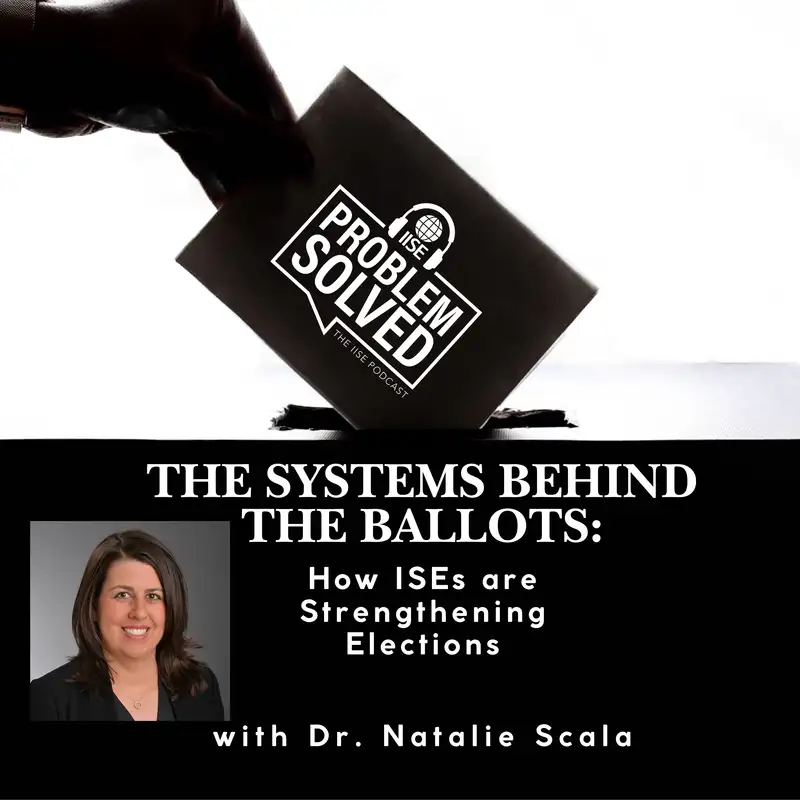
The Systems Behind the Ballots: How ISEs are Strengthening Elections with Dr. Natalie Scala
Download MP3Are you looking to sharpen your
skills, boost productivity, or
take your career to the next level?
The IISE Training Center offers
world-class professional development
built for busy engineers,
managers, and problem solvers.
Whether you're diving into analytics,
earning a Lean Six Sigma certification,
or exploring supply chain logistics,
our expert led courses deliver
practical tools with real results,
learn online or in person with options
tailored to every career stage.
Plus our training works.
Past participants have applied their
knowledge to save their companies over
$250 million in real world projects
and 90% of Lean six Sigma candidates
pass their exam on the first try.
Visit ii se.org/training to explore
the full course catalog and start
transforming your career today.
Here's the problem.
Elections are one of the most complex
and consequential systems we rely
on, decentralized, human driven, time
critical and under constant scrutiny yet.
Most of us only see the final
output, but behind the scenes,
thousands of decisions have to be
made with little margin for error.
And if something goes wrong, it can
have a huge effect on public trust.
So how can industrial and systems
engineers help design these
systems, identify risks and
help strengthen the human fact?
Involved all without becoming political.
On this episode of Problem Solved IISE's,
Keith Albertson sits down with Dr.
Natalie Scala of Towson University to
unpack how ISE tools are being used to
address election security misinformation,
poll workers support, and more.
Join us,
Natalie.
Hello.
Thank you for joining us today.
It's great to have you
back on the podcast.
Thanks for having me.
It's always good to be with you.
Yeah.
Well, last time we talked about elections
was five years ago, which is a long time
ago, and a lot has happened since then.
At the time, we were in the middle
of the pandemic and we were headed
toward a big election that year.
And you had begun working on elections
and working with some, election officials.
You've done a lot since then and
a lot has happened since then.
But let's go back for a minute.
Just talk about how you got involved
in elections and how you applied
industrial and systems engineering
to this in a way that I don't think a
lot of people maybe thought was a fit
for ISC at the time, but it's turned
out to be a very important aspect.
Sure.
So we started our lab, which
is Empowering Secure Elections.
We're housed primarily at
Towson University in Maryland.
We started early 2017, and
our big motivation was.
Sort of the allegations about
meddling, foreign interference,
questioning about vote counts.
It all started quietly
after the 2016 election.
And our lab is inherently nonpartisan.
We let the data tell the story.
sometimes we have a history of looking
at some pretty politically charged
questions, but we put data around
them to see what's really going on.
but we had some concerns about
the health of our democracy.
We wanted, I personally
felt like I wanted to.
Help or contribute or, Just, you
know, patriotism I guess in some ways.
so we started looking at what
is going on at the local level.
So a lot of the research before 2016
looked at elections primarily at the state
level and primarily from a cyber hacking,
traditional cybersecurity perspective.
but where people interact with the
elections process is at polling places
primarily or with your mail based ballots.
But primarily they happen at.
Polling places, you know, high school
gyms, churches, things like that.
And there wasn't a lot of
energy and research attention
put into those situations.
But poll workers are our first
line of defense in elections.
we need not only the right, correct
count, a free and fair election, but
we also need the American people to.
To believe in the outcome of
it for our democracy to work.
So people need to have a
positive, affirming experience
at the polling place as well.
And in terms of is, industrial and
systems engineering process, right?
I mean, how do people
interact at the polling place?
What do they do?
how do we keep the vote in the
intact, the integrity intact from
the cast to the counted moment?
That's all supply chains,
that's all processes.
That's classic.
IE. Mm-hmm.
And you've had handled
different aspects of this.
You had an article for us a few years
ago in the magazine about mail-in
ballots, which obviously became a very
popular way to vote during the pandemic.
There's so many different aspects of this.
tell us about some of
the work you're doing.
What different facets of, voting and
elections are, are top of mind to you and
how you go about gathering all this data
as well from so many different sources.
Sure.
So we keep the polling place, the local
election, the insider, the trusted
insider, which whether that is the
poll worker, the elections official.
We keep all of that in
the front of our work.
We really stay in a, kind of like
on the ground, if you will, in
terms of how people are actually
interacting with elections.
in terms of mail balloting, we had a
couple studies during the pandemic about,
we went from a process that was primarily.
Absentee.
It was a process that was in place really
since the Civil War in some form or
another, some sort of mail balloting.
But overnight, essentially during COVID,
it became this huge process, the primary
way for lots of people to vote for lots
of different reasons, shutdown reasons,
concerns about the virus, congregation
reasons, all that kind of stuff.
and.
You know, there was a political
thing going on about mail voting in
2020, but you know, there's a real
true IE research question there.
You know, when you dramatically scale
up a process essentially overnight,
yeah, maybe within a couple weeks,
but you know, essentially overnight.
Do we introduce risk into that process?
'cause we wove from something very
small to something very mainstream.
the short answer from that
study is that no, we don't
necessarily introduce new risks.
mail voting, disincentivizes an
adversary, from trying a medal in
the election and it also increases
voter, turnout in voter engagement.
So we believe that that is
a double win for democracy.
so we had that study, but then
we also started to think about.
As people returned to the polling
place and we started to unthaw, if
you will, from COVID restrictions
and started to loosen them.
Really, the poll worker is a primary key
person in this process, and there's about
a million poll workers nationwide that are
needed for a presidential election cycle.
They're all altruistic for the most part.
I mean, could a Holbrook be
rogue and want to be adversarial?
I guess that's theoretically
possible, but they're probably not
predominantly college students.
Retired folk.
predominantly not, not exclusively.
And they, just wanna help out
and have an election help,
you know, with the election.
But they have incredible
responsibility because they are
interacting with us, critical
infrastructure, elections, equipment.
They are responsible for making sure.
those who have access to
the ballot, get a ballot.
Everybody gets that chance to
vote, and the, the polling place
runs smoothly on election day.
So there's a lot of opportunity
there to help them out with their
cyber hygiene behaviors to help
them out with process, to help move
people through the polling place.
make sure those ballots are secure.
And that was an area where we
really haven't seen a lot of IE
research, like I said before,
2016, and even really before 2020.
And they're kind of a forgotten part
of this in some way too, because you've
gotta focus, as you say, volunteers
from different aspects of society.
They're not professionals at this.
And to some extent, you almost have to
retrain a staff over and over again,
personnel wise for different elections.
'cause you're gonna get a
different group of people.
I mean, that's one of the challenges
they face, I would imagine.
Absolutely.
And you, you know, we would classify
them, I think in supply chain research
or retail research as highly seasonal.
Yeah.
you know, they come in for
essentially a day or early voting.
but you're absolutely right, Keith.
they bring whatever
behaviors they have at home.
To the polling place, right?
Mm-hmm.
You know, they do go through
training in Maryland.
There's an extensive four
hour-ish training session
they have before, election.
Sometimes they're longer depending
on the county and things like that,
but you know, are they gonna learn
a culture of security in four hours?
No.
They're learning how to use
equipment and things like that.
So we looked at a lot of ways to help,
poll workers improve that training.
to get more into, I guess, the way
they do their jobs, to look at how,
what kind of behaviors they might be
bringing in terms of cyber, physical,
insider threat type behaviors.
but really risk, not necessarily
threat poll workers are, could
be a risk, anybody can make an
honest mistake and have an issue.
so we've done some work with that
and we've also worked with counties
in Maryland to actually improve that
training process and improve that
daily election day process as well.
Mm-hmm.
You had mentioned there's an app in the
works that you're trying to work on.
Yeah.
Tell us about that and
what it may offer them.
Yeah, so this app will, be available
in some counties in Maryland
in 2026 for this cycle here.
we are hoping to expand that, but
we're using a couple test counties
here in the 26th gubernatorial cycle.
So, midterm cycle.
Excuse me.
So Maryland's, Really runs midterm and
general and presidential election cycles.
They don't necess, they run some
local ones off season, but the real
statewide ones run every two years.
so we're really piloting it this year
and we poll workers are gonna be able
to interact with some of the basic
definitions in tru type work in the app.
They're also gonna be exposed
to potential cyber, physical,
insider risks that could happen.
So they can be aware.
the biggest thing with a poll
worker is to raise that concern.
Could they mitigate themselves?
Yes.
They could put the card with
the password on it away.
They could lock their screen
when they step away for the
restroom or to help somebody.
that's very, you know,
kind of 1 0 1 things.
But there are other things that
they can do to raise concern or
awareness too to, to a chief judge.
Or the Board of Elections, if they
see something, potentially kind
of see something, say something.
So we want them to be aware of what
they need to be watching out for.
And also the app is based on pedagogical,
pedagogical education, research in terms
of segmentation and interaction and
usability studies and a lot of stuff.
We've actually published before
at IISE conferences, we're just.
Applying now into some of this work too,
some of the usability stuff we looked
at, some of the process stuff we've
looked at, so it's really a nice way.
I'm excited about it because it's
a culmination of that theoretical
or applied research we've done for
academia into an actual usable touchable
app that poll workers can use to.
Support their training and
hopefully improve their security
behaviors at a polling place.
Mm-hmm.
Just make 'em more comfortable
as they come into that role.
Right?
Yeah.
Yeah,
exactly.
Yeah.
And two, if they're hired late and
they don't have time to go through the
formal training, which happen, yeah.
At least they have the app to
sort of have that initial exposure
to what they'd be working with.
Right.
Yeah.
You've worked with, election
officials in Maryland, you mentioned.
Do they come to you?
Do you go to them?
How do you hook up with these folks?
so we actually initially went to
some election officials we had
in our network in 2017, but now
predominantly they come to us.
Mm-hmm.
we've also worked, university of
Maryland has a partnership with the
State Board of Elections in Maryland.
So sometimes needs come through
the University of Maryland,
and that partnership is mostly
with political scientists.
So we compliment their work nicely by
bringing some process, ie stuff, and they
bring a context to our work that we don't
necessarily see, you know, the whole how
applicable it is or to make it work in the
context of what an election is, you know?
Yeah.
And I think that is something that IE,
especially when we optimize sometimes.
Miss, you know, we come up with a
really great product or solution
or analytic or something, and
we sometimes don't necessarily
consider the organizational context.
Could it actually work in that context?
Are we continuously improving
or are we jumping to the optimal
without those continuous steps?
So our political science, colleagues
at Maryland, and we do have some
colleagues at Georgetown too.
Are really helping to put the context
around our work and making sure that
it's actually going to be usable
and beneficial in the environments.
And with all the scrutiny of elections in
recent years, I would imagine they're much
more willing to accept process improvement
maybe than used to be the case.
I mean, certainly they,
they feel the need for this.
Now
we have some very strong
election officials in Maryland
who are very much committed to.
Making sure as many people vote as
possible, to help their processes out, to
help their, you know, their expectations.
Elections of typically nationwide,
not just Maryland, are run locally
and those budgets are not huge, right?
So, you know, anything we can
do to improve a process, make
it easier on them, you know?
Thousands of P 400,000 registered
voters in just one county in Maryland.
And you know, we have
to serve all of them.
is, you know, definitely anything we can
do and continuous improvement is helpful.
Well, now just shifting gears a
little bit, there are different.
Challenges that elections face,
the internal part of it that you're
working on to improve the process,
to streamline what the workers are
doing and how votes are tabulated.
There are a lot of outside agents that
are making things harder for everyone,
passing along misinformation, deep
deepfake videos, that kind of thing.
How do we go about restoring trust and.
Maybe making technology work more for
the process than against the process.
Is there any solutions to being able to,
to handle that and kind of move past it
so people more trustworthy of elections?
Yeah, I think there's
two main pieces to that.
There's this short term piece
and then where are we gonna
be in 20 years kind of piece.
But in terms of the short term.
And I actually had this experience
at Target the other day.
You know, you walk into Target
near my house and there's a couple
near clean, open, bright Lights.
You know, target is struggling
with the number of employees, but
in terms of the actual shopping
experience, clean, bright Lights,
good Macy's, same way fitting rooms.
I was in a target in another, area of
Maryland up by work, and it was a mess.
There was not enough employees.
There was boxes everywhere,
stuff on the floor.
It, I was like, I am not coming
back to this location, you know,
I'm gonna go to another location.
And I, that's very similar in polling in
elections, you know, we go to a polling
place and we stand in line for six hours
and I've had students tell me, oh, we
stood in line for the president election.
it was seven o'clock they called Marilyn
and we were still standing in line.
We haven't even voted yet.
Yeah, you know, you have
those types of experiences.
People are not going to be excited
about engaging in the process.
if you have experiences where you feel
like your vote doesn't matter or your
vote's not being properly counted, or your
poll worker was rude, or whatever could
happen, you're not gonna believe in the
process or you're gonna have challenges.
There is research that's not mine
that says that even a single exposure
to misinformation or disinformation
and disinformation is the intent
to mislead rather than just, you
know, making a mistake does start
to shape our belief systems.
So, you know, some of that stuff can be.
Brewing in the back of your mind
and then you have an experience that
quote unquote validates it for you.
Whether that's true or not, you know?
Yeah.
so for us, you know, having those
clean, tight processes, poll workers
who are less likely to make a mistake
and all those other issues, really we
feel helps to dispel that narrative.
Mm-hmm.
And providing information
that is true, correct.
From the state and helping Maryland get.
At this point, Maryland poll workers and
Maryland citizens get that in their hands
and they know it's trusted from the state.
Also helps.
Where are we gonna be in 20 years?
I don't know right now, but I think
we need to think about it because
boomers are only gonna be about
four to 5% of the population in,
you know, the voting population.
In about, 2050 ish, we're gonna see
a lot of Gen Zs, gen alpha voting.
So what does that mean, you know, and
how do they interact with their lives?
They, predo, g Zi, and Alpha
predominantly, you know, run their day,
run their lives differently than boomers,
so, and even some other generations.
So we have to think about, you
know, keeping voters engaged.
How, what does that look like
for voters who don't necessarily
do pen and paper as much too?
Yeah.
And, and first impressions matter
'cause you've got a young voter
who, or a first time voter who
hasn't gone through the process
and it's a bad experience for them.
That's, like you say, go into a
store and have the same impression.
You've gotta make that good
impression from the get-go.
Right.
And you know, Maryland has a new
process where you can request
your mail ballot online delivery.
You print it out at home, you fill
it out, you put it in a Dropbox or
return it to the Board of Elections,
that's wildly popular people
printing their ballot at home.
Yeah, and that just, I think,
starts to point to some of the
new trends that may be emerging.
Not necessarily just with mail
voting, but just voting in general
over the next couple decades.
Yeah, and there are other, other
processes and that one of the issues
is there's so many processes involved,
and that's because, as you mentioned,
it's all local jurisdictions, right?
And states and they have
their own way of doing it.
There was one area, I can't remember where
it was, I wanna say it was Alaska, where
they did some online voting for municipal
elections where people could vote online.
Doesn't work for
everybody, obviously, but.
You know, we have mail-in, we have
paper ballots, we have machines.
Is there any way we can
somehow standardize this?
Or is it just gonna be something
we gotta work with, with this
sort of piecemeal approach?
So our international listeners
might be kind of interested by this.
You know, the federal government
does not run elections in
the US It is a state process.
And when I talk to my international
friends, they're like, oh, what?
You know, I mean, so
there's 50 at a minimum.
There's 50 separate state processes
plus the territorial processes.
Mm-hmm.
we got that.
And then some states run a pretty,
I don't wanna say a tight ship, but
they have a pretty standard process.
So Maryland has.
One type, one predominant
type of voting equipment.
And then they have one other,
basically a paper ballot going
through, an optical scanner.
Mm-hmm.
if you have disabled access needs, or
even if you're able-bodied, you may also
choose a ballot marking device, which is a
touchscreen type in, you know, environment
that helps with those with disabilities,
sight and sound, disabilities and
touch and things like that also vote.
So that's it.
Like that's what Maryland uses.
Do counties sort of.
Round the edges, if you will,
and kind of customize the process
a little bit to themselves.
They sure do.
but those are minor type of.
Touches, if you will, based on really the
size of the county and the population.
Mm-hmm.
They're serving and things, but
then you have other states where
the counties have way more control
the counties and the localities.
Mm-hmm.
And sometimes the equipment used
across the state isn't even standard.
Different counties, different
regions are using different things.
we did a paper a lot, very much
at the beginning showing that,
you know, the standard processes.
Have their own challenges too, because
if an adversary wanted to target a
standard process, then, you know,
once you're in one, you're in awe,
you know, a standard situation, right?
If you have different equipment,
you have to target different things.
I also wanna be clear that we've
never, we don't have evidence that a,
an election in the US has ever been
targeted at scale to affect an outcome.
We don't have that evidence, but we are
here to make sure that that never happens.
Right.
What problems might we
have on the horizon?
I don't know if we can look ahead
and see what could be coming, 'cause
you're busy dealing with what's there.
But, as this evolves over time, are
there other ways that bad actors could
get involved that we have to anticipate
somehow stay ahead of them, a step or
two ahead of what processes or, or, you
know, infiltrations might be a threat.
It keeps us busy.
but I think.
You know, some of the other more
predominant work we've done is look
at an attack tree for elections
at both the male level and the
in-person optical scanner level.
You know, attack tree is basically a work
breakdown structure for cybersecurity.
you start at the top, that's
your threat, you know, you know,
compromise something, and then you
go down the tree, basically to show.
Lowest level activities
that have to happen, right?
Mm-hmm.
For something to be successful and there's
and gates and there's or, or gates.
And gates don't necessarily
have to be in parallel.
They could be in sequence, but
multiple things have to happen.
Or gates one or more fault
Trees basically, too.
I know a lot of systems
engineers use fault trees a lot.
but Attack Tree is a
cybersecurity version of this.
and.
You know what we did was the, the
Elections Assistance Commission
published Attack Trees in 2009.
That was before elections.
Equipment was considered critical in
the us It was obviously before COVID and
all the changes we had like that with
that drop boxes and things like that.
And like to your point, the adaptive
adversary, the adversary is not
technologically in the same place or
motivations that they were in 2009.
so some of the work we've done is
update those trees and to put a
mathematical utility based risk
assessment around it too, because.
States localities can't
necessarily focus on everything.
they have that limited
budget that I talked about.
So what are the threats and most
concern that we should chase?
And if you wanna think of it in IE
terms, you know, that's a bottleneck.
You know, chase that, break that
bottleneck, secure that, and
then let's go to the next set.
You know, and you know, the classic
things like Efficient Frontiers and
all that all come into play here.
And yeah, we use those types
of tools to figure out what to
be most focused on and when.
Mm-hmm.
And new technology, right?
If there's any new technology out there
that might be both more secure and also
easy to use, I guess that's kind of a
target that they might wanna aim for.
Yeah, exactly.
New technology is interesting
because we have such a.
His history tradition in
the US of lining up to vote.
but we're also noticing that that
lines and that queuing and those
processes aren't necessarily, reaching
everybody too, which is mm-hmm.
Becomes a very politically gray area,
quickly, you know, both sides of the
aisle have very strong opinions on that.
Different ways.
but there is a technology piece too.
If we want everybody, as many people
voting as possible, we are gonna have
to be creative about how to reach them.
Now what's ahead for you as far
as the work your team is doing,
but also annual conference?
You've been a presenter at
annual conference several times.
yes.
We hope to see you there again.
Do you have something planned
at, the upcoming event?
Well, first of all, annual
conference is always a good time.
Like there's a great, you know, there's
an actual networking component of it, but
there are a ton of people I don't see all
that often, but I see at annual conference
and that makes it a very, very fun.
Experience, I will say that.
So yes, I will definitely
plan on being there.
what are we looking at for
annual, annual conference?
Well, we definitely want to have
people if we can, in a session,
test and try out our app.
even if you're not a poll worker,
we are looking for, we are gonna
be writing some studies this
year about the usability of it.
How people interact with it.
Pedagogical type, kind of like,
kind of like engineering education
type studies as well to make sure
it is people actually learning the
way we want them to learn from it.
Yeah.
so we hope to be able to demo it there.
We're also gonna be talking a little bit
generally about our overall research and
where our trajectory was, the kind, the
types of risk analysis we've been able
to contribute to the academic literature,
and then how hopefully in 26 and beyond,
we're now starting to translate that into
actual, usable, tangible, improvements in
actual processes, like I said, the app.
Different ways we can get
that research into action.
Well, we look forward to that.
Is there any way people can find out more
about your group if they're interested?
Do you have a website and some
contact information we can
also include in our show notes?
Sure.
So, my website is just dr natalie
scala.com, dr natalie scala.com.
One word.
for me, there's a projects page at.
Goes through all the papers we've had,
including the ones from annual conference.
There's a media page that sort of
summarizes some of my work when I've
done other types of media engagements.
That's probably the
easiest way to learn more.
there's a contact us page there too, if
you wanna fill it out and you know that
it comes to me and my lab and my students,
or you can just email me as well.
it's just N scala, NSCALA @towson.edu.
Great.
Well, thanks so much.
It's been very enlightening.
I'm glad we were able to catch up
and find out what you're working on.
We'll do it again in five years to see
where we are and we thank you so much.
You know, getting people to vote
and making it more secure and and
more attractive to people is really
important and it's something we
appreciate and we certainly want
everybody to get out and vote this
year because it's important to do so.
Yeah.
Thank you so much.
All right.
Thank
you.
I really appreciate being here.
This was a good time.
A big thank you to Dr. Natalie Scala
for sharing her work and for her
commitment to using systems Thinking
to strengthen such an important issue.
If you enjoyed this episode, share
it with a colleague and make sure
you subscribe to Problem Solve
so you never miss an episode.
Join us next time.
Every great solution is
a story worth telling.