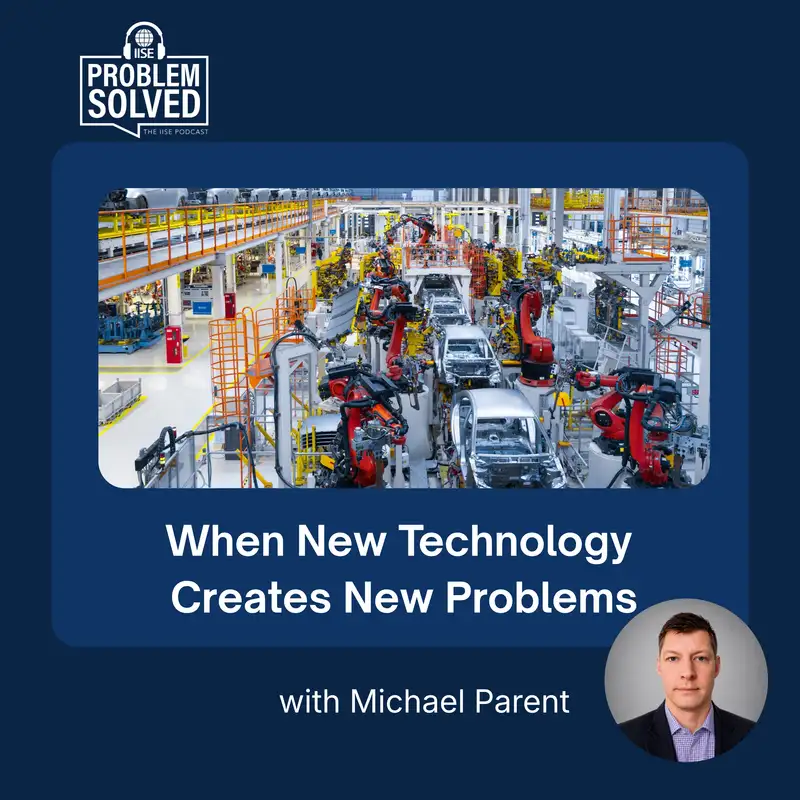
When New Technology Creates New Problems with Michael Parent
Download MP3Hi everyone, and welcome
to Problem Solved.
Technology is supposed
to make our lives easier.
In business,
we invest in new machines,
automated systems,
and increasingly sophisticated software
to make operations faster, safer
and more efficient.
But what happens when those improvements
create entirely new problems?
Today we're talking about the unintended
consequences of technology.
My guest is Michael Parent,
a management consultant
and principal
of Michael Parent Consulting Services.
Michael has worked with organizations
across manufacturing,
insurance, warehousing,
and human resources.
He holds a degree in industrial
and operations engineering
from the University of Michigan,
and an MBA from William and Mary.
He's also a certified
Lean Six Sigma master black belt and ASQ
Certified Manager of Quality
Operational Excellence,
and was recognized
as a 40 under 40 Rising Star
by the American Society for Quality.
So, Michael, thank you for being here.
And welcome to Problem Solved.
It's great to be here.
Thank you. Elizabeth.
Did I get all that accurate?
Yeah,
I feel highly
credentialed after
you're reading it back. Okay, good.
Well, again, thank you for being here.
And your work.
Kind of. As I said in the intro.
Your work focuses on helping companies
improve efficiency,
reduce costs of operational problems.
But you've also spent a lot of time
studying what happens when the solutions
themselves create new problems.
And I was just curious
if you could kind of take a minute
to tell our listeners
what first
sparked your interest
in that kind of work?
Yeah, I have a Substack, and I write
a lot about the man machine interactions
and how systems have different dynamics
and how the behavior of systems
can sometimes arise
out of our best intentions.
So that's really a lot of my focus.
I've always been
interested in systems
from way back in undergrad.
I always knew that this was going to have
some bent of my career trajectory,
so I like understanding
the systems behavior I like.
I think systems are sometimes
seen as inscrutable,
and I like trying to dissect those
and figuring out
what those dynamics are underneath it.
You know,
one of the key axioms of systems thinking
is this understanding
that what we do locally
is going to have a
different effect globally.
So if we try to optimize a machine
or a department or a metric,
that's going to probably sub optimize
something at the global level,
and understanding
that this is a lot of my work
and my interest is
I want to get a fuller scope of that
to help decision
makers or whomever is listening,
understand what the best decision is
on the aggregate.
Rather,
the most expedient thing at the time.
Nice.
Well, we
tend to assume that
the newer the technology is,
that means it's going to perform better.
Like, you know, the newest,
the newest iPhone is always
going to be the best iPhone.
But is that always true?
And maybe you can give us
an example of where
a technological improvement
has actually created
an unexpected problem.
Yeah,
I think the history of technology
is fraught with this tension
between what our best, what we hope
the technology will do for us versus
what it actually does.
So if we think way back,
like the steam engine, the locomotive,
yes, it created railroads,
but it also created for us
the train wreck. Right.
Those those two things are part
and parcel to the same invention.
We can't just decouple one
and say, wouldn't
it be nice to have railroads
without these train wrecks?
Well, yes, of course,
but that the whole technology
is both sides of that coin.
So we see that
with in more recent
technologies, things like the internet
with the rise of cybercrime,
certainly the internet
has been a good we've
democratized knowledge.
We can do something
like video chat like this,
but it's also created
opportunities for mass surveillance
and cyber criminals
using that technology for bad
rather than good. In terms of industry,
one of the things that I see very,
very often,
and I always laugh
because this was not in an issue
23 years ago, is ERP systems, right?
So if you input something incorrect
into an ERP system,
if you put the wrong routing in
or you put the wrong rate
or price in there,
that's going to propagate
through your entire system.
And this is actually how the ERP system
is designed, right?
That's it's a feature of the system,
not a bug.
So understanding
what these new technologies
are means
understanding the whole technology,
both the good and the bad,
and then making
an educated decision to say
is, can we live with the new bad
because of the good it provides us?
That's a great question.
So I was reading about one of the case
studies that you have on your web,
on your website
and your consulting firm did a case
or did
some work with an organization
called Perfection Wheel,
which is a company
that refinishing automotive wheels.
And they had invested
in some new equipment
thinking that it would,
improve their production goals,
but it was not working.
So could you take a moment to talk about
what was happening in that facility
when you first got involved?
And it's kind of talk about that case,
what happened when you started
looking at
the operation
and what the actual problem was?
Yeah, Perfection
Wheel is a really interesting
business model,
and it's something that most people
probably don't even know exists.
But when a vehicle
maybe gets in an accident,
maybe the back end is is destroyed
and they total out the vehicle,
they will part off different aspects,
maybe the engine, but also the wheels.
And this company will essentially buy up
those undamaged wheels and refinish them.
They'll rebalance
the wheels, we'll put fresh
professional coatings on them
and then they'll sell them
to repair shops and stuff at a discount
so that, you know,
they can kind of increase their margin
a little bit.
So it's a fascinating industry.
What they were trying to do
was speed up
and increase the capacity of the facility
by putting in this new fancy oven.
I think it was like an infrared oven.
And what this was supposed to do
is it was supposed to
move from batch
production of many wheels.
So anybody who's got a lean
background immediately
says, okay, that's a good thing, right?
We're moving away from batch production
and we're trying to increase the,
excuse me, decrease
the cycle
time of these wheels cooking in the oven.
And why would we cook
the wheels in the oven?
Well, to help
the paint cure
is the main reason
we would do such a thing.
So in looking at this,
it actually created a number of issues
because we went from this batch process
to this one piece flow process.
But what we didn't in encounter,
we didn't expect to encounter
was that as the wheels go through,
depending on what wheel we're producing,
the wheel might have to go through one,
two, three,
maybe even four times through this oven.
So when we think about it
that way,
the cycle
time of the oven for any unique wheel
is maybe even four times more than what
we expected it to be.
So with that in mind,
what we actually solved for
was the optimal product
mix of making sure
that we had enough capacity
in this new oven
so that based on the number of passes
and kind of like the recipe
or the routing of the wheels,
we were adequately supplying the oven.
And then we also did some,
you know, kind of tricky arithmetic
to set the oven temperatures
of the old batch oven to still be used
within a different context,
kind of like heating it
so that the paint would cure quicker.
So it was a multifaceted approach,
but the real insight
and the real fun in
that was optimizing the facility,
not with any material flow
or any of the asset
utilization that you would
normally encounter,
something like facility design
or capacity increasing.
But looking specifically
at the product mix
and then working with procurement
to make sure we had the correct wheels,
and working with sales
to making sure that they were discounting
and promoting the correct wheels,
so that while we had the product
mix correct in the facility,
it was also translating
to the marketplace.
Yeah, I thought it was
really fascinating.
I'm not an engineer,
so I didn't understand
all of the things of that case study.
But, I did think it was fascinating that
a lot of the solutions
were things like moving tools around.
And, you know,
you know,
those kinds of things
that had nothing to do
with the new piece of technology.
So it's kind of like, like you said,
just optimizing the entire system better.
And one piece of new technology
isn't going to solve all the problems.
Absolutely. Yeah.
There's there's a number of improvements.
The bigger ones were the ones
I already mentioned.
But as you said, a lot of them were
very basic facility layout design.
Where are we storing the work in process?
How are we organizing our tools?
Are we making sure that
we have a sufficient buffer
so that we don't starve one of the
product lines or one of the departments?
So that way
we can
maximize the throughput of the facility.
What was one of the biggest lessons
that you took away from that project?
You know,
one of the bigger
lessons is communication.
We can say that this works on paper,
but you really have to have
the stakeholders involved believe it.
So communicating what the ideas are
and why it's
going to translate to savings
is absolutely vital.
And then building relationships
and making sure those are people
that can trust you
and that when you come into a job
like that
and you come out of left field and say,
hey, I think the thing
that you really need to work on
is your product mix,
bracing them for that,
but also having a good relationship
to make sure that they trust
that your recommendation is
is going to work for them.
Just kind of veering off for a second.
How do you build that trust
when you come into,
to work on a project
with somebody with that,
you're just like, you know,
you've never really had
a relationship with before,
but you've got to quickly build
trust with them.
Yeah,
I think it's a mix of how you present it.
Right.
Bracing them for,
hey, we're going to try some stuff
that's a little bit different stuff
that you might not have seen
or have thought would be on the table.
A lot of it's starting
with their expectations
to begin with and asking them, what?
What do you want me to look at?
Are there
things that you don't want me to touch
because it's
the political third rail,
or it's something
that's going to get us in trouble
if we start bringing in other parties.
And then giving them the the easy, low
hanging fruit
like moving the facility
storage locations around,
those are things that they can
immediately reap the fruits of
and the benefits of very quickly.
So you kind of build credibility
with the small things.
And then I'm one
that focuses on experimentation.
I love to say, look,
it works on paper
or I think it's going to work on paper,
or I have an intuition on why
this might work for us.
Let's do a pilot.
Let's see what it looks like in two weeks
and we can prove it out that way.
I'm not the arbiter of what the truth is
and what's actually going to happen,
but I involve the facility,
and I involve them
in validating
some of these
opportunities and recommendations.
Do you think that sometimes
companies will automatically
look for an expensive
technological solution
when the real problem is
something much simpler?
Yes, very much in this facility.
As an example,
they were recently bought
by a private equity firm.
So the private equity firm,
their value is bringing money
to the table
so that they can invest
in new technologies.
So I think a lot of organizations,
departments have a bias towards
solving problems with the budget. Right.
They have a budget at their disposal.
They would be a fool to leave
some of that stuff on the table.
But that's also going to bias
some of the opportunities
that they're going to be looking at
or not looking at.
That makes sense.
Before you and I,
we spoke of something
called the automation paradox,
something that you introduced me
to, which
I'm going to let you talk about
that as I understand it,
it's the more that we automate a process,
the less experienced
people may become at performing
the task itself.
And an obvious example being,
you know, autopilot.
So can you talk a little bit
about that and explain how that happens?
Yeah, I think you did
a great job of summarizing it.
The automation paradox,
I would say, has two real prongs to it.
The first one is, as you mentioned,
the more we use automation,
the less experience
and the less familiarity
we have with the thing
that we're trying to automate.
The autopilot is a great example,
and we know that what pilots have to do
to keep up
their pilot's
license is constant
simulation training, right?
Despite that they're using autopilot,
they're always in the simulator,
and they're always looking
at kind of those edge cases
when they're going in the simulator,
they're not just flying Detroit
to Atlanta on a nice,
you know, cruising route.
They're doing these edge
cases of something
went wrong or the engine's down
or I've got crosswinds.
And that way they constantly keep up
the most difficult
part of their job,
even though they might not experience it
very often.
So they have a familiarity
with running into these situations.
That's the other difficult part
of the automation
paradox is when we automate something
and it fails, it typically fails
not for routine things.
It fails in edge cases.
It fails
when the system might be
crunched for time
or have different constraints or issues
that now the human operator
has to come in and solve.
And they are still lacking
the familiarity in it.
So they're not as familiar
with the situation.
They're coming in
and they're solving for the automation,
they're solving
some of the more difficult problems,
and they're solving them in contexts
like time crunches,
where they have to make a decision
very quickly.
And that creates a very,
very fragile system that if we're not,
we're not deliberate
in how we use
automation and understand
that this is part and parcel
what automation is,
just like the locomotive
in the train wreck, right, is
if we're going to bring in automation,
it is going to fail.
It is not going to work 100%
of the time for the rest of our lives
or the rest of civilization.
It's going to fail at some point,
and we have to be prepared
to intervene in those situations.
Yeah.
And one thing that you mentioned was,
quality inspections as an example.
So what happens when,
a company is relying on automation
and machines to do things
like quality control
and identify defects in products,
and something goes
wrong with that system?
Yeah, it's very much the same thing.
Right? If we are
if we are training our quality
control operators to identify defects,
they're going to be familiar.
They're going to have lots of experience
with it.
And most of the time
they'll be finding
routine errors
or routine issues that need to be solved.
And when we automate that, typically
the thing that's automating it,
looking for errors or issues,
whatever it might be,
they're also going to find
the really easy ones.
They're really routine ones.
Now, when that automation system breaks
and it stops working
or which I think is scarier,
the system starts
missing things
that are kind of on the fringe.
Now we have to still have
that manual oversight
to come in and intervene,
but now we're intervening
in a different situation.
We've got those fringe cases,
which we've already identified.
Our Q CS are not as highly certified
or trained
as they would have been previously,
and we might have time crunches
because that automation failed.
We might have to get the thing out
the door.
We might have back orders,
we might have to expedite this situation.
So now there's a time crunch
or some other constraint
that's being imposed
from the environment on to the operators.
What's the best solution for that?
Is it just more training
like better training,
more specific training
for the human side of things or what?
What is the best, I guess, fallback?
I think it's
a judicious decision
on how we're going to use automation.
One of the things that's
being talked about a lot, right now
with AI
is the human in the loop
of still having the human oversight.
And I think that's very important
and very helpful.
There's a number of tools
that the airline industry uses.
One of them was simulation,
which we talked about,
which is you constantly
give them those edge cases
so that they're very familiar with them.
When they do occur,
even if they're occurrence is very rare.
Another thing that you could do
would be like
situational adaptability, right?
So if you think of air
traffic controllers,
the way they operate in the tower,
when there's one plane in the air
is different than how they operate
when there's 20 planes in the air.
So they have new protocols
and different protocols on
how they behave based on the situation.
I think that's something we
could take and learn from.
Yeah.
I want to talk about
another example that you shared
and that's Amazon fulfillment centers.
You talked about how those
automated systems
and like robotics and stuff,
how those can be very, very effective
in controlled environments.
But then you pointed out
that the same approach
might go horribly wrong.
And or,
you know,
it might not be able
to be implemented at all
in a different factory
where there's more variables.
Can you talk about why that might be?
Yeah. Thank you.
This is again
the general topic of all of these things
are like the limits of technology,
and the limits are not like
an arbitrary line on a map
saying we can't go beyond this,
but it's
parts of technology that are it's
aspects of technology
that are part and parcel
to the technology itself.
So in things like automation
and the automation paradox,
we cannot get around that.
That's part of what it is.
Another aspect of technology
is the operational design domain,
which is this fancy way of saying,
how am I trying to get this thing
to operate,
or in what environment
am I trying to operate this in?
So if we take an example of
autonomous guided vehicles or AGVs,
these are things that are used
predominantly in supply chain.
They might also be used
in manufacturing at some point.
But they are prevalent in this industry
because we have
total control of our environment.
We can map all of their routes.
We have standardized storage locations.
We know where the parts are.
We know when the AGVs need to be charged
and we can build
redundancy in the system.
So it's very robust
and it works very well.
If we compare that to something
like a job shop
where
we've got high variability,
the cycle times are not the same.
The storage locations
are not standardized.
We can see just in terms of the
thought experiment,
that the AGVs are not going to be able
to do as well or perform as well
in that job shop
because of the variability
the number of parameters within
the environment
has ballooned
because of all this variability,
whereas it's tightly controlled
in like an Amazon fulfillment center.
This is the same issue that we see
with driverless vehicles, right?
The driverless vehicle
is this operational design
domain expanded to thousands and millions
of different dimensions.
Right.
It's now we have to control for wind.
And if there's water and other drivers
and if the environment has changed.
And this is why
one I'm pessimistic
of driverless vehicles,
but also how you see
a lot of these weird memes of the driver
of the driverless vehicles getting stuck
when they are trying to go over a puddle,
or they
they won't let the driver
out of the vehicle,
it's because of the design domain
that it's ill suited
for what it's being asked to do.
And just to conclude with this idea,
with driverless vehicles,
even amongst the industry,
there are different
philosophies on how to crack this egg.
Crack this nut, so.
Tesla is trying to solve the hard problem
of this O.D.D.
the operational design domain.
They are trying to create
a very robust driverless vehicle
that can go in all situations,
in all environments.
Other companies like Waymo,
what they're trying to do is
they will go and map an entire city,
and they will try to control
as much of that environment as possible.
It's much closer to the AGV style
of driverless vehicles,
as the Tesla is so much more robust.
So all that to say,
there's
a relationship
between what we can control
and the goodness of the solution
with regards to automation or technology.
That's so interesting.
Do you feel like,
with AI and automation,
do you think that businesses
and companies,
do you think that there's sometimes
implementing the technology
before they fully understand it?
Yes, of course I think, yeah,
I think a lot of, CTOs right now
are scrambling to just have a response
to how the question of
how are we using AI?
And I think a lot of times
AI is not the correct answer.
I saw just kind of a great example today,
but it was
choose a number one through ten
and the AI will always choose seven.
And of course you should have,
you know, 10%
be the number one, 10%
be the number two, 10%
be the number three.
If this is kind of a random selection,
humans are also not good at that.
We tend to choose numbers in the center
and less on the extremes,
but the LLM doesn't perform
as well as like a simple calculator.
So I think a lot of these things we’re
we're not really scrutinizing
if it's the right tool for the job.
It's as if somebody said,
how are you going to use this hammer?
And we see a screw in this wall and say,
I can take care of that screw there.
You might be able to do that,
but there might be
a better solution out there
for you as well.
Okay.
So as far as engineers
and business leaders out there
who are listening,
how can they
differentiate between I have a process
that needs to be solved
or I need a new piece of technology,
like what are the questions
they should ask themselves
before they move forward
with investing in some major new
piece of equipment versus
I might just have a systems problem.
Yeah.
I think
how I began with expanding the scope
of what we're looking at
and try to really understand
the whole environment
and the organization.
I grew up on the lean stuff.
One of the
the most important parts of
lean is your overarching philosophy.
You don't want to
impede the organizational identity
for efficiency
or for particular performance goal.
So I think always starting with the why
and working back from
that is very, very important.
I would also say in
just in terms of investment,
you usually can get 20,
25, 30%
without capital investment, right?
I would much rather
try to optimize
the current operation
before
I look for any kind of
radical transformation.
And then in terms of advice,
if we are going to go down the role
of technology, I would try to
avoid turning technology into legacy.
Any technology that we invest in now
is going to become an albatross
around our neck
in 20, 30, 40 years, right?
We we went through
digital transformations.
Anybody who's been in the industry
for ten, 15 years
where we were trying
to get rid of fax machines,
we were trying to get rid of teletype.
Right.
That was all really cool
new technology in the 1970s and 1980s.
But eventually this innovation
becomes legacy
that you can't get away from.
And it takes a lot to get away from.
I think from like
a civilizational perspective.
We look at
maybe some of our roads or highways
and we say, what were we thinking?
Is it was this really the best
we had to offer?
That's going to happen in 50 years
with data centers as well, right?
That's going to become a legacy.
It's going to become infrastructure.
And once it becomes infrastructure,
it's very, very difficult to escape.
It takes a lot of deliberate effort
to get around that.
So I would caution anybody,
focus more on using
the technology
tactically rather
than infrastructure, really,
if you think about the microwave,
for example,
the microwave is pervasive in society.
Probably every home
has it in the United States.
If tomorrow we said, hey,
you can't use microwaves anymore,
it would probably disrupt our lives
very little.
Right?
We say, okay, it's gone.
Right? It's not infrastructure.
It's not legacy.
I still know how to use a stove.
I still know how to use an oven.
So I would focus on trying
to use technology
more like a microwave
and less like infrastructure.
That's a really interesting perspective.
I don't think I've heard anybody
say that. Very interesting.
I wanted to ask you about,
we kind of talking about the future, but
your opinion on,
AI in the future of technology,
what makes you the most optimistic?
I know that you talked about
being pessimistic with,
driverless cars and stuff,
but what makes you the most optimistic?
Yeah,
I mean, it's hard to look at.
It's hard to look at AI
and not be optimistic about its potential
right now, I see AI being used
as like an aggregator,
and I think this is pretty cool.
A lot of people are using it to parse
data to, you know,
bring insights together,
but then it's typically getting funneled
into a very narrow use,
either image matching in industry.
Anyway.
So I'm excited about that.
I'm excited about the optimization
of many of our existing processes
through the use of LLMs.
So that's something
I'm really bullish on.
Do I think superintelligence
is just around the corner?
No, I don't I'm
not even worried about it.
But, I'm
optimistic about the narrow
applications of it for sure.
Okay.
If you don't mind,
I kind of wanted to end off
with,
you giving a little bit more advice.
I know you've given some already, but,
for those who are listening,
who are in different stages
of their career that you've
maybe already gone through,
we have students listening.
We have young professionals,
young professionals listening.
If they're interested in
going down the same path,
that you've gone down,
can you give some words of wisdom,
some advice?
What should they be studying?
What should they be looking at?
What should they be reading?
What should they be?
Where should they be interning?
That kind of thing.
Yeah. That's great.
I you know, I will couple this
with your last question
of what I'm bullish about
and what I'm concerned about
with artificial intelligence.
One of my chief
concerns is how we interface with it.
And this dissolution of
the man in the machine.
It's becoming much,
much more difficult to figure out
if I'm talking to a machine
or human being.
And the way we interface
with artificial intelligence
and how it uses “I” pronouns,
and how it has a conversational tone
and natural language,
when you listen to it,
all of those things are obscuring
the distinction between man and machine.
And I think that right now
is the most prescient
risk of kind of our, our AI revolution.
So I would say anybody who is interested
in starting a career
or trying to figure out where
their career trajectory should
go, should be focused intently
on the human,
on the human side of things,
and making sure
that we're designing things
with the human in mind,
not just the human
as we'd like them to be
or expect them to be.
But, really, as we are.
So there's a number of programs
that I've used
and I respect, there's an ideal
human centered design,
program that I think you can take online.
I would read any book by Don Norman.
He is a design guy.
He's he wrote originally
about the automation paradox.
That's not my idea.
That's his.
And, I would focus on the design aspect
and the interface of how
we interact with our machines,
because I think that is going to become
so much more important
in the next 10 to 15 years.
Oh, that's great advice.
Before we close,
was there anything that you wanted to say
that I didn't ask or
that we didn't get to
No
I think we talked about it all.
I plugged my Substack
right at the very beginning.
I'll say it's called
Systems of Human Performance.
You can find it
at Performance Systems,
dot Substack dot com and I write
about the topics
of human centered
design, human error,
infrastructure, interfaces,
just about anything
that we've talked about here,
as well as a little bit
more on technology and society.
That's great.
Well,
thank you so much
for being here, Michael.
I really enjoyed talking to you
and I learned a lot.
Thank you so much.
It is a pleasure.
Thanks for listening to Problem Solved.
If you enjoy this podcast,
we'd love it
if you would take a moment
to rate and reviews us.
It helps others discover the show
and we would really appreciate your
support. See you next time!