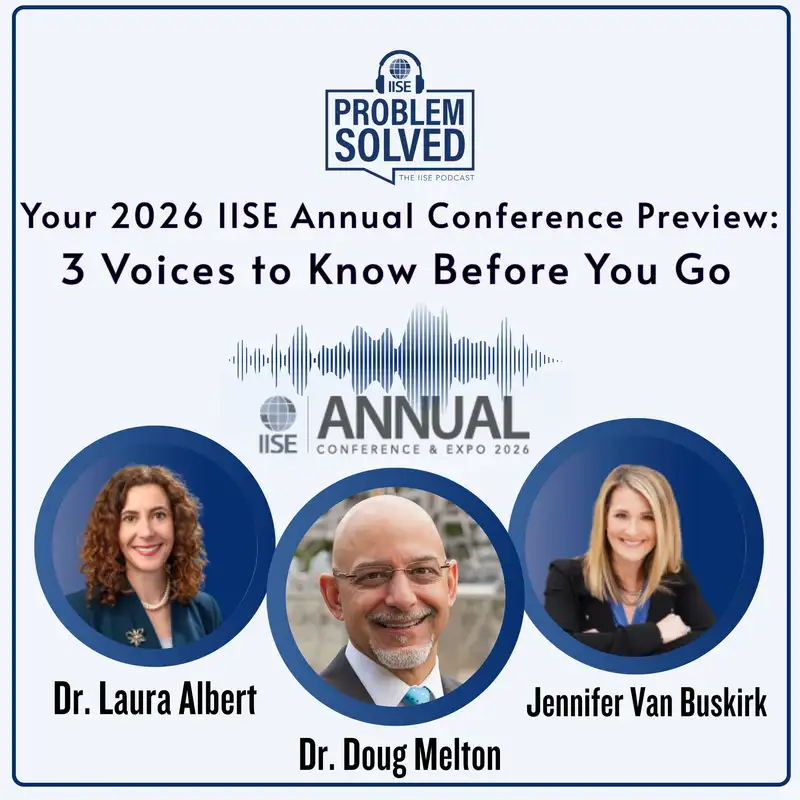
Your 2026 IISE Annual Conference Preview: 3 Voices to Know Before You Go
Download MP3Here's the problem.
Industrial and systems engineering is one
of the most impactful fields in the world,
and somehow it's still a well-kept secret.
The demand is growing, problems are
getting more complex, and the need
for ISE has never been greater.
So how do we ensure the field keeps
evolving and continues to make an impact?
That's what IISE's annual
Conference and Expo is all about.
And in this episode of Problem Solved, we
are giving you a preview of what's ahead
May 16th through 19th in Arlington, Texas,
and three voices you should know before
you go from the future of the field to
leading transformation in the industry
to building an entrepreneurial mindset.
This is your 2026 IISE
annual conference preview.
We're starting with Dr. Laura
Albert, professor at the
University of Wisconsin, Madison.
Founder of ISE Day, she's a
keynote speaker this year,
and her message is important.
The future of this field is
something we all help shape.
Dr. Albert, we greatly
appreciate your time.
we're very excited to have you at
the IISE annual conference this may.
What would you like the conference
attendees to take away from your keynote?
Discuss?
You know, a few things.
Number one is that it's a consequential
time for industrial and systems
engineering, and it's up to us to set
the, the future for our field and,
and that's an awesome responsibility,
but also it's very exciting, Lisa.
It's very exciting to me, and I'll talk
a little bit about ISE day and why I
believe it's a consequential time, but
right now, I mean, we've seen for the
last century that our tools are malleable.
They can be applied to many
different disciplines, and that's
a source of strength for us.
That we can apply industrial and systems
engineering tools to new domains.
That's constantly a source of strength.
not that we're losing sight of our past.
I often say manufacturing is our past
and it's also our present and our future.
but there's a lot of different ways
we can go and, you know, finally that
culture is really important and we get
to cultivate the culture of our field and
make it exciting for newcomers to join us.
You mentioned ISE Day, that was an event
that, really seemed to come outta nowhere.
of course we credit you and
your team for, pitching it and
putting it out in the world, and
it, it caught fire real quickly.
and I know you're looking to, build
on that success for this year.
So the launch was very successful in 2025.
what are your plans for 2026?
How are you planning to expand,
for this year's ISE Day?
Sure.
Before I answer that, I'm gonna just
tell, talk a little bit about what
ISE Day is, and it's been something
that's on the back burner for me.
I mean, I love celebrating like National
Donut Day and National Pie Day, and it's
like, well, why can't we have a National
Industrial Systems engineering day?
And really it's to increase awareness
of industrial and systems engineering.
ISE is a well kept secret whether we
like it or not, but we can change that
and we really wanna inspire future
art generations to pursue career.
Is in industrial systems engineering.
And as an academic, that often means
ins inspiring the next generation to
choose industrial engineering as a major.
And so that's really our north star
that we are, we're coming back to.
And you know, one approach is
that if everybody does a little
bit, nobody has to do a lot.
Like we all start telling people
about industrial engineering.
The next generation will know about
industrial and systems engineering.
It won't be such a well kept secret.
We are really looking at
strengthening two areas.
One is increase.
See in our global participation,
and that was kind of a surprise
in our first ISE day is that it
was a truly international event.
We ended up having, I think, 22
countries, participate in the
first ISE day, which was fantastic.
And so we're hoping to have a, maybe
a series of virtual international
events over the day given the, the
different time zones we're all in.
We're also making this year,
K 12 outreach, priority,
which is a little bit more.
Work to get started.
But if we can lower that barrier to
entry and really meet, especially middle
school students, high school students,
and even younger, to get them excited
about STEM and ISE in particular,
that is a real opportunity for us.
Why should ISEs be more
willing to toot their own horn?
'cause as you say.
This is sort of the, the well-kept secret.
I keep coming back to this paradox
for our field in that industrial
systems engineering is growing faster
than almost every other engineering
discipline or graduates are well paid.
They find jobs fairly easy compared
to, some of our other, other STEM
disciplines and ISE is really
consequential to the world economies.
So the world needs us and yet enrollment
in industrial and systems engineering
programs has dec. In the last few
years, and it's not a sign that our
field is dying because we see all
the demand and we see the growth.
We know what a vibrant and exciting
field we have and we're just not
effectively sharing our story.
And so that is me lighting the fire
under us needing to toot our own horn.
And we don't all need to like shout it
from the rooftops, but if we can all
just tell a few people about industrial.
Systems engineering or be that contact for
a friend who has a, a child considering
engineering degrees, and we can talk
about industrial systems engineering.
Just open the door, show them
the view through the window.
Some will go through the
door if we can do that.
How are universities and departments
helping to prepare students then
for the evolving and potential
challenges presented by ai,
by the advancing technology?
How are we preparing for the future?
A couple of different ways.
I can't speak for every
department or university.
I can speak for my own at the
University of Wisconsin Madison.
And it's a little bit of continuous
improvement and big picture
vision as a faculty member.
And I always ask myself,
where is the field going?
Where does it need to go?
And what do we have to do
to be at the forefront?
And that's like my guiding principle into,
you know, keeping our curriculum relevant.
Well, as we mentioned before, the
IISE annual conference and Expo
2026 will be taking place May
16th through the 19th at the Loews
Arlington Hotel in Arlington, Texas.
You will be a keynote there, but you've
also been an attendee of a number
of these conferences in the past.
How do you benefit, from attending
the annual conference and
connecting with colleagues and
other ISEs from all over the world?
it's, for me it's mostly about
collaboration and networking
as well as the great talks.
So I will see a number of talks, but I
most enjoy meeting new people, meeting
old friends, making new friends, and, just
hearing about the latest and greatest from
the people actually making those advances.
Dr. Albert from University of Wisconsin
Madison, greatly appreciate your time.
Thank you so much.
Now we turn to Jennifer Van Buskirk,
another keynote speaker, and she
talks about how industrial and
systems engineering has made an
impact in industry where she has
spent more than two decades inside.
One of the most complex systems
out there, telecommunications.
Yeah, thanks for having me.
This is an exciting, opportunity
and I'm thrilled to join you today.
I grew up on the East coast and
I got my industrial and systems
engineering degree from Virginia Tech.
and I went into management consulting
after school, until I started with
singular wireless, which was, the company
I was just created in Atlanta in 2001.
And there I had the opportunity
to work alongside and really
learn from some of the.
The, just the legends of the industry.
It was in a remarkable time.
Singular became part of at and
t back in 2007, and I've been
here at at and t ever since then.
over my 25 years here with
the company I've held.
14 different jobs.
I've been able to work in nearly
every corner of the company, and
be part of some of the biggest
events in the wireless industry.
It's been pretty exciting.
I'm now a proud Texas resident where
the conference will be located.
I lead business operations
here at at and t, which serves
business customers of all sizes.
Throughout their life cycle.
Well, if you can give us just a, a little
bit of a preview, a brief look at what
topics you might introduce in your keynote
and what you hope some of the attendees
there will be able to take away from it.
Yeah, I, I'm not gonna tip the whole
story here, but I hope people walk
away believing one thing deeply,
that you chose the right field.
Industrial and systems engineering
taught me how to tackle complexity.
make tough trade-offs and do hard things.
and just as importantly, it gave me
the confidence to step into challenges
really before I had all the answers.
And that foundation has served
me at every stage of my career.
ISEs are uniquely equipped
to solve complex problems.
Drive meaningful change and
shape business trajectory.
and this field doesn't just
prepare you to analyze systems.
it prepares you to lead transformation
and businesses in every field,
in every part of the world.
They need ISEs to help build.
Simplify, transform and
enable their businesses.
And so I hope leaders, leave inspired to
act, with maybe a little sharper point
of view, a few practical nuggets, and the
courage to move fast and make an impact.
And so that's what really I hope
people take away from my keynote.
Well, and as an industrial engineer, shout
out to our hokey friends at Virginia Tech.
Go hokey.
how do you plan to explain some of
the processes you use as an ISE to
solve problems and to fix processes
in the communications field?
yeah.
You know, technology and
telecommunications is really one of the.
Most complex, interconnected systems
in the world, and that's exactly where
industrial and systems engineers thrive.
ISE expertise helps in designing, in
optimizing, in scaling the systems
that connect people, businesses,
and data reliably and efficiently.
And so there's lots of ways ISEs
enhance, telecom in this industry.
I'll highlight just a
few that are top of mind.
first on ipro improving reliability.
Resilience and performance at scale,
applying systems, modeling, capacity
planning, risk analysis, all of that to
ensure networks perform under peak demand
and recover quickly from disruptions.
This is really key.
second.
That ISEs are well equipped to is
turning data into operational insights
and using analytics to predict
demand, prevent outages, prioritize
investments overall, improve quality
and consistency of operations.
And third is one I'm particularly
passionate about is how do we reduce cost
while improving the customer experience?
and this really centers today
on leading AI transformations
to streamline processes.
reimagine workflows eliminate waste.
generally align technical performance
with customer expectations.
So as communications networks become even
more software defined and AI enabled,
even more critical to our economy, ISEs
play a really central role connecting that
technology to outcomes and driving, impact
from the innovation that we see around us.
And, and about that innovation.
We've seen so many advances
in wireless, communications
and technology over the years.
We have these magic little boxes in our
pocket that connect us to the world.
What are some of the innovations
we might see coming down the
road, particularly with ai now?
A big part of the mix.
Yeah.
Wireless has been such an exciting.
Field.
I've been in it for 25 years now,
like, it's hard to believe, but the
iPhone will be, the first launch
was 20 years ago, coming up soon.
and.
That phone launched on a two G network.
when data speeds were at basically
a snail's pace, like downloading a
video was practically impossible.
And today, as we've improved wireless
coverage, speed latency coverage, we've
really enabled life changing things
that most of us take for granted today.
Things like.
getting places using Google Maps or
calling Uber or maybe doing Zoom meetings.
today we have these lightning fast
5G networks that stream 4K video
instantly from practically anywhere
even support self-driving cars.
So this industry has
literally changed the world.
But it's not the end of the road.
This technology continues to evolve
at a rapid pace, and the coming
years are gonna be bring some like
truly game changing innovations.
one that we're already starting to
see satellite based connectivity is,
augmenting terrestrial networks to create.
Complete seamless connectivity
in hard to reach places.
Ev like pretty much everywhere you
wanna go, you're gonna have coverage.
six G networks are, coming
right around the corner.
It's hard to believe 'cause
we're all talking about 5G.
And finally we're gonna see a massive
IOT or Internet of Things expansion.
And this will support billions of low
power devices and anything from smart
cities to, agriculture applications.
Robotics is really hot right now.
and even, logistics will continue to use
these devices and so expect a future with.
Smarter, faster, and even more ubiquitous
connectivity that blurs the lines, between
devices, between people, technology
and the environment that we operate in.
That sounds fantastic.
Yeah.
And you've earned quite a few, awards
and a good bit of recognition as a
successful and high achieving female
leader in the technology field.
W how do you see your success
and maybe that of others in
similar positions, helping to
inspire and create opportunities
for young women in STEM fields?
You'll have a lot of young students
at the conference will be listening.
how do you see the, your success maybe
being able to set a good example for them?
Yeah.
At this point in my career, that's
a, that's a priority for me.
So I've learned for every hand you're
given, you have to reach back and
bring someone else along with you.
And so it's an exciting time.
The, the field and technology in general
is, it's all not just expanding, but
it's becoming increasingly critical.
and as.
Telecom and other technology
evolves with more software
defined AI enabled industries.
Demand is really growing for
leaders who can connect that
technology to business outcomes.
And that intersection where strategy,
systems, data, and people come together
as an area where women, and especially
ISEs, are making a really big impact.
technology today is all
about designing systems.
Leading transformation,
managing this complexity all
to drive real world outcomes.
and those are, those
are leadership skills.
so beyond the technology leadership is
really important and they're essential
to turn these big ideas into impact.
And so, I hope to inspire all the
attendees at the conference, but my
specific advice to women entering
or advancing in this space is to be
intentional, build deep expertise.
Stay curious about emerging technologies.
Don't underestimate the value of your
preparation, your system's thinking, your
ISE background and your point of view.
And then just don't overthink it.
Like go for it.
Just do it.
And the future of telecom and every
other industry is gonna be shaped
by those who are courageous enough,
to, to take action, to lead the way
and turn innovation, into impact.
You'll have the opportunity too,
while you're there to interact
with some of the, attendees.
You'll have a room full
of very smart people.
What do you hope to gain from visiting
the conference and maybe being able to
connect with some of the people there?
Yeah, this is my first conference
and I could not be more excited.
I hope to gain inspiration
and perspective.
This conference is a great
reinforcement of why this field
matters, right, and how this prepares
people to make a meaningful impact.
But really most of all, what I'm
excited about is, is about the people.
I'm excited to connect with other ISE
leaders, practitioners, students, to
share ideas and learn from one another.
These opportunities are great ways
to build networks and learn and make
connections in areas you don't otherwise.
I'm excited to see how systems thinking
is being applied to solve some of the
hardest problems that we face today
and that we'll see into the future.
Well, thank you so much.
Absolutely.
Thank you.
Jennifer's perspective is about scale
and leading in complex environments,
but i's annual conference isn't
just about what you will hear,
it's about what you will do.
Doug Melton's workshop focuses
on something that connects
everything you've heard so far.
Taking that information and
using it to create value.
Doug, thanks for your time.
Thanks for being with us.
give us an idea and overview for
folks that aren't familiar on, what,
engineering Unleash is about and why
an entrepreneurial mindset is, is a
really a great value, particularly
to industrial and systems engineers.
People involved in problem solving.
Yeah, so Engineering Unleashed formed,
through the efforts of the Kern Family
Foundation a while back, and this has been
connected to maybe a program that people
have heard of called Keen Engineering.
Unleashed, though is an all invite.
Everyone's invited to this
that connects to the mission.
And so whether people are from a Keen
school or not from a keen school, or
they're faculty or industry or graduate
students, they're invited to this
event because it fits that engineering
unleashed brand and it's really.
A collection of, content, but
it's a collection of people.
It's a community on this platform.
In fact, people can go to engineering
unleashed.com now and they can sign
up for being part of this community.
It only takes a minute.
There's no cost associated with it.
And the notion, the reason why
they've gathered around this.
Is because of this idea.
You asked about the second part
of your question, this idea of
entrepreneurial mindset, the idea
of creating value in any context.
Let's say that you are an
engineer working at a company.
And usually, you know, these are, it takes
a team to actually do something, you know,
and, and so you can find yourself in an
organization, maybe a particular unit, but
that idea that you have an entrepreneurial
mindset is gonna make a difference because
you're gonna be focused on creating value.
And that's really what it is.
It's a habit of mind around creating
value using your engineering, the
art and science of engineering, and
creating value with it as a disposition.
And other aspects that are connected
to it are being more curious, thinking
in a systems or connected way.
And that certainly seems.
Just part and parcel of what so
many folks within IISE naturally,
and when people think of an
entrepreneurial mindset, they're
thinking of starting a business.
This is a whole different
kind of pathway, isn't it?
It's really more of an approach,
to, to solving problems in general.
Yeah.
Keith, I, you, you hit
the nail on the head.
Sometimes that word has a lot of
baggage for people and they're
thinking, you know, this is a, a
startup venture, so sort of thing.
But it's not.
It's about using this notion of
creating value in any context.
An NGO, a government organization,
a company you could even some
people have that are, are in our
community, have extended it even to.
Their personal as well
as professional life.
And, and it's a very interactive, program
that you have at the workshop too.
You get people that are involved
in, in, in different ways.
You encourage them to bring a device.
just give us an idea of how that
works and if there's anything new
that's gonna be presented this year.
Oh, so part of the lineup,
fortunately, does not just depend
on me, but it's folks like James.
It's it's folks.
It's a collection of faculty that come
from this discipline that have been
involved, and they, they come to this
ready to talk about how it applies
to this particular context to this.
Particular discipline.
So they'll be bringing in examples
of all sorts of things, examples from
their classroom, examples from industry.
And those examples will end up being
discussion points up on a screen,
discussion points at a table.
And Keith, you're exactly right, this is
not a sit and get, this is much more about
being interactive because I, I think, you
know, people are starved for community.
And people are also starved for
community where there are great
ideas that they can see moving.
Kind of the ball forward, and
we're not, we're talking about,
you know, being able to create,
value in such a variety of ways.
Personal value, societal value, value
it from an industry perspective.
And it's not just all about the funding
or the money connected to that term
value, but it's really about good and
being, using our engineering to do.
Something good at translation.
Yeah.
And as James May attest, this kind
of fits in with a lot of our other
training too, doesn't it, James?
That and, and kind of the ideas
that we wanna pass along to people
that not are, are just theories, but
here are things you can actually use
it.
Sure does.
Keith, we're so grateful to, to Doug
and the engineering Unleash team.
Helping us bring that into our courses and
our, our most popular courses, our green
belt courses have this full integration
with the idea of entrepreneurial mindset.
in fact, I just taught a class this
weekend and what I love about it is
we talk about skillset, being able
to apply these technical tools,
but then we talk about mindset.
How do you actually use this information?
How do you use these tools to
make really good decisions?
Add societal impact that, that make
you sort of an engineering superhero.
you know, it, it's not just about solving
problems, it's solving important problems.
And how can you use that, that
curiosity connection to creating value.
To really bring that all together and
solve important problems in the world.
And students are so energized by that.
You know, it's not just how do
I do the math to get the right
answer for process capability.
It's what am I gonna do now that I know
that to solve an important problem?
And I think it really brings that, makes
that connection explicit for students.
And they really love it.
Well, it all sounds great and we
are looking forward to it Again.
I know you'll get a good crowd.
Again, we've we've got a big
conference plan and we should
have a really good attendance
there, two to 5:00 PM on May 16th.
it's a free course.
A free workshop, but you still
have to register in advance.
And if you haven't signed up for
the conference yet, please do so.
I'm excited for this and I look
forward to being there and it's
just a privilege to work with this
group and its members, so thank you.
Alright.
Thank you Doug.
And, and I'll say I'm excited as well.
Great way to network with other
industry practitioners, other folks
in academia, or if you're a graduate
student, great way to make connections
either in academia or in industry.
Yeah.
And if you're in the, Dallas-Fort
Worth, Arlington area, by all means,
please sign up and come join us.
We'd love to have you.
Thank you again, Doug.
We look forward to seeing you
there, and look forward to
sharing news from the conference
and your workshop going forward.
Thank you, Keith.
Thank you, James.
Take care.
The IISE Annual Conference
and expo takes place May 16th
through 19th in Arlington, Texas.
There's still time to register at
iise.org if you'll be there in person.
Look for the Problem Solved LIVE
booth follow problem solved on
LinkedIn and Instagram for updates.
Thanks for listening to Problem Solved.
every great solution is
a story worth telling.