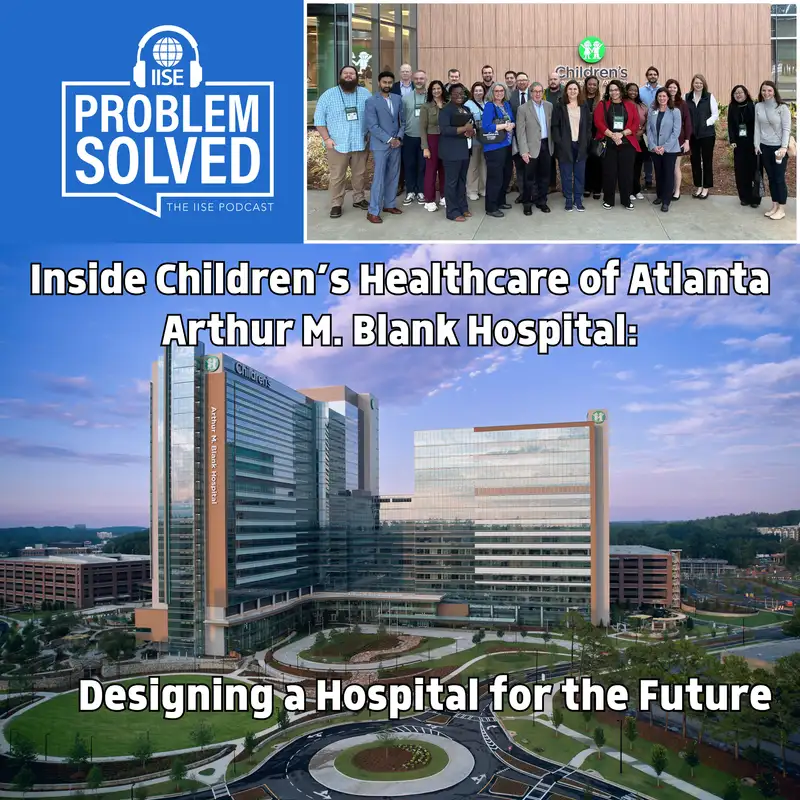
Inside Children's Healthcare of Atlanta Arthur M. Blank Hospital: Designing a Hospital for the Future
Download MP3Here's the problem.
How do you design a hospital with
innovations that will grow with the
future in an aesthetic that feels
warm, fun, even recreational and less
clinical, but with all the benefits
and best medical technology available?
And how do you do so without breaking
the systems that keep it all running?
Standardize where we can
and customize where we must.
Earlier this year, in February
at the Healthcare Systems
Process Improvement Conference.
We got the chance to step inside
one of the most advanced pediatric
hospitals in the country.
Arthur M, blank Hospital, children's
Healthcare of Atlanta here.
We spent time in a massive 19 story,
2 million square foot facility
where advanced technology is used
in ways that support staff and
therefore benefit the patients.
A patient who was going to, they were
going to take them off life support
and the parent was unable to be there.
So we were able to use the technology
to connect the parent to the child
to say goodbye to his child before
they were removed from life support.
So to me, that's.
That's my why and what
really made an impact.
Join us on this episode of Problem Solved,
walking into the lobby of Children's.
This doesn't feel like a hospital.
There are large windows, a lot of space,
a lot of light families and games.
In the lobby, there is a large
interactive wall where motion tracking
sensors allow you to make the animals
on the wall move, leap or fly.
Our group of professional engineers
immediately started playing with this.
And we are told about Ryan Seacrest
Studios where musical artists come
perform for the kids, and there's
a wall of celebrity autographed
photos like Justin Bieber.
We were led on our tours by Kristen
Bowman and Felicia Reynders.
We have video games,
they come down and play.
We have miniature golf,
we have basketball.
We have soccer mats that they can
play cornhole so they can just come
down and be a kid and not have to
worry about being in the hospital.
It is joyful and it's bright.
It's not accidental, it's engineered.
Children's has some of the most advanced
technology in clinical care, but before
anything reaches the patient, it gets
tested here in the simulation lab.
This is Megan De Fury, one of
the simulation lab coordinators.
And it's been like a labor
of love, creating this space.
We've been working on it since like 2020.
And so our goal in creating this space
was why not replicate what you see in
the actual patient care rooms here?
and so this has been really
beneficial 'cause we have an or
right there, I'll show it to you
guys, the trauma center, ICU and GPC
rooms as well as an ED skills room.
In this space, they're not just
testing clinical skills, they're
testing entire systems, and they do
so in an environment that mirrors real
patient care as closely as possible.
Clinicians notice gaps, especially around
human factors and ergonomics that weren't
being captured in traditional simulations.
So they built a space that could.
Our bread and butter really is
looking at process improvement.
so evaluating using simulation existing
or new processes within the system.
We can look at new or existing
processes before they go live.
What we, the simulation
coordinators typically do, we
plan it from start to finish.
We can do a tabletop exercise,
making sure everyone's on the same
page, bringing all the players in.
So interdisciplinary.
Everyone sometimes has their
own thoughts on the process.
we'll run through that simulation.
We identify latent safety.
Threats or any areas of opportunity that
could impact our patient safety impact,
our staff workflow and efficiency.
'cause we know that's like super
important, especially during this
high risk, high state situations.
What we have found, we recently started
doing, and I really enjoyed it, is
we do action planning afterwards.
It was very clear the level of detail
that was put into this space and
how important it is to training.
You can see like the booms will move.
You guys are welcome to walk
around, play with touch, whatever.
You're not gonna break anything
here because that's a point of
simulation to be able to practice.
But you can see these booms, we
can actually rotate the room,
we can rotate the bed space.
We are like, whatever the OR is receiving,
we want to try to replicate that or, you
know, how can we get the same footprint?
Yeah.
So, that was really the goal.
Even all the way down
to the circle in the.
Room because a lot of, clinicians, at
least I know this from my time at the
bedside, a lot of us will orient our,
positionings during like emergencies
or procedures based off the circle.
Yeah.
Then we move into another room, set up
with x-ray imaging, intubation, equipment,
and everything needed to support a
level one massive transfusion protocol.
I actually just did some training,
on Monday in here for a role
that's called a CPR coach.
It's like an a HA standard to have this
role that will actually, help the provider
take off some of the cognitive load.
And we're implementing the ED right now.
So we were able to work on a lot
of ergonomics with the actual
new role and how that looks
within the emergency department.
In this simulation lab and throughout the
entire hospital, technology is everywhere.
Not to replace people,
but to support them.
Interpreter services are
integrated into care.
Information flows smoother,
decisions happen faster, and staff
can stay focused on the patient.
And in a space this big where providers
are covering more distance than ever, that
kind of support makes a real difference.
This is Michelle Tillis, CNIO,
and Vice President of Information
Systems and Technology and Jason
Skelley, director of Information
Systems and Business Partnership.
All of the visualization that we
helped to enable with just being
able to see where my, my team member
is, if they're in the other room.
obviously when we think about the cameras
and just the possibilities, we were only
scratching the surface and I think that
it's really put us in a great position.
To reimagine what healthcare looks
like and as we have kind of that
the demands and competition of
resources and challenges and staffing,
I think that we've got a really
great opportunity to help improve
that just with the technology.
We deployed virtual
nursing in a pilot program.
making sure the technology works,
understanding how staff would
use it, having people come in and
portray as patients and, their
family members or the actual patient.
and it really helped us to figure out,
here's some opportunities to improve
this process from the patient standpoint.
Yeah.
And how the technology's used and.
I, I was curious about the telehealth
with the, like the virtual nursing.
was that hard to make that still
feel personal to the families?
Was that one of the concerns
that you had to overcome
to date?
I think the numbers play out that
the patients have appreciated.
Yeah.
The virtual nurse and what they bring
to the table with the admission and
the discharge tasks that they handle.
and I think it also helps that,
right, we're piloting our GPC unit.
Mm-hmm.
the virtual nurses are also serving as,
when they're not in a virtual nurse role.
They're serving as a
bedside nurse on the GPC.
Yeah.
So they can, because they work
there every day, they can give
that more personal aspect as well.
Yeah.
And Atlanta's such a, like, diverse place.
I mean, just the, the language
barriers that might be
Well, that's the other benefit too.
I think that what we've seen so far,
at least, 'cause we're only on month
three of the virtual nursing pilot and
we surveyed the, the staff, both the
bedside staff and the virtual nurses.
And we're all obviously.
Surveying our patients if
they choose to respond.
Mm-hmm.
But what we've seen is that it has
been a really great facilitator with
patients that have a language barrier.
Yeah.
'cause you're able to
engage the interpreter
mm-hmm.
Services on the call and it really
helps to fac facilitate that.
Mm-hmm.
And take that off of the bedside nurse.
Right.
but again, they're just another
member of the care team.
So we've just really kind of
expanded what the care model looks
like for nursing on that floor.
Technology is used on an
even more personal level.
We did have a really great story.
I felt like it was
really touching Oh, yes.
About, it was a patient who was
going to, they were going to take
them off life support, and the
parent was unable to be there.
So we were able to use the technology
to connect the parent to the child
to say goodbye to his child before
they were removed from life support.
So to me, that's, that's my why
and what really made an impact.
Yeah.
Last year, children's treated
more than 5,000 trauma cases
and cared for over 90,000 kids.
Behind the scenes systems are in place
for the moments you hope never happen.
They're one of just 13 regional emerging
special pathogen treatment centers in the
country equipped to care for pediatric.
Patients with diseases like Ebola or
other novel respiratory threats teams
train regularly with full-scale PPE
exercises, preparing for scenarios they've
thankfully not had to activate yet.
Again, we pass through the lobby a
chapel and hear about special events and
activities that are always available.
A lot of times we have a lot
of donors that come in and they
want to do patient parties, so
at Christmas time, ACE Hardware.
Donated 500 metallic trees.
Every patient that was in the hospital
received a tree with ornaments lights.
Then we had someone
provide a hot cocoa bar.
So it's just an area that a lot of
patient parties happen down in here.
And then we got to the robots.
If you want to see industrial and
systems engineers light up, show
them about 90 robots delivering
medication, meals, and other supplies.
We entered a large warehouse.
Space beeps, echo op, the
cement walls and floors.
So, so this right, this right
down the cards, you see some
robots parked over there.
We have 90 robots in total.
Three different types.
backup house ones are
called key three xls.
They're a little bit bigger.
You'll know them because they're
white, they are not skinned.
You notice the food
surfaces, that's a T three.
It'll skin like an ambulance.
we have 20.
Seven of those, and we have 33
zena's for pharmacy and lab.
We got trash, supply chain, dirty
meal carts, regulated medical
ways, minutes, and supply chain.
Robots move autonomously, guided on
their own path, parking themselves,
moving to their elevator, waiting
patiently to get on and then off.
And even here.
The most important thing isn't
the technology, it's the process.
watch here.
Oh, that is a food delivery cart.
so the kitchen meals
come into the kitchen.
They have 16 minutes to get
the meals made and up to their
destination on a patient floor.
So they put the meals,
it's gonna come that way.
It's gonna go through y'all's.
so they put the meals in the cart,
so that destination on their iPad
in their, location, and it goes
up carts and a food services team
member removes the meal trays from
the cart and delivers 'em to the.
these are mapped via software to
get to their locations, right?
So every delivery stop, every path was
mapped, and then a team member, you can
see the UI on the pillar over there.
team member will come over
and say, I need a small trash
cart sent up to the 15 store.
and whatever robots up next
does, working here, he has a good
question about the elevators.
They are a MR specific.
They were worked into the
plant from the beginning.
We decided on those before we even.
Knew what robots we were going to have.
So there are 12 robot dedicated elevators.
all the robots would get off when
they come down with dirty linens
or empty supply cards or trash.
they would all come out those
elevators, follow these tracks down
to the intersection at the far end of
the wall at the far into the hallway.
Huge, huge bottleneck because
they're sitting there waiting for
other robots to cross their paths
while they move kind of fast.
They're not the speediest things.
so we would see a significant.
And backup.
So one of the things we did, we're trying
to figure out what's going down there.
Why does it need to, just
basically walking the space.
We figured out linen carts and trash
carts have no reason to go down there.
They can, because they're
not employees, right?
We don't care how many steps they get.
We don't care if they're
tired, they're gonna run.
we could instead send them on a
longer, a slightly longer path.
That's just one way around the
building and they never interact
with that junction down there.
So.
Robots now turn right, go all the way
down this hallway, turn left, turn up
again to get to where they're going,
and then they come back this way.
huge time savings.
Significant improvement
in their performance.
significant reduction in traffic jams.
because if one robot gets backed
up, they all get backed up because
they're not, smart enough yet to
navigate around if there's a a problem.
Biggest bottle net for the elevate for
the robots is always the elevators.
It's always just waiting on another.
Waiting on their elevator to come up.
'cause once they pick an elevator,
they are beholden to that elevator
until they finish their job.
Right?
We're working with the vendor on like
some AI to say, Hey, this vendor,
this elevator's gonna take a minute.
Can you jump to the next one
that's coming down right now?
That doesn't, we came into
the robots eyes wide open.
really got to utilize this.
We're talking about IISC, right?
Process improvement.
a lot of the processes around right?
Go, go meet 'em where they are.
go walk in their shoes, go see how
they're utilizing the technology.
And it's funny 'cause it seems like
we're, we optimize the robots, we work
through all these workflows with the
pharmacists and food services teams,
et cetera, to make their, make them
work more effectively for those roles.
Mm-hmm.
But in the end, if we can get the food
up to the floor quicker, if we can get
the meds to the patient on time without
his staff nurse having to run down to the
pharmacy to get medications, we're also
helping the patient and their families
Yeah.
Right.
To, to be better served by.
Children's healthcare.
Yeah.
We spent a lot of time in this space.
Mostly just watching how these
robots move and interact, standing
in the path of the robot to see
if they would run into one of us.
They never did.
Gotta check my time.
'cause I, I could talk
on these for hours too.
Yeah.
I asked Jason and Michelle about
how flexibility, standardization,
and customization is.
Balanced in such a large
and complex organization.
That's
a really broad question.
Yes.
But how do you approach that?
How do we approach it?
So I think the best way is, standardize
where we can and customize where we must.
Right.
standardization makes things reliable.
It sets up clear expectations,
alleviates variations, and variables
from a process makes things safer.
whereas customization, while it can
be, more time consuming, perhaps
even more tedious, it does add value
that you might not normally get.
Mm-hmm.
From, from a system or from a technology.
Yeah.
but it comes with the downfall of,
then once you customize, you always
have to maintain that customization.
And how do, how do you manage that?
Is it worth the cost?
Yeah.
is the value there?
For that.
yeah.
Yeah.
And I would just say to add on to it, the
way that we go about really determining,
you know, where, how do we walk that line?
We do really rely on heavy engagement
with the clinical stakeholders.
So we try to establish informatics
councils and forums where we can have
conversations and we're trying to talk
about it at a system level and come to
consensus and then really understand
where do we maybe need to make an
exception for this clinical area.
Have you ever stopped to think about
like, how different this space is
from hospitals that absolutely.
Were like when you grew up?
Oh yes.
Just the the difference there?
Yeah.
I mean, I think about like
old movies, like Terms of
Endearment, just like what a drag.
It's
a hotel like experience.
I feel like Sam shared with us one comment
that it was like, it felt like a hotel.
Like they didn't wanna leave.
Yeah.
It was a really nice stay.
Yeah.
which is not the typical.
You know Yeah.
Thing that pops into your head when
you think about going to a hospital.
Right.
And, and that, that
was intentional, right?
I mean, it's big, it's open, it's bright.
The rooms are large.
All the rooms are the same size.
It doesn't feel sterile.
Right.
I mean, those, all those design aspects
were thought through over the years.
Yeah.
And so that has such a big
impact on patient care.
How do you think all of
that plays into processes?
That's a good question.
Well, I, I do think that it actually
presented some challenges for processes
with just, you know, we've talked about
that vertical movement and how long
it takes to get from one floor the
next, and then some of the constraints
that we had with the elevator usage.
So I do think that there were definitely
some process improvement opportunities
that we were not perhaps expecting.
As we transition to this bigger space.
So you know, the last year the operations
team has really kind of been working
through how do we solve for that?
How do we make improvements because the
space has now presented challenges that we
weren't faced with at a smaller facility.
Actually, that's a really great point and
something that I think our listeners would
really like be interested in hearing.
So do you have some more like advice
that maybe you can give to healthcare
engineers as they're trying to improve?
You know, and make, make spaces
both a good healing space for
patients, but also be a good place
for processes to work smoothly.
Like as they're working to engineer
spaces, what advice can you
give to them as they're thinking
through these issues in the future?
More elevators, more elevated.
If we had to go back and do it again,
.
A huge thank you to the entire
team at Arthur M Blank Hospital,
children's Healthcare of Atlanta,
for giving our group a chance to
think about the future of healthcare
engineering, building systems that
support people in significant moments.
And a big hats off to all medical
professionals for their skill,
hard work, and compassion.
Thank you for listening to Problem Solved
and being part of these conversations.
Every great solution is
a story worth telling.